How hospice honors wishes in California: A complete guide

How hospice honors wishes in California: A complete guide
TL;DR:
- Honoring end-of-life wishes in California requires legal documents like AHCD and POLST.
- Hospice teams actively review and implement documented preferences during daily care.
- Families play a vital role in advocating, ensuring documents are accessible, and communicating with care providers.
Many families assume that once a loved one expresses their end-of-life wishes, those preferences will automatically be respected. The reality is more nuanced. Honoring final wishes in California requires the right legal documents, clear communication, and a care team trained to put those preferences into practice every single day. Hospice care is uniquely designed to bridge the gap between what a patient wants and what actually happens at the bedside. This guide walks you through the legal tools that protect patient choices, explains how hospice teams apply them, and shows you how to advocate effectively for your loved one.
Table of Contents
- Understanding end-of-life wishes: Legal and practical tools
- How hospice teams honor patient wishes in daily care
- The family’s role in ensuring wishes are honored
- What to do when wishes aren’t honored: Steps for resolution
- A compassionate perspective: The real impact of honoring wishes
- Next steps: Compassionate hospice care for your family
- Frequently asked questions
Key Takeaways
| Point | Details |
|---|---|
| Legal tools are essential | Advance Health Care Directives and POLST forms safeguard patient wishes and guide hospice care. |
| Hospice teams personalize care | Hospice staff use legal forms and family input to ensure compassionate, individualized care. |
| Families must be advocates | Active advocacy by families improves the likelihood that end-of-life preferences are respected. |
| Resolution pathways exist | If wishes aren’t honored, families can utilize meetings, complaints, and legal avenues for recourse. |
Understanding end-of-life wishes: Legal and practical tools
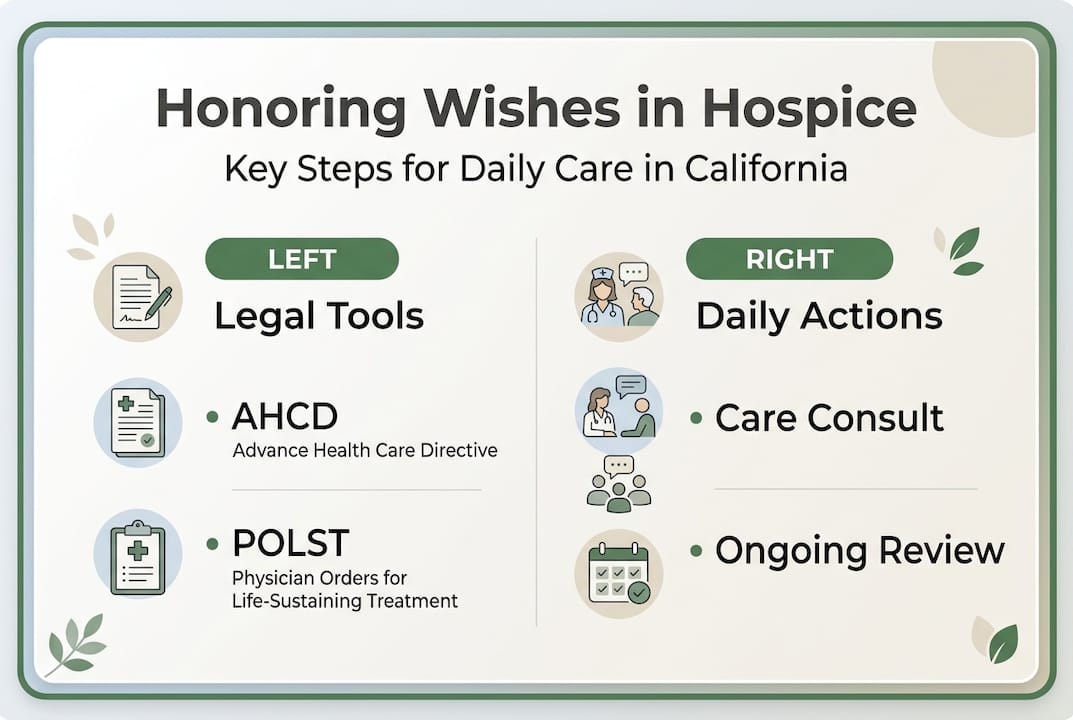
When a loved one enters life’s final chapter, the paperwork may feel overwhelming. But two legal forms stand above the rest in California: the Advance Health Care Directive (AHCD) and the Physician Orders for Life-Sustaining Treatment (POLST). Understanding what each one does, and how they work together, is the first step toward real protection.
The AHCD is a document where a person states their medical preferences and names a health care agent to make decisions if they can no longer speak for themselves. The POLST, by contrast, is a set of actual medical orders signed by a physician. Because it carries the weight of a medical order, AHCD and POLST forms are essential for communicating and enforcing end-of-life wishes across all care settings.
One of the most important features of the POLST is portability. Whether your loved one is at home, in a skilled nursing facility, or being transported by emergency services, that form travels with them and must be honored. This is why keeping it accessible, not buried in a filing cabinet, matters so much.
Here is a quick overview of both forms:
| Document | Who completes it | What it does | Who honors it |
|---|---|---|---|
| AHCD | Patient (with witnesses) | States preferences, names agent | All health care providers |
| POLST | Physician and patient | Issues medical orders | Emergency responders, hospitals, hospice |
Practical steps every family should take:
- Complete both the AHCD and POLST as early as possible
- Ensure forms are signed, dated, and witnessed correctly
- Share copies with all treating providers and family members
- Store originals in an easy-to-find location at home
- Review and update forms at least once a year, or after any major health change
Pro Tip: Assign one trusted family member as the primary advocate. This person should know where every document is, have digital scans saved on their phone, and be the first call for any care team when questions arise. Learning about compassionate at-home support can also help this advocate understand what to expect.
Families who want a broader picture of what the process looks like can explore end-of-life care steps and review hospice care standards in California to know what providers are required to uphold.
How hospice teams honor patient wishes in daily care
Having the right forms is only half the equation. The other half is a care team that knows how to read those documents and translate them into daily decisions. This is where hospice truly shines compared to traditional hospital care.

At intake, every hospice team reviews the AHCD and POLST thoroughly. They do not wait for a crisis to check what the patient wants. Before any major intervention, whether it is starting a new medication, adjusting nutrition, or making a comfort decision, the team refers back to those documented preferences. POLST portable medical orders must be honored by California providers with only limited exceptions, which gives families real confidence that the plan will hold.
The difference between hospital care and hospice in terms of honoring wishes is significant:
| Care aspect | Typical hospital care | Hospice care |
|---|---|---|
| Personalization | Standardized protocols | Individualized care plans |
| Communication | Episodic, often reactive | Ongoing, proactive family meetings |
| Flexibility | Limited by institutional rules | Adapted to patient’s daily needs |
| Document review | At admission | At intake and before every major decision |
Here is how a hospice team typically enacts a patient’s wishes step by step:
- Review all legal documents at intake with the patient and family present
- Hold a family care meeting to align everyone on the patient’s goals and values
- Build an individualized care plan that reflects documented preferences for pain management, hydration, feeding, and comfort
- Document every care decision and the reasoning behind it in the patient’s record
- Schedule periodic reevaluations to adjust the plan as the patient’s condition evolves
Routine care decisions, including how pain is managed, whether a feeding tube is used, and how hydration is handled, all flow from the patient’s stated wishes. Families can learn more about the qualities of hospice staff that make this level of personalized care possible, and see how it plays out in the comfort care workflow during home visits. For a full picture of what hospice care in California looks like, the resources available can help you feel more prepared.
The family’s role in ensuring wishes are honored
While hospice staff are trained advocates, families are often the most powerful voice a patient has. You know your loved one better than any care team ever could. That knowledge is irreplaceable, and it belongs at the center of every care conversation.
Families play several critical roles in this process. They facilitate honest conversations about preferences before a crisis occurs. They make sure all documents are physically available wherever care is being provided. They attend care plan meetings and ask questions when something does not feel right.
As California law makes clear:
California law requires all providers to honor valid POLST and AHCD forms, making families’ advocacy critical to ensuring those forms are in place and accessible at every point of care.
Advocating effectively means staying informed and staying present. Here are practical ways families can do this:
- Attend every care plan meeting and bring a written list of questions
- Communicate changes in your loved one’s condition or preferences to the hospice team promptly
- Ask the care team directly how each decision aligns with the documented wishes
- Request a care plan review if you feel something has shifted or is not being followed
- Know your rights as a family member or designated health care agent
When POLST must be honored except for invalid forms or ineffective care, families who understand this rule are far better positioned to speak up when something feels off.
Pro Tip: Keep both paper copies and digital scans of all directives and POLST forms. Store them in a shared cloud folder that every key family member can access instantly in an emergency. A social worker on the hospice team can help you organize these materials and understand your options.
For families who need additional support, resources on caregiver support and the role of caregivers in hospice can provide meaningful guidance during this time.
What to do when wishes aren’t honored: Steps for resolution
Even with thorough preparation, situations arise where a patient’s wishes are not followed as intended. This can happen for several reasons: a form may be incomplete or improperly signed, preferences may be unclear or conflicting, or a specific intervention may be medically ineffective. Knowing what to do in these moments can make a real difference.
When POLST medical orders are not honored, it is usually due to invalid forms or care that cannot achieve the intended outcome. Understanding this distinction helps families respond calmly and constructively.
Statistic to know: Research consistently shows that properly documented POLST forms are honored in the vast majority of cases across California, underscoring how much the quality of documentation matters.
If you believe your loved one’s wishes are not being respected, here are the steps to take:
- Clarify the concern by asking the care team specifically which preference was not followed and why
- Request an immediate care meeting with the hospice nurse, social worker, and medical director
- Escalate within the hospice organization if the issue is not resolved at the team level
- Contact the California Long-Term Care Ombudsman if you believe there is a systemic failure or violation of rights
- Seek legal counsel if you believe the patient’s documented wishes were willfully ignored
Families should also revisit hospice care standards to confirm what providers are legally required to do. If you are new to this process and need a foundation, reviewing what is hospice care can help you understand the framework before raising concerns.
The goal is never confrontation. It is clarity, and ultimately, dignity for your loved one.
A compassionate perspective: The real impact of honoring wishes
Most guides on this topic treat honoring end-of-life wishes as a compliance exercise. Follow the forms, check the boxes, move on. But families who have been through this experience know the truth: it is deeply personal, and the difference between honoring wishes and simply following protocol is felt in ways that last long after the patient is gone.
We believe that true compassion means staying in dynamic conversation with patients and families, not just at intake, but throughout the entire journey. What a person wants in month one of hospice may shift by month three. Pain levels change. Relationships evolve. Priorities clarify. A care team that only checks the AHCD at admission and never revisits it is missing the heart of what hospice is supposed to do.
Ignoring or delaying a patient’s wishes does not just create legal problems. It creates emotional wounds that families carry for years. Conversely, when wishes are honored with consistency and care, families describe a sense of peace and closure that is genuinely healing.
The most overlooked piece of advice we can offer is this: treat the conversation about wishes as ongoing, not a one-time event. Explore resources on compassionate at-home support to understand how this dynamic approach looks in practice.
Next steps: Compassionate hospice care for your family
At Graceland Hospice, we understand that this journey asks more of families than most people expect. We are here to make sure your loved one’s wishes are not just documented but truly honored, every day, in every care decision. Our team provides full support for completing and managing legal directives, coordinating care, and keeping families informed and empowered throughout the process.
To find compassionate hospice care that puts your loved one’s preferences first, we invite you to connect with us. You can also explore hospice services tailored to your family’s needs, or learn more about Graceland Hospice Care and our commitment to dignity and excellence. Please contact us today for a free consultation.
Frequently asked questions
What legal forms must hospice providers honor in California?
Hospice providers are required to honor valid Advance Health Care Directive (AHCD) and POLST forms under California law. These AHCD and POLST forms are the primary tools for communicating and enforcing end-of-life wishes.
What happens if a form is invalid or care is ineffective?
If a POLST form is invalid or the requested care is ineffective, providers may not honor that specific directive and will work with the family to clarify next steps. POLST portable orders carry legal weight but include limited exceptions for these situations.
How often should families review end-of-life wishes and documents?
Families should review AHCD and POLST forms at least once a year and any time the patient’s health status changes significantly. Keeping forms completed and current ensures preferences remain accurate and enforceable.
Who can advocate for a patient’s wishes in hospice?
Any family member or designated health care agent can work directly with hospice staff to ensure end-of-life wishes are honored. Families facilitate discussions and serve as the most consistent advocates throughout the care journey.
Recommended
- End-of-Life Planning Guide: Hospice & Comfort Care at Home | Graceland Hospice Care Blog
- Understanding Hospice Care Levels: A Guide for California Families | Graceland Hospice Care Blog
- Essential end-of-life documentation steps for California families | Graceland Hospice Care Blog
- Emergency care in hospice: a guide for California families | Graceland Hospice Care Blog
- Why updating life insurance matters for California families - Jenkins Insurance Agency Inc.