Essential end-of-life documentation steps for California families
Essential end-of-life documentation steps for California families
TL;DR:
- California families need three key documents: AHCD, POLST, and hospice election forms.
- Proper completion, signing, and regular updates of these forms ensure valid and effective end-of-life care.
- Open family conversations and emotional preparation are essential alongside paperwork to honor loved ones’ wishes.
When a loved one is nearing the end of life, the last thing a family should face is confusion over paperwork. Yet many California families find themselves scrambling to locate the right forms, unsure who signs what, or discovering that critical documents are missing or outdated. That confusion can delay hospice care and, worse, lead to medical decisions that don’t reflect your loved one’s true wishes. This guide walks you through every essential document you need, from the Advance Health Care Directive to Medi-Cal hospice election forms, so you can focus on what matters most: being present and providing comfort.
Table of Contents
- Understanding essential end-of-life documents in California
- Step-by-step guide to completing your documentation
- How to verify and update documents: Avoiding costly mistakes
- Documentation for hospice eligibility and ongoing care
- What most guides miss about end-of-life paperwork in California
- Get compassionate help with your end-of-life planning
- Frequently asked questions
Key Takeaways
| Point | Details |
|---|---|
| Document types matter | Use both AHCD and POLST to cover wishes and specific medical orders for California end-of-life care. |
| Right signatures required | Forms are only valid with the correct signatures from the patient, witnesses, and healthcare professionals. |
| Hospice provider handles submissions | Families do not send hospice forms themselves; the provider submits all required documents. |
| Keep everything current | Review and update end-of-life documents regularly or after important health events. |
| Communication prevents confusion | Talking openly with your family and care team is just as important as the paperwork itself. |
Understanding essential end-of-life documents in California
California families navigating end-of-life care at home typically need three core types of documentation. Each serves a distinct purpose, and understanding the difference between them is the first step toward getting everything in order.
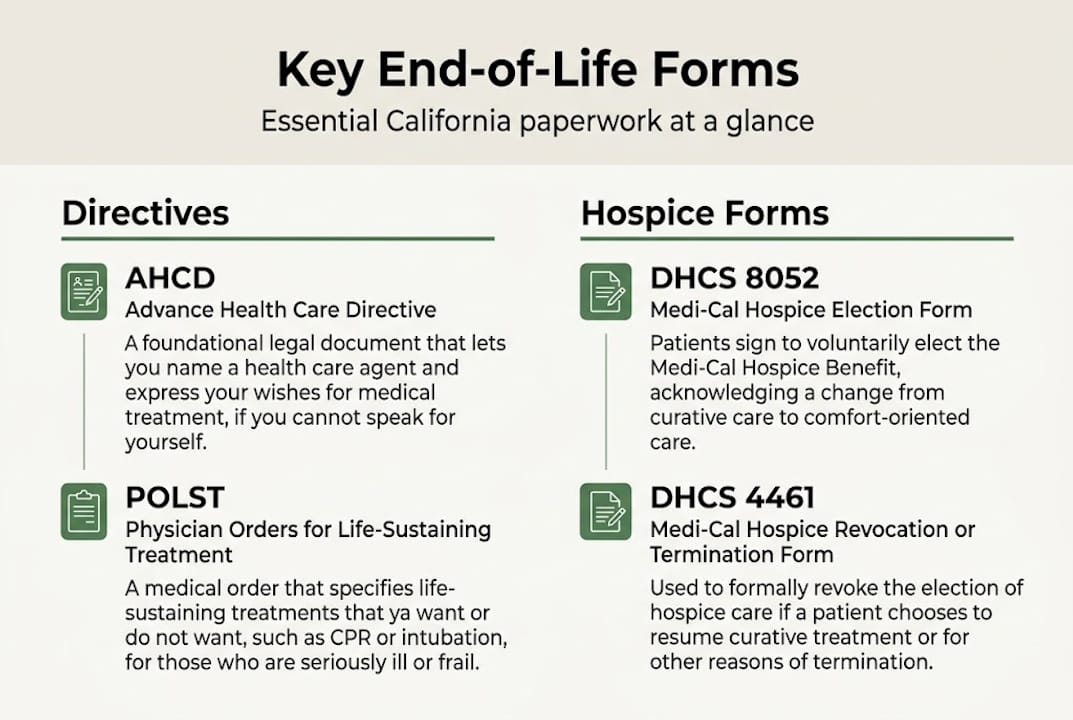
The Advance Health Care Directive (AHCD) is a legal document that lets a person appoint a trusted agent (someone to make medical decisions on their behalf) and outline their broader medical wishes. It covers a wide range of situations, from resuscitation preferences to organ donation, and remains valid even if the person becomes unable to speak for themselves.
The Physician Orders for Life Sustaining Treatment (POLST) form is different. It translates a person’s wishes into specific, immediately actionable medical orders. Emergency responders and care teams follow POLST instructions directly. The California POLST guide explains that it is designed for people with serious illness or advanced age.
For Medi-Cal recipients, hospice election forms are also required. These include the DHCS 8052 (Election of Hospice Care) and DHCS 8053 (Non-Covered Services Notice), both completed with the hospice provider.
| Document | Who signs | What it controls | When it’s used | Validity |
|---|---|---|---|---|
| AHCD | Patient + 2 witnesses or notary | Broad medical wishes, agent appointment | Ongoing, when patient can’t speak | Until revoked |
| POLST | Physician/NP/PA + patient or surrogate | Specific medical orders (CPR, hospitalization) | Immediately, in any care setting | Until updated or revoked |
| DHCS 8052/8053 | Patient + hospice provider | Hospice election, non-covered services notice | At hospice enrollment | Per benefit period |
It’s important to know that POLST and AHCD work together. The POLST does not replace the AHCD. Instead, it acts as a real-time medical order that reflects the wishes already documented in the AHCD. Common situations where each form matters include:
- AHCD: When a person is hospitalized and cannot communicate their wishes
- POLST: When emergency responders arrive at the home
- DHCS 8052/8053: When enrolling in or continuing Medi-Cal hospice benefits
For a broader look at planning, our end-of-life planning guide covers the full picture of hospice and comfort care decisions.
Pro Tip: Keep at least three copies of every document: one at home in a visible location, one with a trusted family member, and one with your medical team or hospice provider.
Next, let’s break down exactly how to prepare and complete these documents.
Step-by-step guide to completing your documentation
Knowing which forms you need is only half the work. Completing them correctly, with the right signatures and witnesses, is what makes them legally valid and medically actionable.
Here is the sequence that works best for most California families:
- Discuss wishes openly. Before any pen touches paper, have an honest conversation with the patient, family members, and the primary physician. Clarity now prevents conflict later.
- Complete and sign the AHCD. The patient signs in front of two qualified witnesses or a notary. Witnesses cannot be the patient’s healthcare agent, heirs, or care providers.
- Obtain a POLST if the patient is seriously ill. A physician, nurse practitioner, or physician assistant signs alongside the patient or their legal surrogate. This form should reflect the conversations from step one.
- Work with the hospice provider to complete election forms. For Medi-Cal patients, the hospice documentation process requires the physician to certify a terminal illness with a life expectancy of six months or less, and the patient or representative to sign the election statement with the hospice provider.
| Document | Who signs | Witness or notary needed | Who submits |
|---|---|---|---|
| AHCD | Patient | 2 witnesses OR notary | Patient keeps; share with care team |
| POLST | Physician/NP/PA + patient/surrogate | No witness required | Travels with patient |
| DHCS 8052/8053 | Patient + hospice provider | No notary required | Hospice provider submits to Medi-Cal |
One of the most common mistakes families make is using an outdated or unsigned form. A form that is missing a signature, or one that was filled out years ago without a review, may not be honored. The hospice provider handles delivery of DHCS forms to Medi-Cal. Families do not need to submit these themselves, but they should confirm with the provider that submission has occurred.
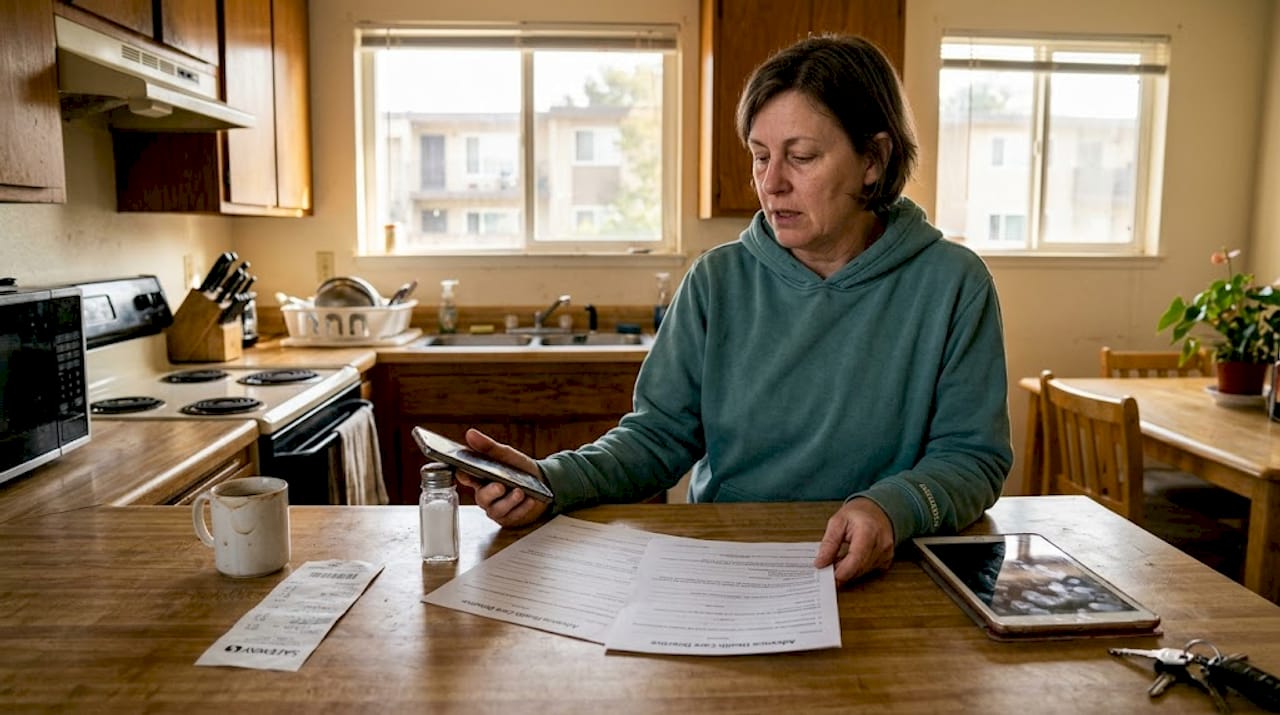
Our end-of-life care checklist offers a practical companion resource, and for broader context on choices for families facing this stage, we have additional guidance available.
You can also reference the Medi-Cal hospice manual for the official procedural requirements.
Pro Tip: Review all forms every year or after any major change in health status, diagnosis, or personal wishes.
Once you have your documents, it’s essential to verify their validity and resolve common issues.
How to verify and update documents: Avoiding costly mistakes
Even well-intentioned families can end up with documents that don’t hold up when they’re needed most. Verification is not a one-time task. It’s an ongoing responsibility.
Use this checklist to confirm your documents are ready:
- All fields are filled in completely, with no blank sections
- Signatures are present from all required parties
- Witnesses meet California’s legal requirements (not heirs, not care providers)
- Form dates are current and reflect the patient’s most recent wishes
- Copies are distributed to all relevant parties
If the patient is no longer able to sign or communicate, California law allows a surrogate to act on their behalf. POLST validity rules confirm that copies and faxes of a signed POLST are legally valid, and that a surrogate such as a healthcare agent or next-of-kin (in the order specified by California law) may sign when the patient cannot.
If an AHCD and a POLST give conflicting instructions, follow the most recent directive on that specific issue.
This matters more than many families realize. If a POLST was signed last month but the AHCD is from five years ago, the POLST’s instructions on resuscitation would take precedence for that issue. Keeping forms current eliminates this ambiguity.
To update or revoke a document, the patient (or authorized surrogate) can complete a new form or provide a written revocation. Notify all care team members and replace old copies immediately. Common situations that require an update include:
- A new diagnosis or significant change in prognosis
- Moving from home to a care facility or vice versa
- A change in the patient’s wishes after reflection or family discussion
- Lost or damaged documents
For families navigating these transitions, our guides on compassionate at-home support and supporting a loved one offer additional emotional and practical guidance.
Now that key documents are in order, let’s clarify the requirements for starting and maintaining hospice services in California.
Documentation for hospice eligibility and ongoing care
Getting into hospice care requires more than a conversation. There is a specific documentation process that must be followed, and understanding it helps families avoid delays in receiving the support they need.
Here is how the process works:
- Physician certification. A physician must certify in writing that the patient has a terminal illness with a life expectancy of six months or less if the illness follows its expected course.
- Hospice election form. The patient or their representative signs the DHCS 8052 election statement with the hospice provider, formally choosing hospice care over curative treatment.
- Benefit periods. The first two benefit periods are each 90 days long. After that, care continues in 60-day periods, each requiring recertification by the hospice physician or a nurse practitioner.
Recertification is not just a formality. It requires a face-to-face encounter between the patient and the hospice physician or nurse practitioner. This ensures that the patient still meets eligibility criteria and that the care plan reflects their current condition.
The hospice provider, not the family, submits the DHCS 8052 and DHCS 8053 forms to Medi-Cal. However, families play an important supporting role. Here is how you can help:
- Track the start dates of each benefit period so you know when recertification is due
- Keep your own copies of all signed forms
- Schedule regular check-ins with the hospice provider to confirm documentation is current
- Ask the care team about any upcoming assessments or reviews
Families who stay engaged with the documentation process help ensure there are no gaps in care coverage. For more on starting hospice care at home and understanding hospice care standards in California, we have detailed resources available. The Medi-Cal hospice FAQ is also a helpful reference for specific coverage questions.
Having addressed all the technical steps, it’s important to reflect on what families should know but may not hear elsewhere.
What most guides miss about end-of-life paperwork in California
Most articles focus on which forms to complete and where to sign. That information matters, but it misses something more important: the biggest documentation failures are rarely technical. They happen because families haven’t talked.
At Graceland Hospice, we have seen situations where all the paperwork was technically correct, yet family members were in conflict because no one had discussed what the patient truly wanted. A signed POLST does not replace the conversation that should have preceded it.
Documentation is powerful precisely because it captures a moment of clarity. But that clarity has to come from somewhere real. When families use the paperwork process as a reason to sit down together and talk honestly about goals, fears, and wishes, the forms become meaningful rather than mechanical.
We also encourage families to think of caregiver support during hospice as part of the same preparation. Emotional readiness and legal readiness go hand in hand. The families who navigate this stage with the most peace are those who have done both.
Get compassionate help with your end-of-life planning
Navigating end-of-life documentation in California is a significant responsibility, and you don’t have to do it alone. At Graceland Hospice Care, our team is here to guide families through every step, from understanding which forms apply to your situation to ensuring all documentation aligns with your loved one’s wishes. We work closely with families to ease the paperwork burden so that your energy can go toward connection and comfort. Explore our full library of end-of-life care resources or contact us today for a free consultation. We are ready to help.
Frequently asked questions
Who needs to sign end-of-life documents in California?
For the AHCD, the patient signs along with two qualified witnesses or a notary. For the POLST, a physician/NP/PA and the patient or legal surrogate both sign, and for hospice forms, the patient and the hospice provider sign together.
What happens if AHCD and POLST forms give different instructions?
The most recent form’s instructions on a specific issue take precedence under California law, which is why keeping documents current is so important.
Do families need to send hospice forms to Medi-Cal themselves?
No. The hospice provider submits all required DHCS forms to Medi-Cal directly. Families and patients only need to sign the election statement with the provider.
How often should end-of-life documents be reviewed or updated?
Documents should be reviewed every year or whenever there is a significant change in the patient’s health, diagnosis, or personal wishes to ensure they remain accurate and valid.
Recommended
- End-of-Life Planning Guide: Hospice & Comfort Care at Home | Graceland Hospice Care Blog
- What Is End of Life Care? Choices for Families | Graceland Hospice Care Blog
- 7 Essential Steps in an End of Life Care Checklist for Caregivers | Graceland Hospice Care Blog
- Supporting a Loved One Through End-of-Life Care | Graceland Hospice Care Blog