Understanding Hospice Care Levels: A Guide for California Families
Understanding Hospice Care Levels: A Guide for California Families
TL;DR:
- Hospice care in California has four levels to match different patient needs.
- Most hospice days are spent in Routine Home Care, supporting comfort at home.
- Family support quality depends more on providers’ responsiveness than on care level names.
When a loved one is nearing the end of life, families in California often find themselves navigating a maze of medical terms, insurance questions, and urgent decisions. One of the most misunderstood areas is hospice care levels. Many families assume hospice is a single service, but it’s actually structured into four distinct levels, each designed to meet different needs at different moments. Knowing what each level means, and when your loved one might need it, can mean the difference between scrambling for answers and feeling genuinely supported. This guide walks you through each level clearly, so you can focus on what matters most: being present.
Table of Contents
- What are hospice care levels?
- Routine Home Care: The foundation for most families
- Stepping up: Intensive, inpatient, and respite hospice care
- Access, coverage, and what California families need to know
- The real challenge for families: Why support and quality matter more than level names
- Get compassionate hospice guidance for your family
- Frequently asked questions
Key Takeaways
| Point | Details |
|---|---|
| Four care levels | Medicare and Medi-Cal recognize four hospice care levels, each offering different types of support. |
| Routine Home Care dominates | Most families experience routine home care, but intensive options exist for crises or caregiver relief. |
| California-specific rules | In California, certified providers and Medi-Cal coverage make access and choice clearer for families. |
| No extra cost for eligible patients | If your loved one qualifies, higher care levels do not mean higher out-of-pocket costs. |
| Quality matters most | The compassion and responsiveness of your hospice team matter more than any technical level. |
What are hospice care levels?
Hospice care in the United States is not one-size-fits-all. Medicare defines four distinct hospice care levels, each designed to address a different intensity of need. California families enrolled in Medi-Cal benefit from the same structure, since Medi-Cal aligns with Medicare on hospice levels and provider certification requirements.
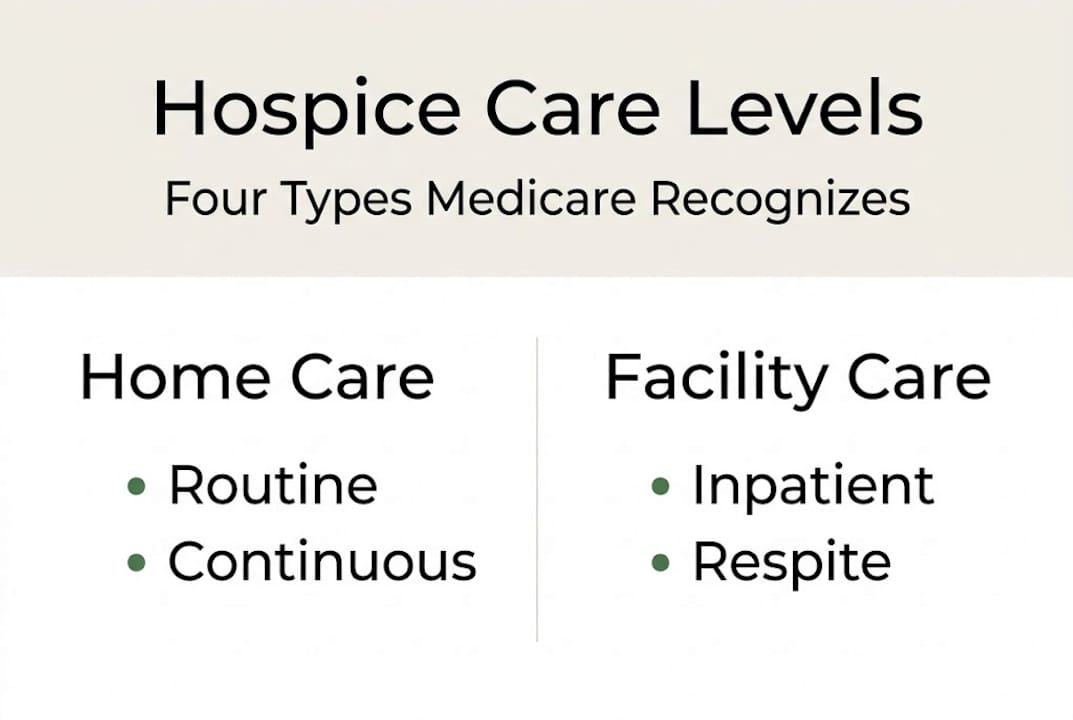
The four levels are:
- Routine Home Care (RHC): The most common level, provided at home or in a care facility. Covers regular visits from nurses, aides, social workers, and chaplains.
- Continuous Home Care (CHC): Intensive nursing care at home during a medical crisis, requiring at least 8 hours of care per day.
- General Inpatient Care (GIP): Short-term care at a hospital or inpatient hospice unit to manage acute symptoms that cannot be controlled at home.
- Inpatient Respite Care (IRC): Temporary facility-based care, up to five days, to give family caregivers a needed break.
One important rule: only one level can be provided and billed per day. A patient’s care team determines which level applies based on current medical needs. Understanding this structure helps families advocate for the right support at the right time. You can learn more about hospice care standards in California and how they shape the quality of care your loved one receives.
| Level | Where it’s provided | Typical services | Duration |
|---|---|---|---|
| Routine Home Care | Home, nursing facility | Nurse visits, aide, counseling, equipment | Ongoing |
| Continuous Home Care | Home | Intensive nursing (8+ hrs/day) | During crisis |
| General Inpatient Care | Hospital, hospice unit | Acute symptom management | Short-term |
| Inpatient Respite Care | Approved facility | Full facility care | Up to 5 days |
Nationally, most hospice patients spend the overwhelming majority of their care days on Routine Home Care, reflecting how central home-based comfort is to the hospice model. Understanding why other levels exist, and when to ask for them, is equally vital.
Families who want a closer look at how visits are structured day to day will find hospice visit workflow guidance especially helpful before the first team member arrives at the door.
Routine Home Care: The foundation for most families
Routine Home Care is where nearly every hospice journey begins and where most of it takes place. RHC accounts for nearly 99% of all hospice care days nationally in 2024. That statistic tells an important story: most families are supported at home, in familiar surroundings, with people they trust nearby.
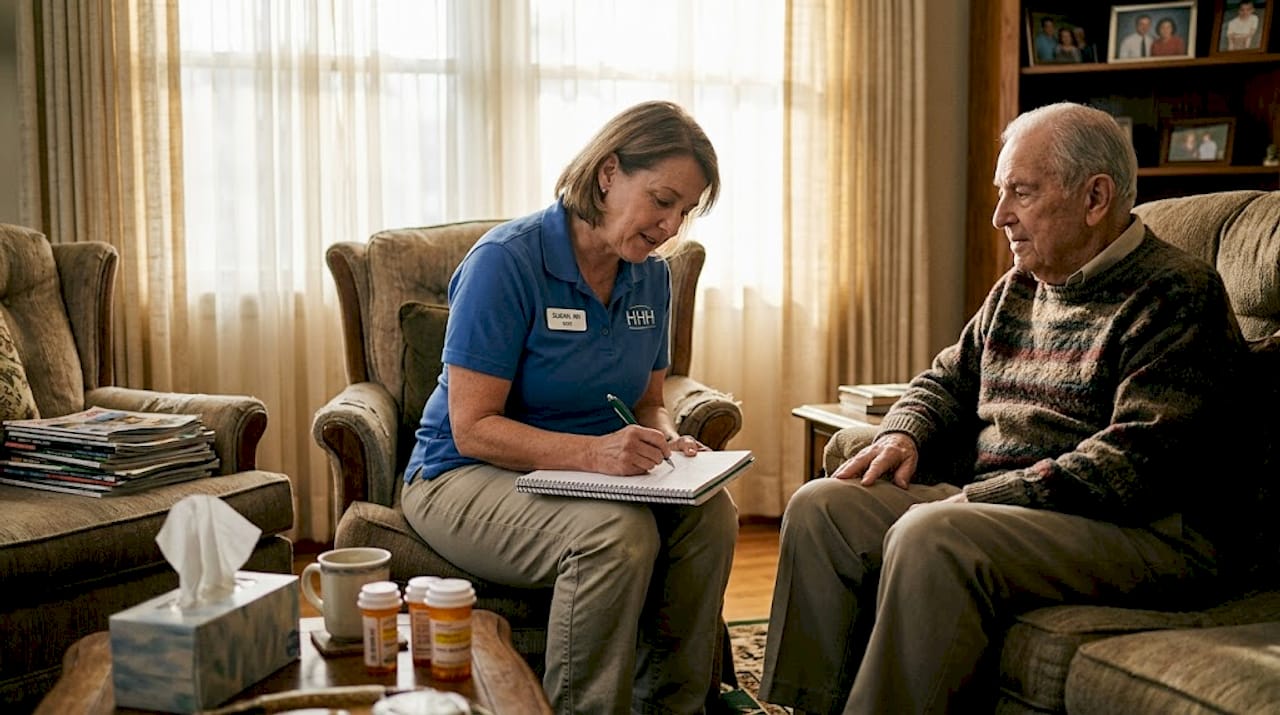
The services included in RHC are broad and designed to address the whole person, not just physical symptoms. RHC is available at home, in nursing facilities, or in other residential settings, making it flexible enough to fit many living situations.
Typical Routine Home Care services in California include:
- Registered nurse visits for pain and symptom monitoring
- Home health aide support for bathing, grooming, and personal care
- Medical social worker visits for emotional and practical guidance
- Chaplain or spiritual care counselor visits
- Prescribed medications related to the hospice diagnosis
- Medical equipment such as hospital beds, wheelchairs, or oxygen
- Bereavement counseling for family members
- Volunteer support for companionship and respite
Needs and visit frequency are reassessed regularly. If a patient’s condition changes, the care plan is updated accordingly. Families should feel empowered to communicate openly with the care team about anything that feels insufficient or overwhelming.
Pro Tip: Keep a simple notebook near your loved one’s bed to log symptoms, questions, and concerns between nurse visits. Sharing this log with the hospice team helps them fine-tune the care plan much faster than trying to recall details in the moment.
Families who want a fuller picture of day-to-day operations will benefit from reading about the home hospice workflow and understanding the role of caregivers in keeping loved ones comfortable between visits.
Stepping up: Intensive, inpatient, and respite hospice care
Sometimes, a patient’s needs change quickly. Pain becomes harder to control. Breathing becomes labored. Or a family caregiver simply reaches their physical and emotional limit. This is when the three higher-intensity hospice levels become essential.
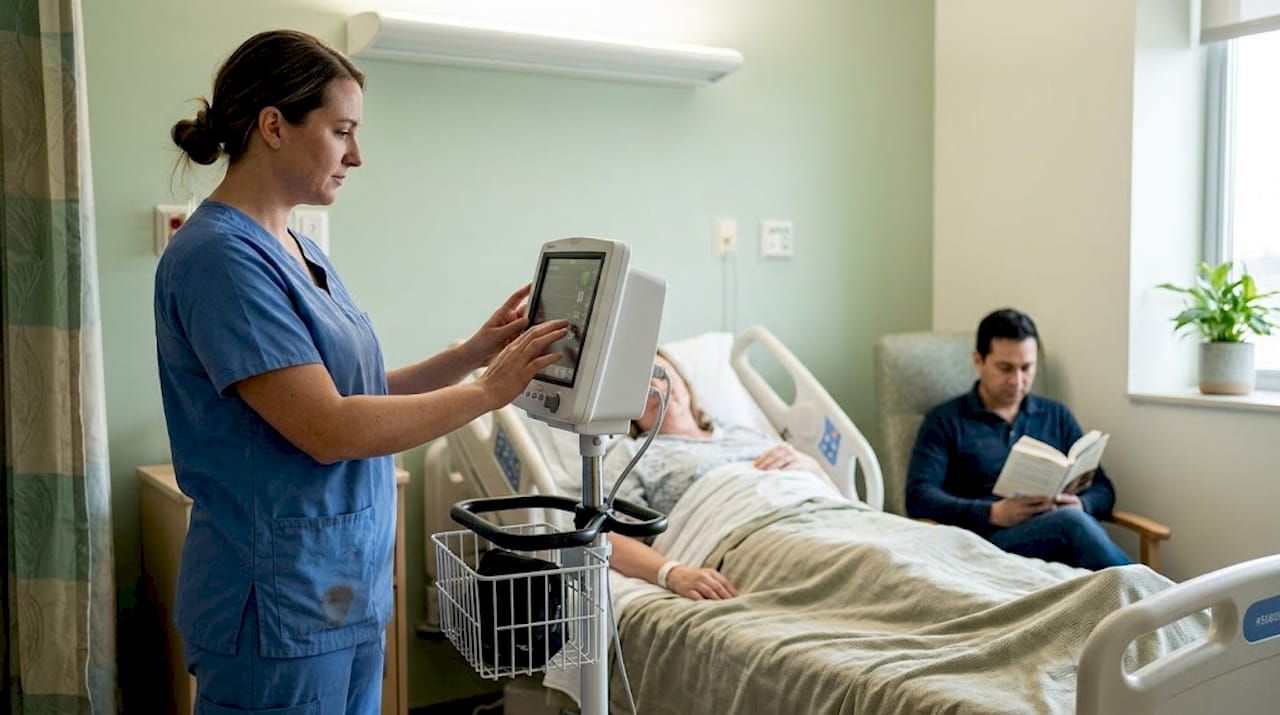
CHC requires a minimum of 8 hours nursing per day during crises, GIP is for short-term acute symptoms, and IRC provides caregiver relief up to five days. Each level has specific eligibility requirements, and not every provider has the capacity to offer all three.
| Level | Trigger | Setting | Key stat |
|---|---|---|---|
| Continuous Home Care | Medical crisis at home | Home | Requires 8+ hrs/day nursing |
| General Inpatient Care | Unmanageable symptoms | Hospital/hospice unit | 0.8% of hospice days in 2024 |
| Inpatient Respite Care | Caregiver exhaustion | Approved facility | Up to 5 consecutive days |
Here is how to request a higher level of care when the situation calls for it:
- Contact the hospice nurse or on-call line as soon as symptoms worsen or caregiver capacity reaches its limit.
- Describe the situation clearly: what symptoms are present, how long they’ve been occurring, and what has been tried.
- Ask whether the current situation meets criteria for CHC, GIP, or IRC specifically.
- Request written documentation of the level change so you have a clear record.
- Follow up within 24 hours to confirm the transition has been processed and new services have begun.
Many families don’t realize they can ask for these levels. GIP in particular is underused, partly because families aren’t aware it exists. If your loved one is experiencing symptoms that feel out of control, ask directly. For guidance on pain and symptoms management at home, and what to do if a crisis arises, our team has put together practical resources for California families.
Pro Tip: Before a crisis happens, ask your hospice provider which inpatient facilities they are affiliated with for GIP and IRC. Knowing this in advance means one less frantic phone call during an already difficult moment. Review our emergency hospice care guide to prepare your family now.
Access, coverage, and what California families need to know
One of the most reassuring facts for California families is this: if your loved one qualifies for Medicare or Medi-Cal hospice benefits, there is no extra cost for higher levels of care. No extra cost applies for higher levels if eligibility requirements are met. The financial burden of escalating care does not fall on families.
Medi-Cal follows Medicare certification and structure, covering election periods, tiered RHC rates, and the Service Intensity Add-on (SIA) payment for RHC days near the end of life, which increases nursing and social work visits in the final days.
To qualify, a patient must have a terminal diagnosis with a life expectancy of six months or less if the illness runs its natural course, and must elect the hospice benefit by signing a form waiving curative treatment for that condition. Election periods can be renewed, and patients can disenroll and re-enroll if their situation changes.
When choosing a hospice provider in California, families should ask:
- Is the provider Medicare and Medi-Cal certified?
- What is their track record and quality rating?
- Do they have the capacity to provide CHC, GIP, and IRC if needed?
- How do they handle after-hours emergencies and weekend visits?
- Can they share family or patient satisfaction data?
- Do they have experience with your loved one’s specific diagnosis?
Recent enforcement actions by California health authorities serve as an important reminder to choose reputable hospice providers that are certified and accountable. Your end-of-life planning guide can help you think through these decisions before the pressure of a crisis sets in. You can also review the full Medi-Cal hospice requirements directly to understand what providers must meet to serve California patients legally and ethically. Families who choose well benefit from the at-home hospice benefits that go far beyond what many expect.
The real challenge for families: Why support and quality matter more than level names
Here is something no brochure tells you: knowing the four hospice care levels by name will not, on its own, make this experience easier. What shapes a family’s journey is the quality of the people showing up at the door, the clarity of communication from the care team, and the willingness of a provider to adapt when things change.
We have seen families technically enrolled in the right level but still feeling lost because their provider was rigid, unresponsive, or hard to reach. And we have seen families in Routine Home Care feel completely held because their team was attentive, flexible, and genuinely present.
The hospice caregivers’ impact on a patient’s daily dignity and comfort is profound. A level transition handled smoothly by an experienced team barely registers as a disruption. But the same transition managed poorly can leave families feeling abandoned at the worst possible time.
Our perspective at Graceland Hospice is straightforward: certification and compliance are the floor, not the ceiling. Every family deserves a provider who treats the technical requirements as a baseline and builds something genuinely human on top of them. Ask about provider track records. Trust your instincts when something feels off. And do not settle for a team that treats your loved one as a case rather than a person.
Get compassionate hospice guidance for your family
At Graceland Hospice, we understand that understanding hospice care levels is just the beginning. What you really need is a team that can translate those levels into meaningful, personalized care for your loved one. Our experienced team is ready to walk alongside your family, explaining exactly what services apply to your situation and how Medicare or Medi-Cal can cover the support your loved one deserves.
We invite you to explore our hospice care services or review all hospice support options available through our team. Reaching out costs nothing and can bring your family the clarity and comfort you need right now. Please contact us for a free consultation.
Frequently asked questions
What are the four hospice care levels under Medicare?
Medicare defines four levels of hospice care: Routine Home Care, Continuous Home Care, General Inpatient Care, and Inpatient Respite Care, each addressing a different intensity of patient need.
Is there any extra cost for higher levels of hospice care in California?
No. If your loved one qualifies for Medicare or Medi-Cal hospice benefits, no extra costs apply for higher levels of care, making level transitions a medical decision rather than a financial one.
How is Routine Home Care different from General Inpatient Care?
Routine Home Care is ongoing support provided at home or in a residential setting, while General Inpatient Care is short-term, intensive symptom management delivered in a hospital or hospice inpatient unit, as outlined in Medicare’s level definitions.
What should I ask when choosing a hospice provider in California?
Ask about Medicare certification, quality ratings, capacity for all four care levels, and experience with your loved one’s specific condition. Recent California enforcement actions make it clear that provider reputation and accountability are non-negotiable.
Can my loved one switch between hospice levels?
Yes. Patients can move between levels as their needs change, but only one level is billed per day and any transition must be supported by medical documentation confirming the clinical need for the change.
Recommended
- End-of-Life Planning Guide: Hospice & Comfort Care at Home | Graceland Hospice Care Blog
- Understanding Hospice Care: A Guide for Families | Graceland Hospice Care Blog
- Emergency care in hospice: a guide for California families | Graceland Hospice Care Blog
- Why Hospice at Home Matters for Families | Graceland Hospice Care Blog
- Compassionate Guidance for Supporting a Grieving Child or Teen