Step by Step Hospice Admission for Families at Home
Step by Step Hospice Admission for Families at Home
TL;DR:
- The hospice admission process can be overwhelming but becomes manageable with proper preparation and understanding. Families need to confirm eligibility, gather essential documents, and know that ongoing support is available round-the-clock to ensure compassionate care. Building a partnership with hospice providers like Gracelandhc helps families focus on their loved ones during life’s final chapter.
When a loved one needs hospice care, the step by step hospice admission process can feel like an overwhelming maze of paperwork, phone calls, and emotional weight all at once. Understanding exactly what to expect makes the difference between feeling lost and feeling prepared. This guide walks you through every stage of the hospice admission process, from confirming eligibility to setting up care at home, so you can focus on what matters most: being present for your loved one during life’s final chapter.
Table of Contents
- Key takeaways
- Understanding hospice eligibility before admission
- The step by step hospice admission process
- Managing common challenges during admission
- What happens after admission
- My perspective on what families actually need to hear
- How Gracelandhc can walk beside your family
- FAQ
Key takeaways
| Point | Details |
|---|---|
| Eligibility comes first | A physician must certify a prognosis of six months or less before Medicare hospice benefits can begin. |
| Prepare documents early | Gathering advance directives, medication lists, and insurance information before the visit prevents delays. |
| Admission visits take time | The initial visit lasts 2 to 3 hours and covers physical assessments, consents, and care planning. |
| The care plan is flexible | Your loved one’s Plan of Care adjusts continually based on symptoms and family feedback. |
| Support is available around the clock | Hospice teams provide 24/7 phone access and can dispatch a nurse for urgent concerns at any hour. |
Understanding hospice eligibility before admission
Before any paperwork is signed or a nurse steps through the door, you need to know whether your loved one qualifies for hospice care. This step shapes everything that follows, and getting clarity here saves time, reduces confusion, and sets the right expectations.
To qualify for the Medicare Hospice Benefit, a physician must certify that the patient has a prognosis of six months or less if the illness follows its expected course. Equally important, the patient must choose comfort-focused care over curative treatments. This is not giving up. It is a deliberate decision to prioritize quality of life and dignity.
Once eligibility is confirmed, gathering the right documents is the next priority. Here is what you will want to have ready:
- Advance Directive or Living Will: Outlines the patient’s wishes for medical treatment
- Durable Power of Attorney for Healthcare: Names the person authorized to make medical decisions
- Current medication list: Includes dosages, prescribing physicians, and pharmacy contact
- Insurance cards and Medicare/Medicaid information: Needed for billing verification
- Recent medical records and physician contact information: Supports continuity of care
- Emergency contacts and next-of-kin details: Required for the hospice intake procedure
One of the most practical things a family can do is create a dedicated hospice binder. A physical document binder centralizes all of these records and saves critical time during urgent situations or off-hours visits.
Pro Tip: Label each section of your hospice binder clearly: medications, legal documents, insurance, medical history, and contacts. During a 2 a.m. call with an on-call nurse, you will be grateful you can find what you need in seconds.
| Document type | Why it matters |
|---|---|
| Advance Directive | Guides care decisions if the patient cannot speak |
| Durable Power of Attorney | Identifies the authorized decision-maker |
| Medication list | Prevents dangerous drug interactions at admission |
| Insurance information | Confirms coverage and avoids billing delays |
| Medical records | Helps hospice team understand existing diagnoses |
Understanding eligibility also means knowing how Medicare structures hospice benefit periods. Coverage begins with two 90-day periods, followed by unlimited 60-day recertification periods, each requiring a physician to confirm ongoing eligibility. Families who understand this from the start avoid confusion about why recertification visits happen.
The step by step hospice admission process
Once eligibility is confirmed and your documents are ready, the formal hospice admission workflow begins. Here is a clear, step-by-step breakdown of what actually happens.
Step 1: Make the referral A physician, hospital discharge planner, or the family can initiate contact with a hospice provider. The hospice intake team will gather basic information about the patient’s diagnosis, current medications, and living situation to begin the step by step hospice intake process.
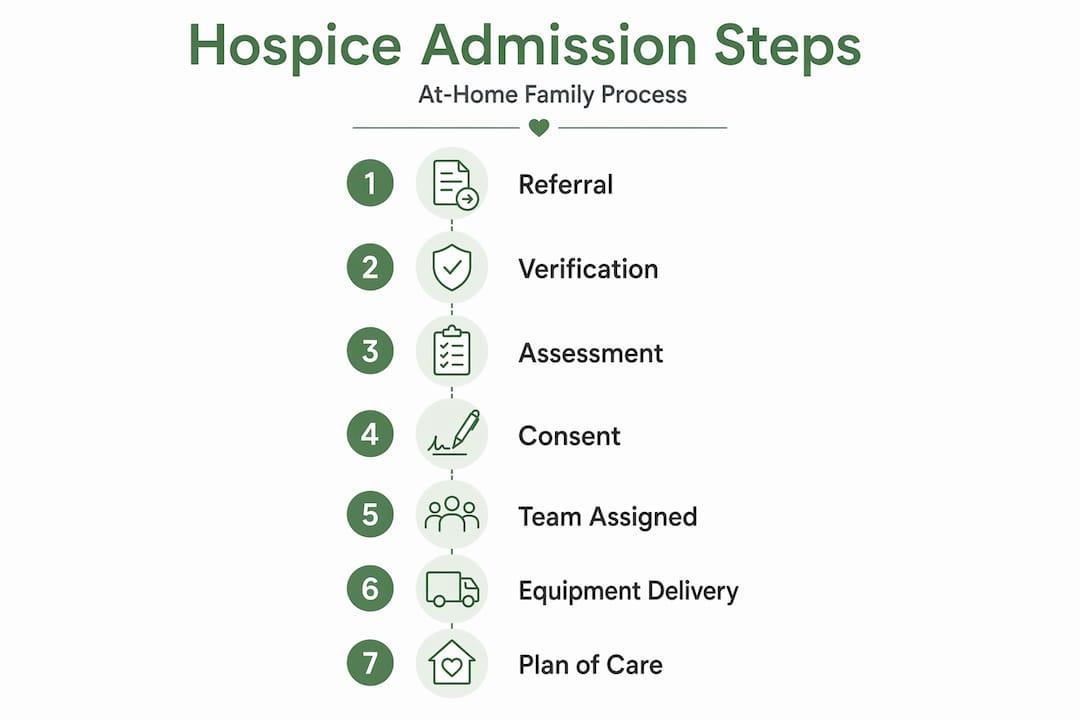
Step 2: Insurance and eligibility verification The hospice team verifies Medicare, Medicaid, or private insurance coverage. They confirm that the physician’s certification of prognosis is in order. Verifying insurance and consents is part of meeting Medicare’s Conditions of Participation, so this step is not optional.
Step 3: Schedule the admission visit The hospice nurse typically arrives within 24 to 48 hours of the referral. The initial admission visit lasts 2 to 3 hours. Block out that time. It is detailed and involves multiple assessments and consent forms.
Step 4: The comprehensive assessment During the admission visit, the hospice nurse conducts a head-to-toe physical assessment. They evaluate pain levels, current symptoms, nutritional status, skin condition, and the home environment itself. This forms the foundation of the Plan of Care.
Step 5: Signing consents and election forms The patient or their legal representative signs the Medicare Hospice Election form and several consent documents. These forms explain what hospice covers, what it does not cover, and the patient’s rights. Take time to read them. The nurse can answer questions.
Step 6: Interdisciplinary team assignment The hospice interdisciplinary team is formally assigned after admission. This team typically includes a registered nurse, a home health aide, a social worker, a chaplain, and a medical director. Each role addresses a different dimension of care, from physical symptom management to emotional and spiritual support.
Step 7: Equipment and comfort kit delivery Within 24 to 48 hours of admission, a hospital bed, wheelchair, or other durable medical equipment arrives at the home based on the patient’s needs. The hospice team also delivers a comfort kit. This is a small box of pre-approved medications kept in the home for managing sudden symptoms like pain, anxiety, or difficulty breathing. Knowing it exists before you need it brings significant peace of mind.
Step 8: Plan of Care development The admitting nurse develops an initial flexible Plan of Care that details care goals, scheduled visits, medications, and family responsibilities. This document is reviewed and updated regularly throughout the hospice stay.
Pro Tip: Ask the admitting nurse to walk you through the comfort kit medications one by one: what each medication is for, when to use it, and how to reach the on-call nurse if you are unsure. Families who know this feel far less frightened during difficult moments.
Managing common challenges during admission
Even with good preparation, the hospice admission process brings real-world complications. Knowing what they are ahead of time helps families handle them without losing composure.
When the patient cannot sign One of the most common hurdles families face is a patient who is too ill or cognitively impaired to sign admission forms. When this happens, legal proxies with documented authority step in to sign on the patient’s behalf. The documentation must clearly identify the decision-maker and include clinical notes explaining why the patient cannot sign. Having an advance directive and Durable Power of Attorney already in place makes this moment far less complicated.
Documentation delays Incomplete or missing documents are the number one cause of admission delays. Families who arrive at the admission visit without a medication list or insurance information create avoidable bottlenecks. Call the hospice intake team a day before the visit and ask them exactly what they need. Confirm that your documents are ready.
Emotional weight during the process The admission visit is not just logistical. Signing a form that states your loved one has a prognosis of six months or less is emotionally significant. Hospice teams understand this. They are trained to move at a human pace, not a clinical one. Still, it helps to know this moment is coming and to plan for emotional support afterward.
“Hospice teams aim to blend into the home environment and support families with dignity rather than overtake care, easing emotional stress for everyone involved.”
Common mistakes families make during admission include waiting until a crisis to call hospice, failing to designate a legal decision-maker before the patient loses capacity, and misunderstanding that hospice does not mean abandoning medical care. Hospice replaces curative treatment, but it provides attentive, expert symptom management every step of the way. You can learn more about how social workers support families during this transition to better understand the emotional resources available to you.
What happens after admission
Admission is not the end of the process. It is the beginning of an ongoing, coordinated care relationship. Understanding what comes next helps families stay engaged and confident.
After admission, a registered nurse visits the home on a regular schedule, typically one to three times per week depending on the patient’s condition. The hospice nurse’s role includes monitoring symptoms, adjusting medications, communicating with the medical director, and educating the family on what to watch for. The home health aide visits to assist with bathing, grooming, and personal care.

The Plan of Care is reviewed at regular interdisciplinary team meetings. Families are encouraged to share feedback at any time. If a symptom changes or a new concern arises between visits, the care plan adjusts. This responsiveness is one of the most important qualities of good hospice care.
Pro Tip: Keep a simple daily log of your loved one’s symptoms, sleep patterns, appetite, and pain levels. Share this log with the hospice nurse at each visit. Patterns you track at home often reveal changes that lead to better symptom control.
Hospice teams maintain direct communication with the patient’s primary care physician throughout the care period. The hospice medical director takes on the day-to-day clinical oversight, but the primary physician stays informed and can remain involved in care decisions.
Most families are relieved to learn that 24/7 phone support is available from the moment of admission. If something alarming happens at midnight, you call the hospice on-call line and a nurse responds. If needed, a nurse can be dispatched to the home. This round-the-clock access is not a bonus feature. It is a core part of the hospice model.
For a deeper look at monitoring your loved one’s condition at home, the Gracelandhc guide to symptom monitoring in hospice provides clear, practical guidance designed specifically for family caregivers.
My perspective on what families actually need to hear
I have worked with families at every stage of the hospice admission process, and there is one pattern I see consistently. The families who move through admission with the most grace are not the ones who knew everything in advance. They are the ones who asked the most questions.
Most people come into admission trying to hold themselves together emotionally while simultaneously processing an enormous amount of new information. My honest advice: do not try to absorb everything at once. Write your questions down before the admission visit. Bring someone with you so one person can listen while the other asks questions.
What I have also seen is that families sometimes delay calling hospice because they worry it feels like “giving up.” That delay almost always leads to a harder admission under more urgent circumstances. Calling hospice early, when there is still time to settle in, creates a calmer, more supported experience for everyone, especially for the patient.
The hospice team is not there to take over. They are there to support what the family is already doing. The families who understand that from day one tend to feel far less overwhelmed. You are not handing your loved one off. You are gaining a team of specialists who work alongside you.
— Sam
How Gracelandhc can walk beside your family
At Gracelandhc, the hospice admission process is designed to feel less like a bureaucratic procedure and more like the beginning of a genuine partnership. The team at Graceland Hospice Care brings decades of experience to every admission, offering thorough assessments, clear communication, and compassionate guidance from the very first phone call. From verifying eligibility and organizing paperwork to delivering equipment and introducing the interdisciplinary care team, Gracelandhc handles the complexity so families can focus on their loved one. If you are trying to understand how to start hospice care at home, contact Gracelandhc today for a free consultation and take the first step with a team that genuinely cares.
FAQ
What are the eligibility requirements for hospice admission?
A physician must certify that the patient has a terminal prognosis of six months or less and that the patient is choosing comfort care over curative treatment. Medicare then covers hospice services under those conditions.
How long does the hospice admission visit take?
The initial hospice admission visit typically lasts 2 to 3 hours and includes physical assessments, paperwork, consent forms, and care planning discussions. Services usually begin within 24 to 48 hours after that visit.
What documents should families prepare before admission?
Families should have an advance directive, Durable Power of Attorney for Healthcare, current medication list, insurance cards, and recent medical records ready before the admission visit to prevent delays.
What happens if the patient cannot sign admission forms?
When a patient is unable to sign, a legal proxy with documented authority, such as a healthcare power of attorney or next-of-kin, signs on their behalf. The documentation must include clinical notes confirming the patient’s inability to sign.
Is hospice care available around the clock after admission?
Yes. Hospice teams provide 24/7 on-call phone support from the moment of admission, and a nurse can be dispatched to the home if an urgent situation arises during the night or on weekends.
Recommended
- Home Hospice Care Workflow: A Step-by-Step Guide for Families | Graceland Hospice Care Blog
- Hospice Visit Workflow for Comfort Care at Home | Graceland Hospice Care Blog
- End of Life Care Steps for Home Hospice Success | Graceland Hospice Care Blog
- End of Life Care Guide for Compassionate At-Home Support | Graceland Hospice Care Blog