How to ensure quality standards in California hospice care
How to ensure quality standards in California hospice care
California spends more on hospice care than any other state, yet its Hospice Care Index score of 8.3 is the lowest in the nation. That gap between spending and outcomes is startling, and it matters deeply to families who are trying to find the best possible care for a loved one during life’s final chapter. More money does not automatically mean more compassion, better pain management, or stronger compliance. This article walks you through what quality actually looks like in California hospice care, how it is measured, and what you can do to make sure your family receives the support you deserve.
Table of Contents
- What defines quality standards in California hospice?
- California and federal regulations: What families must know
- Key quality benchmarks: Measures and real numbers
- How hospice providers put quality into action at home
- Common pitfalls, deficiencies, and red flags
- How to advocate for your loved one’s quality care
- Support for choosing high-quality hospice care
- Frequently asked questions
Key Takeaways
| Point | Details |
|---|---|
| California standards defined | State and federal rules require licensing, certification, and core services for all hospice providers. |
| Benchmarks guide quality | Metrics like the Hospice Care Index and CAHPS ratings show real differences between providers. |
| Watch for red flags | Common pitfalls include incomplete assessments and fraud; know the signs and official reporting channels. |
| Advocate for better care | Use public ratings, ask the right questions, and review reports to ensure compassionate support for your loved one. |
What defines quality standards in California hospice?
Quality in hospice care is not just a feeling. It is defined by law, measured by regulators, and tracked through data. Understanding what the rules require gives you a solid foundation for evaluating any provider you consider.
California hospices must obtain a state license from the California Department of Public Health (CDPH) and meet federal Medicare certification standards. These two layers of oversight work together to set a baseline for every licensed provider in the state. You can learn more about what these hospice care standards mean in practice for California families.
Here is what quality standards require at a minimum:
- 24/7 nursing access so patients and families are never left without support
- Physician oversight coordinated with the care team at all times
- Medications and medical equipment covered and provided as part of the hospice benefit
- Infection control programs to protect vulnerable patients at home
- An interdisciplinary team that includes nurses, social workers, chaplains, and counselors
- Individualized care plans built around each patient’s specific goals and comfort
The caregiver roles in hospice are also defined by these standards, ensuring that every person on the team has a clear responsibility.
Licensing and Medicare certification are the legal floor, not the ceiling. Families should expect providers to exceed these minimums, not simply meet them.
Accreditation from organizations like The Joint Commission and strong CMS hospice quality ratings add another layer of assurance. CAHPS (Consumer Assessment of Healthcare Providers and Systems) surveys capture real family experiences and are publicly available, giving you an honest window into how a provider actually performs.
California and federal regulations: What families must know
Knowing the basic framework is essential. The rules and certifications that hold hospices accountable are more specific than most families realize.
Here is how the licensing and certification process works:
- The hospice applies for a state license through CDPH and undergoes an initial survey.
- The provider must demonstrate compliance with California Title 22 regulations.
- Federal Medicare certification requires a separate CMS survey and ongoing compliance reviews.
- Surveyors conduct unannounced inspections to check for deficiencies.
- Providers must correct any cited deficiencies within a set timeframe or face sanctions.
By California hospice regulations, core services like nursing, physician services, and medications must be available around the clock. Infection control programs are also required, not optional. Understanding the hospice care workflow helps families know what to expect at each stage.
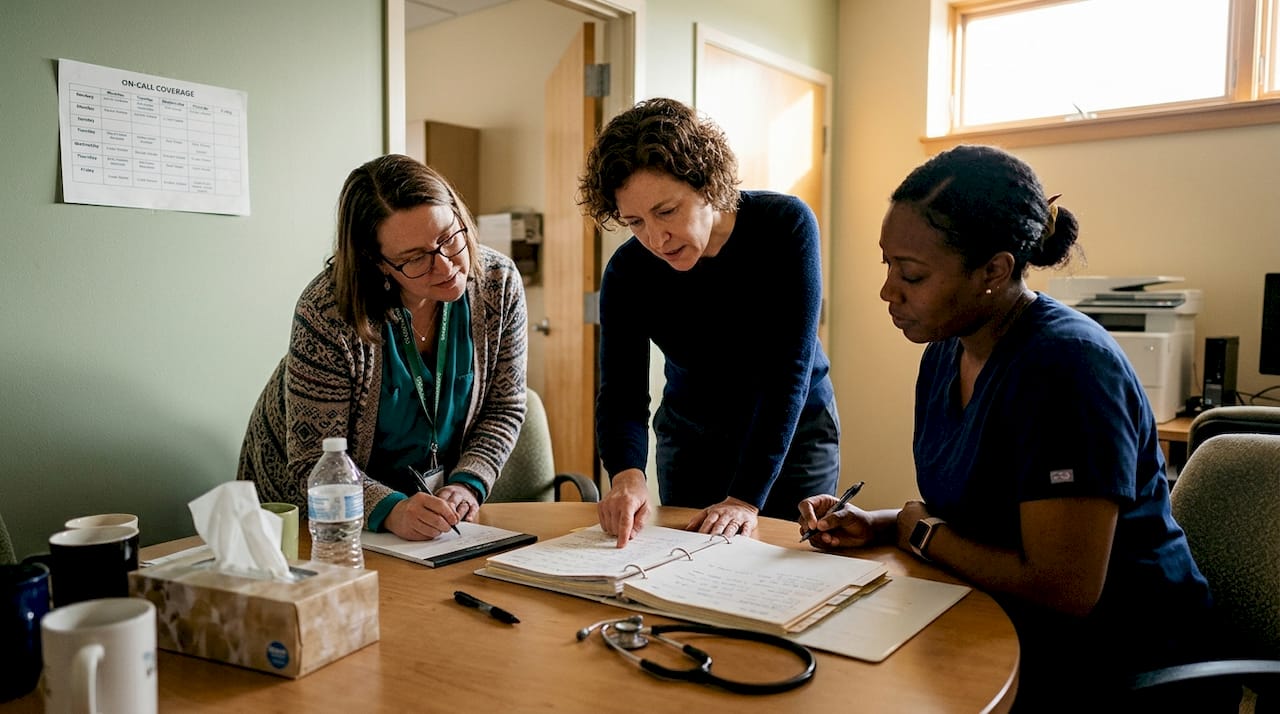
One of the most important protections for your loved one is the care plan review requirement. Individualized care plans must be reviewed by an interdisciplinary team every 15 days, with measurable goals for patient comfort updated at each review. This is not a formality. It is a legal requirement that keeps care responsive to your loved one’s changing needs.
Key quality indicators to look for on a provider’s paperwork:
- Current CDPH license with no active sanctions
- Medicare certification in good standing
- Accreditation from a recognized body
- Recent survey results with few or no deficiencies
- Documented QAPI (Quality Assurance and Performance Improvement) program
- Clear infection control policy
Pro Tip: You have the right to request a copy of any hospice provider’s most recent state survey report. Ask for it before you sign any agreement. Providers who hesitate to share this document are a concern worth noting. You can also review the visit workflow for home hospice to understand what a compliant visit should look like.
Key quality benchmarks: Measures and real numbers
Once you know the legal expectations, it is vital to understand how quality is actually measured and how California hospices compare nationally.
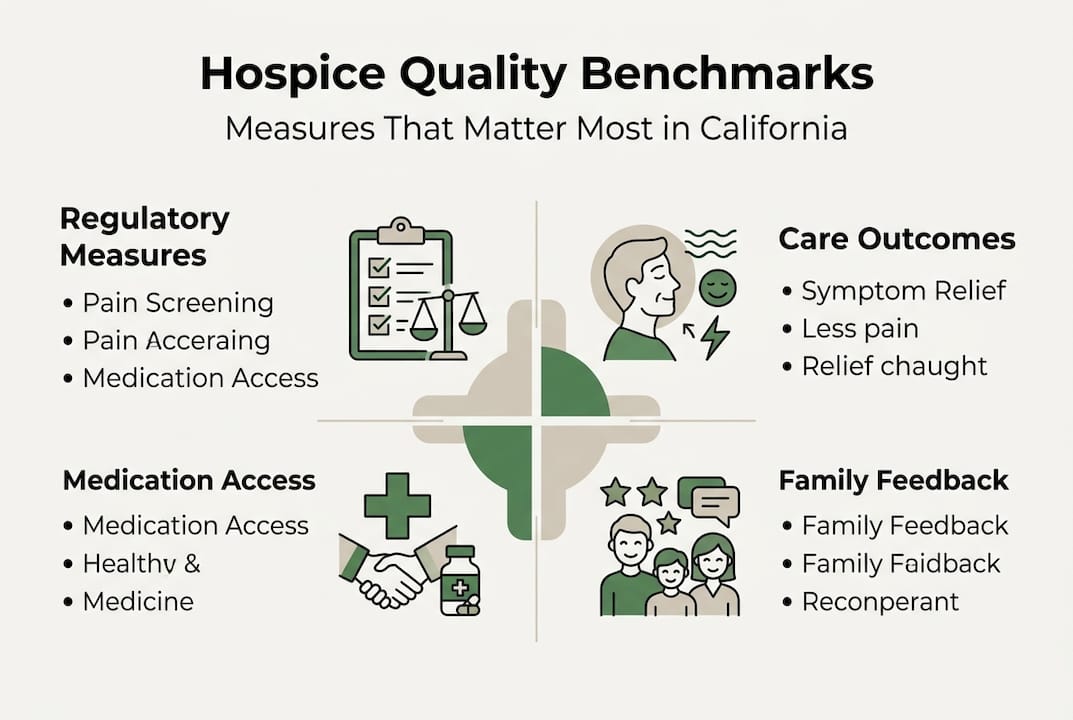
CMS uses several tools to track hospice quality. The main measures include the Comprehensive Assessment at Admission (HOPE), Hospice Visits in Last Days of Life (HVLDL), the Hospice Care Index (HCI, scored 0 to 10), and eight CAHPS patient experience measures. Each one captures a different dimension of care quality.
| Measure | National average | California || |—|—|—| | Pain screening rate | 98.3% | Below national avg | | Pain assessment rate | 95.3% | Below national avg | | Treatment preferences noted | 99.5% | Below national avg | | All 7 care processes completed | 91.9% | Below national avg | | Hospice Care Index (HCI) | ~9.0 (est.) | 8.3 |
National benchmarks from April 2023 to March 2024 show that 91.9% of patients nationally received all seven care processes, 98.3% received pain screening, and 99.5% had treatment preferences documented. California falls short on these measures despite its high spending.
California’s HCI score of 8.3 for January 2023 through December 2024 is the lowest of any state. That number should prompt every California family to ask harder questions when choosing a provider.
Red and yellow flags to watch for when reviewing benchmarks:
- HCI score below 8.5 for any provider
- Low CAHPS star ratings, especially in family communication
- Missing or incomplete pain screening documentation
- No published HVLDL data
- Gaps in care plan completion rates
For a fuller picture of what compassionate, data-backed care looks like at home, the compassionate at-home hospice guide is a helpful resource. You can also explore CMS quality measures directly to compare providers in your area.
How hospice providers put quality into action at home
Knowing the benchmarks is useful, but what does high-quality care actually look like for your loved one at home?
Routine Home Care accounts for 98.8% of all hospice days in fiscal year 2024. This is the level of care most families experience day to day. It should include regular nurse visits, medication management, personal care support, and consistent communication with the family.
| Feature | Routine Home Care | General Inpatient / Respite |
|---|---|---|
| Setting | Patient’s home | Facility or hospital |
| Staffing | Visiting RN, aide, social worker | 24/7 on-site nursing staff |
| Frequency | Scheduled visits plus on-call | Continuous, around the clock |
| Purpose | Ongoing comfort and support | Crisis management or caregiver relief |
| Duration | Ongoing | Short-term or crisis-based |
Every home visit from a quality provider should accomplish the following:
- A full symptom and comfort assessment for the patient
- Medication review and adjustment as needed
- Personal care support coordinated with hospice aides
- Clear communication with family members about changes in condition
- Documentation updated in the care plan
Volunteers also play a meaningful role. 24/7 access and volunteer support are crucial for real support at home, especially during evenings and weekends when families often feel most alone. Understanding the hospice aides’ role helps families know who to call and what to expect from each team member.
Pro Tip: Ask any prospective provider how many RN visits per week are included in the standard plan, what the after-hours on-call process looks like, and how quickly a nurse can reach your home in an emergency. The answers will tell you a great deal about their real commitment to quality. Review the comfort care visit workflow to know what a proper visit should cover.
Common pitfalls, deficiencies, and red flags
Even with guidelines and standards in place, not all providers comply. Families need to know the warning signs.
Common deficiencies found during regulatory surveys include:
- Incomplete assessments at admission or during care plan reviews
- Generic care plans that do not reflect the individual patient’s needs or goals
- Poor QAPI programs with no evidence of ongoing quality improvement
- Medication reconciliation failures that put patients at risk
- Inadequate documentation of family communication and patient preferences
Survey deficiencies like these are more common than families expect. A high live discharge rate, meaning patients are removed from hospice before death, can also signal that a provider is enrolling patients who do not truly qualify, which is a serious compliance concern.
The California Department of Justice warns families to be alert to unsolicited enrollment offers, minimal or unexplained visits, and care plans that are never clearly explained. These are potential signs of hospice fraud. Report suspected fraud to the CA DOJ Medi-Cal Fraud office immediately.
Other fraud warning signs include pressure to enroll quickly, promises of extra benefits not covered by Medicare, and staff who cannot explain the care plan in plain language. Knowing the steps for home hospice and the hospice staff qualities that matter most will help you spot providers who fall short.
How to advocate for your loved one’s quality care
Knowing the risks and standards is one thing. Taking action to protect your loved one is another. Here are five concrete steps to vet and monitor any hospice provider.
- Search CMS Care Compare for star ratings, HCI scores, and CAHPS family experience results for every provider you consider.
- Verify CDPH licensing and Medicare certification status before signing any agreement.
- Request and review survey reports from the past three years to identify any pattern of deficiencies.
- Interview the care team directly, asking about visit frequency, after-hours support, and how they handle changes in condition.
- Understand the care plan for your loved one’s specific diagnosis, including any special requirements for residential or memory care settings.
For families whose loved ones live in residential facilities, waivers and special plan requirements may apply. Make sure the hospice provider has experience navigating these conditions. Reviewing California quality standards and the emergency hospice care guide can help you prepare for unexpected situations.
Pro Tip: The CMS hospice star ratings tool is free, updated regularly, and searchable by zip code. Bookmark it and use it every time you evaluate a new provider. If a provider has fewer than three stars on family experience, ask them to explain why before moving forward.
California families also have legal protections. You can file a formal complaint with CDPH, contact CMS directly, or reach the CA DOJ Medi-Cal Fraud office if you believe care is substandard or fraudulent. You do not have to navigate this alone.
Support for choosing high-quality hospice care
At Graceland Hospice Care, we meet every state and federal quality standard and work every day to go beyond them. Our interdisciplinary team reviews care plans on schedule, maintains 24/7 availability, and treats every patient with the dignity and compassion they deserve. We believe that compassionate hospice care is not a luxury. It is a right. Whether you are just beginning to explore options or need guidance right now, our care specialists are ready to help. Browse our hospice resources for detailed guides, or contact us today for a free consultation. We are here to walk alongside your family every step of the way.
Frequently asked questions
What is the most important quality measure for hospice care in California?
The Hospice Care Index, CMS Care Compare star ratings, and CAHPS family experience scores are the most telling benchmarks. Prioritize these measures when comparing providers in your area.
How often should a hospice team review the care plan?
By law, an interdisciplinary team must review the care plan every 15 days for each patient, updating goals and comfort measures as the patient’s condition changes.
What should I do if I suspect hospice fraud or poor care in California?
Report your concerns immediately to CDPH, CMS, or the CA DOJ Medi-Cal Fraud office. Acting quickly protects your loved one and other patients.
Can I check a hospice’s compliance history before choosing?
Yes. You can request state survey reports directly from CDPH and use CMS Care Compare to review public ratings, star scores, and any documented infractions before making a decision.
What levels of hospice care are available for California families?
The four levels are Routine Home Care, Continuous Home Care, Inpatient Respite, and General Inpatient. Routine Home Care represents 98.8% of all hospice days in fiscal year 2024, making it the most common experience for families.
Recommended
- Hospice Care Standards: Ensuring Quality at Home | Graceland Hospice Care Blog
- Role of Hospice Aides – Impact on Home Care | Graceland Hospice Care Blog
- Role of Caregivers in Hospice – Making End-of-Life More Compassionate | Graceland Hospice Care Blog
- Emergency care in hospice: a guide for California families | Graceland Hospice Care Blog