Hospice Questions Answered for California Families

Answers to common hospice questions: a California family guide
TL;DR:
- Hospice prioritizes comfort, dignity, and emotional support over curative treatment for terminal illnesses.
- It involves a multidisciplinary team providing medical, spiritual, and family caregiver services at home or in facilities.
- Covered largely by Medicare and Medi-Cal, hospice offers flexible care plans adaptable to changing patient conditions.
Many families only discover what hospice truly offers after weeks or months of uncertainty, fear, and exhausting decisions. The word “hospice” carries a weight that can feel like a door closing, yet data shows improved quality of life for patients who choose this path. Hospice is not about giving up on your loved one. It is about giving them something medicine alone often cannot: comfort, dignity, and meaningful time. This guide answers the most pressing questions California families ask, so you can move from confusion to clarity with confidence and compassion.
Table of Contents
- What is hospice care and who is eligible?
- What services and support does hospice provide?
- Understanding levels of hospice care in California
- What does hospice cost and how is it covered?
- How does hospice adapt if needs change?
- Why choosing hospice is an act of compassion, not surrender
- Compassionate support for your hospice journey in California
- Frequently asked questions
Key Takeaways
| Point | Details |
|---|---|
| Eligibility requires physician certification | To qualify for hospice, two doctors must confirm a terminal illness with a likely prognosis of six months or less. |
| Four levels of care covered | Medicare and Medi-Cal cover all four hospice levels, with adaptable options for families’ needs at home or in a facility. |
| Comprehensive family support | Hospice gives holistic support to both patients and families, including counseling, respite, and bereavement services. |
| Minimal out-of-pocket costs | Most hospice costs are covered by Medicare or Medi-Cal in California, easing financial stress for families. |
| Care adapts as needs change | Hospice can be paused or renewed—offering families peace of mind and flexibility if a loved one’s condition changes. |
What is hospice care and who is eligible?
Hospice care is a specialized approach to support that focuses on comfort rather than cure. When a serious illness reaches a point where treatment is no longer working or no longer desired, hospice steps in to manage pain, ease symptoms, and support the whole person, including their emotional and spiritual needs. The goal is not to hasten death or to extend life artificially. It is to honor life’s final chapter with as much peace and dignity as possible.
Understanding hospice care begins with knowing who it is designed for. According to federal guidelines, hospice eligibility requires two physicians to certify that a patient has a terminal illness with a life expectancy of six months or less, and that the patient chooses comfort care over curative treatment. This is an important distinction. The patient must actively elect hospice, which means the decision belongs to the individual and their family, not solely to doctors.
“Choosing hospice is not about losing hope. It is about redirecting hope toward comfort, connection, and quality of life.”
Common eligibility conditions include advanced cancer, heart failure, chronic obstructive pulmonary disease, dementia, kidney disease, and neurological conditions like ALS. However, the list is not limited to these. What matters most is the physician’s clinical judgment about prognosis and the patient’s own wishes.
Here are key facts about eligibility that California families should know:
- Two physicians must certify the terminal diagnosis and prognosis
- The patient must formally elect the hospice benefit, giving up curative treatment for the terminal condition
- Hospice can be accessed through Medicare Part A, Medi-Cal, or private insurance
- Patients can still receive treatment for unrelated conditions while on hospice
- There is no age minimum; children and adults alike can receive hospice services
- Eligibility can be recertified if the patient lives beyond the initial six-month period
One of the most persistent myths is that you must be days away from death to qualify. In reality, hospice care longevity shows that some patients stabilize and live comfortably for months, sometimes longer, once they receive proper symptom management and emotional support.
What services and support does hospice provide?
Now that you know what qualifies as hospice care, let’s look at what kind of care and support you and your loved ones can actually expect. Hospice is not a single service. It is a coordinated team of professionals working together to address every dimension of a patient’s and family’s experience.
The hospice team includes physicians, nurses, aides, social workers, chaplains, therapists, volunteers, and bereavement counselors, all providing interdisciplinary care focused on physical, emotional, and spiritual needs. Each team member plays a distinct role, and together they create a safety net that surrounds both the patient and the family.
| Team member | Primary role |
|---|---|
| Hospice physician | Oversees medical care, manages symptoms, certifies eligibility |
| Registered nurse | Provides skilled nursing visits, pain management, education |
| Home health aide | Assists with bathing, grooming, and personal care |
| Social worker | Coordinates resources, counseling, and practical support |
| Chaplain | Offers spiritual care regardless of religious background |
| Volunteer | Provides companionship, errands, and caregiver respite |
| Bereavement counselor | Supports family before and after the patient’s passing |
Beyond the team, hospice covers a wide range of practical services:
- Prescription medications related to the terminal diagnosis
- Medical equipment such as hospital beds, wheelchairs, and oxygen
- Around-the-clock phone access to a nurse for urgent questions
- Physical, occupational, and speech therapy as needed
- Dietary counseling and nutritional guidance
- Family caregiver training and education
- Caregiver support in hospice programs designed to reduce burnout
In California, Medi-Cal covers hospice similarly to Medicare, including all levels of care. The California Hospice and Palliative Care Association also provides resources and referrals for families navigating the system. This means that financial barriers should not prevent any eligible Californian from accessing this level of care.
The role of the social worker support team is often underappreciated. Social workers help families understand legal documents like advance directives, connect them with community resources, and provide emotional counseling during one of life’s most difficult seasons.

Bereavement services are another often-overlooked benefit. Support does not end when a loved one passes. Hospice programs are required to provide bereavement counseling to families for up to 13 months after the patient’s death, helping them process grief and find their footing again.
Pro Tip: Ask your hospice provider specifically about their bereavement program during the initial consultation. A strong bereavement plan is a sign of a truly patient-centered organization.
Understanding levels of hospice care in California
Understanding the breadth of services leads naturally to questions about where care is delivered and how it is structured. Hospice is not one-size-fits-all. Depending on the patient’s condition at any given moment, the level of care can shift to meet their needs.
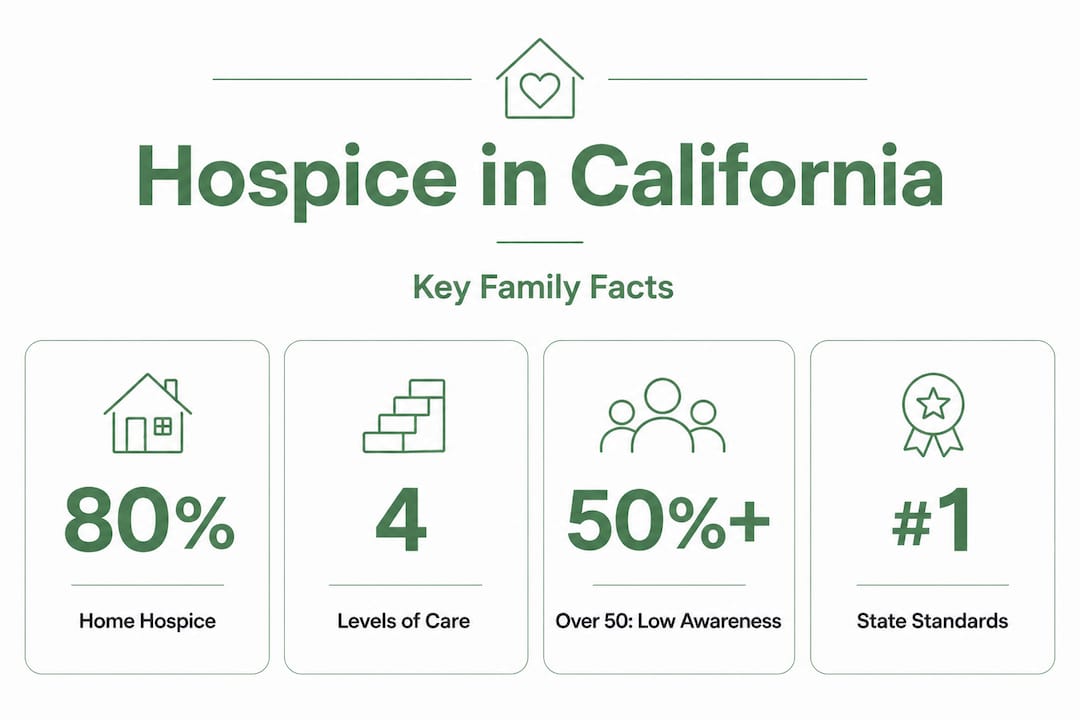
Medicare covers four levels of hospice care: Routine Home Care, Continuous Home Care, General Inpatient Care, and Inpatient Respite Care. Each level serves a different situation, and understanding them helps families plan more effectively.
| Care level | Setting | When it applies |
|---|---|---|
| Routine Home Care | Home or assisted living | Day-to-day comfort care at home |
| Continuous Home Care | Home | Crisis periods requiring intensive nursing |
| General Inpatient Care | Hospital or inpatient facility | Symptoms too complex to manage at home |
| Inpatient Respite Care | Approved facility | Short-term relief for family caregivers |
Here is a simple numbered guide to help you think through which level fits your situation:
- Start with Routine Home Care if your loved one is stable and wishes to remain at home. This is the most common level and covers regular nursing visits, medications, and equipment.
- Request Continuous Home Care during a crisis, such as uncontrolled pain or severe breathing difficulty. A nurse or aide can be present for up to 24 hours a day during these periods.
- Transition to General Inpatient Care when symptoms cannot be managed safely at home, even with continuous support. This is a temporary measure to stabilize the patient.
- Use Inpatient Respite Care when the primary caregiver needs a break. Medicare and Medi-Cal allow up to five consecutive days in an approved facility for this purpose.
Knowing about hospice care levels in advance means you will not be caught off guard when a crisis arises. Families who understand these options tend to feel more in control and less overwhelmed when transitions become necessary.
Many families are also surprised to learn that hospice at home is the most common and often most preferred setting. Being in a familiar environment, surrounded by loved ones and personal belongings, can significantly improve a patient’s sense of comfort and peace.
What does hospice cost and how is it covered?
Once you’ve grasped the types and settings of hospice care, the next big concern is often cost and who pays. The good news is that for most California families, hospice is largely covered.
Medicare covers nearly all hospice costs with minimal copays, and Medi-Cal in California provides parallel coverage. This means that eligible patients can receive the full range of hospice services without facing large medical bills.
Here is what is typically covered under Medicare and Medi-Cal:
- Physician and nursing services
- Home health aide and homemaker services
- Medical equipment and supplies
- Prescription drugs for symptom control and pain relief
- Physical, occupational, and speech therapy
- Social work services
- Dietary counseling
- Spiritual care and counseling
- Bereavement support for the family
There are some situations where small costs may apply. Patients may pay up to 5 percent of the Medicare-approved amount for outpatient drugs, or a small daily copay for inpatient respite care. These amounts are modest compared to the full scope of services received.
Statistic to know: Research suggests that a significant portion of adults over 50 have limited knowledge about hospice coverage and costs, which leads many families to delay enrollment out of financial fear. That delay often means missing weeks or months of meaningful support.
Pro Tip: Always verify that your hospice provider is licensed and Medicare-certified. California has high hospice utilization but also fraud concerns, so choosing a reputable, regulated provider protects your family and ensures you receive the full benefit of your coverage.
For a detailed breakdown of what to expect financially, the hospice cost coverage guide for California families is a practical starting point.
How does hospice adapt if needs change?
With the financial questions settled, families often wonder: what if our needs change or our loved one’s condition improves? This is one of the most important and least discussed aspects of hospice care.
Hospice can be revoked if the condition improves or if the patient decides to pursue curative treatment again. This is called revoking the hospice election. It is not a failure. It is simply a shift in the patient’s goals and medical situation. After revoking, the patient can return to standard Medicare or Medi-Cal benefits immediately.
If a patient lives beyond the initial six-month prognosis, recertification allows them to continue receiving hospice care as long as a physician confirms that the terminal prognosis still applies. There is no hard limit on how long someone can receive hospice, provided they continue to meet eligibility criteria.
Key points about flexibility in hospice care:
- Patients can revoke hospice at any time, for any reason
- Returning to curative care does not disqualify a patient from re-enrolling in hospice later
- Recertification periods allow ongoing access beyond the initial six months
- In California, children under 21 can receive concurrent care, meaning they can pursue curative treatment and receive hospice support at the same time
- Bereavement services for family members continue for up to 13 months after the patient passes
Caregiver support resources remain available throughout all of these transitions, including during periods when the patient’s condition is changing rapidly.
Pro Tip: Have an open, ongoing conversation with your hospice care team about any changes you notice in your loved one’s condition or in your own capacity as a caregiver. The team can adjust the care plan quickly, and early communication almost always leads to better outcomes.
Why choosing hospice is an act of compassion, not surrender
After working through the practical details, it is worth pausing to address something deeper. Many families carry guilt about choosing hospice. They worry that stopping curative treatment means they have stopped fighting for their loved one. This belief, while completely understandable, is not accurate.
Evidence consistently shows that patients who enter hospice often experience less pain, fewer hospitalizations, and more meaningful time with family than those who continue aggressive treatment in the final months. Choosing comfort is not passive. It is one of the most active, loving decisions a family can make.
California’s hospice care standards are among the most rigorous in the country. The state requires licensed hospice agencies to meet strict regulatory requirements, which means families can trust that the care they receive is both ethical and high-quality. That regulatory framework exists because California recognizes the profound responsibility that comes with caring for people at their most vulnerable.
The real courage in hospice is not in fighting a disease that can no longer be beaten. It is in saying, “I want my loved one to feel held, heard, and free from pain.” That is an act of profound love. Families who choose hospice are not giving up. They are giving their loved one the best possible version of the time they have left.
Compassionate support for your hospice journey in California
As you consider options for your loved one, you do not have to navigate this alone. At Graceland Hospice, we are here to walk alongside California families every step of the way. Whether you are just beginning to explore your options or ready to take the next step, our team offers free consultations to help you understand what care is available and what fits your family’s needs.
Explore our California hospice care options to learn more about how we serve families across the state. You can also review our full list of hospice services to see exactly what support is available. Families in Southern California can connect directly with our Orange County hospice team for local, compassionate guidance. We believe every eligible patient deserves the gift of hospice, and we are committed to making sure that gift is within reach for your family.
Frequently asked questions
Who qualifies for hospice care in California?
A patient qualifies for hospice when two doctors certify a terminal illness with a life expectancy of six months or less and the patient chooses comfort care over curative treatment. Both conditions must be met for the hospice benefit to begin.
What services does hospice provide for families?
Hospice includes medical, emotional, and spiritual support, pain management, equipment, and resources for family caregivers, including bereavement counseling that continues for up to 13 months after the patient passes.
How much does hospice care cost in California?
Medicare and Medi-Cal cover almost all hospice costs, with only minimal copays possible for certain medications or short-term inpatient respite stays. Most families pay very little out of pocket.
Can hospice be ended if my loved one improves?
Yes. Hospice can be revoked at any time if the patient improves or chooses to pursue curative treatment, and it can be restarted with physician recertification if the patient’s condition later meets eligibility criteria again.
What makes California hospice care unique?
California offers Medi-Cal hospice coverage for all levels of care, strong state regulatory standards, and additional provisions such as concurrent care for children under 21, giving California families broader access and stronger protections than many other states.
Recommended
- Understanding Hospice Care Levels: A Guide for California Families | Graceland Hospice Care Blog
- How hospice honors wishes in California: A complete guide | Graceland Hospice Care Blog
- Are hospice costs covered? A California family’s guide | Graceland Hospice Care Blog
- End-of-Life Planning Guide: Hospice & Comfort Care at Home | Graceland Hospice Care Blog