Advance Directives in Hospice: A California Caregiver's Guide
Advance Directives in Hospice: A California Caregiver’s Guide
TL;DR:
- Advance directives in California give patients and families legally protected authority to ensure their care preferences are honored during hospice. They include documents like the AHCD, POLST, and hospice election, which must be current and aligned to guide medical decisions effectively. Regular review and honest conversations are essential to prevent conflicts and promote compassionate, person-centered end-of-life care.
Many families assume that telling a doctor or loved one what they want is enough. It isn’t. Without formal legal documents in place, healthcare providers in California may be required to follow standard protocols rather than a patient’s personal wishes, even when hospice care has already begun. Advance directives change that reality. They give patients and families a clear, legally protected voice at the most critical moments of life’s final chapter. This guide walks you through exactly what advance directives are, which documents matter most in California hospice care, and how to keep them current so your loved one’s wishes are always honored.
Table of Contents
- What are advance directives in California hospice care?
- Key documents: AHCD, POLST, and hospice election
- Conflicts, changes, and practical realities
- Advance care planning: Why it matters for hospice outcomes
- A caregiver’s perspective: What actually works when preparing advance directives
- How Graceland can support your family with hospice and advance directives
- Frequently asked questions
Key Takeaways
| Point | Details |
|---|---|
| Complete core documents | Every California hospice patient should have an AHCD, a POLST if seriously ill, and a hospice election statement. |
| Keep wishes updated | Advance directives can be revised whenever the patient changes their mind and can express wishes. |
| Resolve conflicts clearly | If documents conflict, the newest one usually takes priority—update both AHCD and POLST for clarity. |
| Better planning means better care | Advance care planning improves quality of hospice and helps families receive comfort-focused support. |
What are advance directives in California hospice care?
Advance directives are legal documents that serve two important functions. First, they allow a person to express their treatment preferences in writing. Second, they allow that person to name a trusted agent, often called a healthcare proxy or surrogate, who can make medical decisions on their behalf if they are no longer able to speak for themselves.
In hospice care, these documents take on even greater weight. The hospice setting is specifically designed to prioritize comfort rather than cure. That shift requires clear guidance. Without documented preferences, care teams may face difficult choices about pain relief, breathing support, or other medical interventions, often during moments when there is very little time to consult family members.
California has its own specific rules about how advance directives are prepared, stored, and updated. One of the most reassuring aspects of California law is that directives are not permanent. As Scripps explains, directives can be changed or canceled at any time when the person can still express their own wishes. This flexibility is important because a person’s values and circumstances can evolve, and the documents should evolve too.
“The goal of an advance directive is not to limit care. It is to ensure that every form of care given reflects what matters most to the patient.”
Here are the core functions advance directives serve in California hospice:
- Clarifying pain and comfort preferences: Directives specify how aggressively pain should be managed and whether comfort is the primary goal.
- Guiding decisions about life-sustaining treatment: This includes preferences around resuscitation, mechanical ventilation, and artificial nutrition.
- Naming a decision-maker: A designated agent can speak for the patient when communication is no longer possible.
- Protecting families from impossible choices: Clear documentation relieves family members of the burden of guessing what their loved one would have wanted.
When hospice is elected in California, the process becomes even more formal. Through Medi-Cal hospice election, a patient or their representative files an election statement with a hospice provider. This statement acknowledges the intent to alleviate pain and suffering rather than to cure, and it describes which Medi-Cal benefits are being waived under the hospice election. This formal step aligns closely with the spirit of advance directives and reinforces the transition to comfort-focused care.
For a fuller picture of what to prepare, review these essential end-of-life documentation steps and learn more about how hospice honors wishes in real care situations.
Key documents: AHCD, POLST, and hospice election
There are three primary documents that every California hospice caregiver should understand and manage. They each serve a different purpose, and together they form a complete picture of a patient’s care wishes.
| Document | Purpose | Who completes it | When it applies |
|---|---|---|---|
| AHCD (Advance Health Care Directive) | Names an agent; outlines general treatment goals | Patient, with witnesses | Ongoing; applies broadly |
| POLST (Physician Orders for Life-Sustaining Treatment) | Converts wishes into active medical orders | Clinician, with patient input | Emergencies, transfers, immediate care |
| Hospice Election Statement | Formally begins hospice; waives curative services | Patient or representative | At hospice enrollment |
The Advance Health Care Directive (AHCD)
The AHCD is the foundational document. It allows a person to appoint a healthcare agent and describe their overall values and treatment goals. This document is broad by design. It provides a framework for decision-making but does not function as a direct medical order. Think of it as the “big picture” document that guides every medical conversation.

The POLST form
The POLST is more immediate. Clinicians complete this form in conversation with the patient or their representative, and it translates preferences into specific, actionable medical orders. Because POLST travels with the patient across care settings, including hospitals, skilled nursing facilities, and home, it is especially critical in hospice transitions. California guidance makes clear that families should prepare and align both documents so that the AHCD and POLST reflect the same current wishes.
The hospice election statement
This document formally initiates hospice care. According to DHCS Hospice Information, hospice election is initiated by the patient or representative with the hospice provider. It acknowledges the shift from curative to comfort care and specifies what Medi-Cal services are being waived. Caregivers need to fully understand what they are signing and what it means for ongoing care.
Here is a simple numbered approach to managing these three documents:
- Start with the AHCD. Name an agent and write down the patient’s values and general preferences while they can still communicate them clearly.
- Work with the clinical team on a POLST. Ask the hospice or attending physician to complete one, and make sure it aligns with the AHCD.
- File the hospice election statement. Do this when transitioning to hospice, and make sure the family understands what the election means in practical terms.
- Keep all three documents together. Store them in an accessible place and share copies with everyone involved in the patient’s care.
- Review regularly. Revisit the documents any time the patient’s condition or wishes change.
Pro Tip: Ask your hospice provider for a checklist of documents they need at enrollment. Being prepared ahead of time means care can start smoothly without delays or confusion.
For a broader look at this process, the end-of-life planning guide on our blog offers practical direction for families at home. Families navigating cognitive changes may also find these memory care tips for families helpful when preparing or updating directives.
Conflicts, changes, and practical realities
Even the most carefully prepared documents can run into complications. Understanding how to handle those situations is just as important as having the documents in place to begin with.
One of the most common practical issues involves conflicting instructions between the AHCD and the POLST. Because these documents address different purposes, one being a broad legal expression of wishes and the other being immediate medical orders, they can sometimes say different things. California guidance is clear on this point: the most recently completed document takes priority in areas of conflict. This rule exists to ensure that the most current expression of a person’s wishes is always respected.
Here is a quick overview of how conflicts are typically handled:
| Conflict scenario | What generally happens |
|---|---|
| POLST and AHCD disagree on CPR | Most recent document prevails |
| Agent instructions differ from POLST orders | Clinical team reviews and may seek clarification |
| Outdated directive conflicts with current condition | Team requests updated documentation |
| Family wishes contradict written directive | Written directive is legally binding |
“Healthcare teams are trained to review all documents carefully, but they cannot read minds. The clearer and more current your paperwork, the less room there is for unwanted outcomes.”
The good news is that directives can be changed or canceled at any time as long as the patient can still express their wishes. This is a critical protection. A directive created years ago during a different health situation may no longer reflect what the person wants today.
When should you review and update directives? Consider doing so when:
- The patient’s diagnosis or prognosis changes significantly.
- The patient is moved to a new care setting.
- The named healthcare agent is no longer available or willing to serve.
- The patient expresses new wishes or changes their mind about previous choices.
- A significant period of time has passed since the last review.
Pro Tip: Set a calendar reminder every six months to review all advance care documents with the care team. It takes only a short conversation to confirm whether everything is still current.
For answers to the questions families most often ask, the common hospice questions guide offers clear, direct responses. If you are thinking through the process of changing or reviewing directives, this resource on reviewing family care decisions can help you navigate difficult conversations.
Advance care planning: Why it matters for hospice outcomes
Some families wonder whether all this paperwork actually makes a difference. The evidence says it does, in ways that matter deeply.
Research consistently shows that advance care planning documentation is linked to less aggressive end-of-life treatment and higher rates of hospice use. Patients with completed directives are more likely to spend their final days in the setting they chose, with the care they wanted, surrounded by the people they love. That is not a small thing.
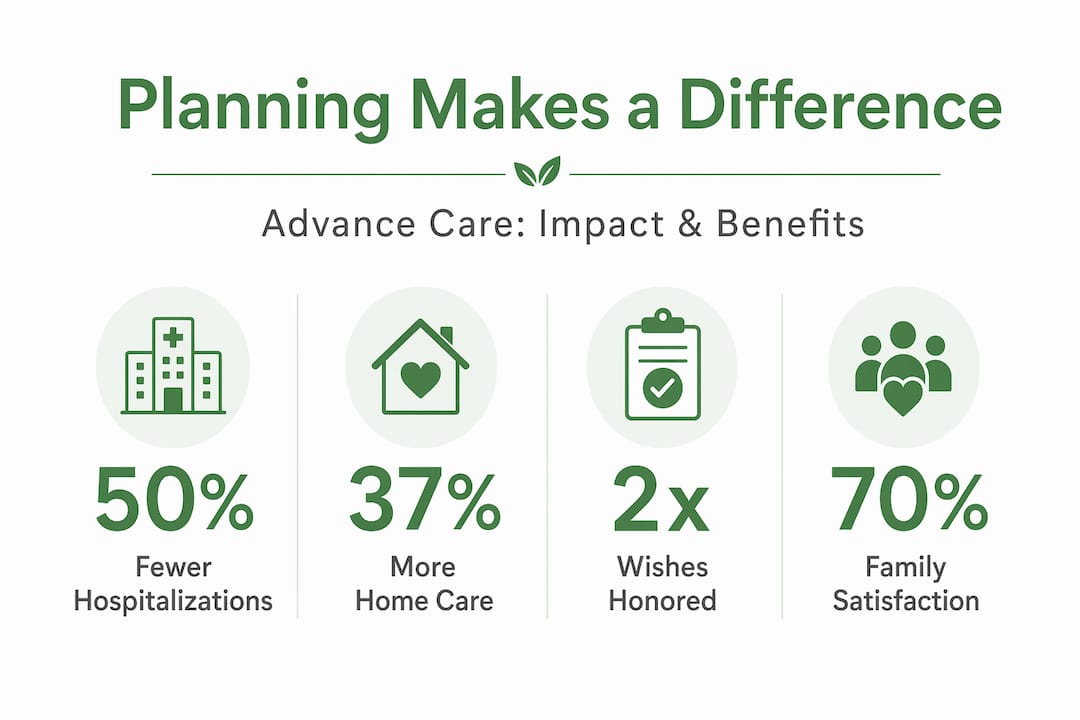
Beyond the individual patient, advance care planning has a measurable impact on families. When wishes are documented clearly, family members are spared the anguish of making impossible decisions under pressure. They can focus on being present rather than trying to manage conflicting medical recommendations.
Care teams benefit too. Hospice nurses, physicians, and social workers work most effectively when they have clear, current documentation to guide them. Ambiguity slows care and can lead to interventions that nobody wanted.
Here is a summary of what documented advance care planning can do:
- Reduce unwanted hospital stays: Patients with completed directives are less likely to receive aggressive treatment that conflicts with their comfort goals.
- Increase time in preferred settings: More patients receive hospice care at home or in a familiar environment.
- Lower caregiver stress: Families report feeling more confident and less guilty when decisions are grounded in documented wishes.
- Improve care team efficiency: Clear paperwork means faster, more coordinated responses to changes in condition.
- Honor dignity at every stage: Documented wishes ensure that care remains person-centered, even when the patient can no longer speak.
Understanding hospice coverage in California can help you see how advance planning connects to the practical benefits your loved one is entitled to receive. If you are also thinking ahead to the grief journey that follows, these grief support tips offer meaningful guidance for California families.
A caregiver’s perspective: What actually works when preparing advance directives
Here is something the official guides don’t always tell you: the paperwork is actually the easy part. The harder work is the conversation that has to happen before a single word is written down.
We have seen families arrive with beautifully completed AHCD forms only to realize that no one had ever actually asked the patient what they wanted. The document had been filled in based on assumptions, not honest conversation. And in more than a few of those situations, what was written did not match what the patient would have chosen.
The most effective advance care planning we witness starts with a real discussion. Not a formal meeting, not a checklist. A genuine conversation where someone sits down with the patient and asks: “What matters most to you? What are you most afraid of? What does a good day look like for you right now?”
Families sometimes avoid these conversations because they feel too heavy. But the weight of not having them is much greater. When a crisis hits and there is no clear guidance, families fracture. Old conflicts surface. Decisions get made in emergency rooms under fluorescent lights, in the worst possible conditions for thoughtful judgment.
Outdated paperwork is another real problem. Hospice teams work with what is in front of them, and an AHCD completed five years ago may no longer reflect the patient’s current wishes or medical situation. An outdated POLST can cause real friction during emergency transfers. Current, consistent documentation makes every part of the care process move more smoothly.
Our honest advice: don’t wait for the right moment. The right moment is now, while there is still time to have a calm, unhurried conversation. Then review the documents regularly, ask your hospice provider what they need, and make sure everyone who is part of the care team has access to the same current paperwork.
For support in those difficult conversations, hospice communication strategies can give you practical language and approaches that work. And as you walk alongside a loved one through this time, these insights on navigating grief and loss may offer comfort for the road ahead.
How Graceland can support your family with hospice and advance directives
Knowing what documents are needed is one thing. Having experienced, compassionate support to actually prepare them, review them, and act on them is another. At Graceland Hospice, we walk alongside families at every step of this process, from initial conversations about advance care planning to coordinating care that fully reflects the patient’s documented wishes.
Our team helps ensure that your loved one’s AHCD and POLST are consistent, current, and ready when they are needed most. We guide families through the hospice election process, explain what is being waived and why, and make sure no one feels alone in navigating the California system. Explore our full range of hospice care services or browse our resources for caregivers to find guidance tailored to your situation. Contact us today for a free consultation.
Frequently asked questions
Can advance directives be changed after hospice is started in California?
Yes, as long as the patient can still express their wishes, directives can be updated or canceled even after hospice care has begun.
Which document takes priority if POLST and AHCD conflict in an emergency?
The most recently completed document generally takes priority when the two documents contain conflicting instructions.
What is the first step to elect hospice care in California?
The patient or their representative must file an election statement with the chosen hospice provider, which formally begins hospice care and outlines waived benefits.
Why is advance care planning important for quality of hospice care?
Documentation is linked to reduced aggressive treatment at end of life, higher hospice use, and a smoother, more supported experience for both patients and families.
Recommended
- Understanding Hospice Care Levels: A Guide for California Families | Graceland Hospice Care Blog
- How hospice honors wishes in California: A complete guide | Graceland Hospice Care Blog
- Role of Caregivers in Hospice – Making End-of-Life More Compassionate | Graceland Hospice Care Blog
- Hospice communication strategies for California caregivers