Your step-by-step hospice assessment guide for caregivers

Your step-by-step hospice assessment guide for caregivers
TL;DR:
- Hospice assessment involves a structured, federally regulated process that ensures patients receive consistent, comprehensive care. Families must prepare documentation, understand team roles, and advocate effectively during evaluations to support their loved one’s comfort and dignity. Regular recertification and ongoing communication are essential to maintaining hospice benefits and addressing the holistic needs of patients.
When a loved one’s illness reaches a point where curative treatment is no longer the focus, many families feel a wave of confusion, grief, and urgency all at once. Navigating the hospice process can feel like being handed a complex map with no legend. The good news is that hospice care in the United States follows a structured, federally regulated process, and understanding each step can bring real peace of mind. This guide walks you through exactly what to expect during a hospice assessment, what paperwork is required, who will be involved, and how to advocate effectively for your loved one’s comfort and dignity.
Table of Contents
- Understanding hospice assessment requirements
- Preparing for the initial hospice assessment
- Step-by-step hospice assessment process
- Addressing emotional, psychosocial, and spiritual needs
- Hospice recertification and follow-up steps
- Our hard-won lessons: What actually matters in hospice assessments
- Connect with compassionate hospice assessment support
- Frequently asked questions
Key Takeaways
| Point | Details |
|---|---|
| NOE is essential | Submitting the Notice of Election within 5 days is crucial for immediate Medicare coverage. |
| Team-based assessments | The interdisciplinary team evaluates physical, emotional, and spiritual needs within 5 days. |
| Follow HOPE sequence | The HOPE tool structures assessment at key intervals to keep care comprehensive. |
| Ongoing recertification | Care continues with recertification every 90 or 60 days to ensure eligibility and quality. |
| Holistic care focus | Hospice assessments go beyond medical needs, embracing psychosocial and spiritual well-being. |
Understanding hospice assessment requirements
Before any care begins, a formal assessment process must take place. This is not simply a formality. These assessments are federally regulated to ensure that every patient receives a consistent standard of care, regardless of where they live or which hospice provider they choose. If you are new to this process, understanding hospice care as a whole can help you frame what comes next.
The Notice of Election (NOE) is the first legal step in starting hospice care under Medicare. The NOE must be filed within 5 calendar days of the hospice admission date to ensure Medicare coverage begins from day one. Missing this window can result in gaps in coverage, which is a stress no family needs during an already difficult time.
Here is a quick look at what the assessment process requires from a documentation and team standpoint:
Documentation and team requirements at a glance:
| Requirement | Details |
|---|---|
| Notice of Election (NOE) | Filed within 5 calendar days of admission |
| Physician certification | Terminal prognosis of 6 months or less |
| Comprehensive assessment | Completed within 5 calendar days of hospice election |
| Patient/family consent | Signed election statement required |
| Care plan | Developed by the interdisciplinary team |
| Recertification documentation | Required at each benefit period renewal |
Key team members involved in every hospice assessment include:
- Attending physician or hospice medical director: Certifies eligibility and oversees the medical plan
- Registered nurse (RN): Leads the clinical assessment and coordinates care
- Licensed clinical social worker: Evaluates psychosocial needs and assists with community resources
- Chaplain or spiritual care counselor: Addresses spiritual and existential concerns for the patient and family
- Home health aide: Assists with personal care needs and reports changes in condition
- Volunteer coordinator: Supports supplemental comfort services
Understanding these roles helps you know exactly who to speak with and when. The end-of-life care steps involved in this process are designed to work together seamlessly when every team member is actively engaged.
Preparing for the initial hospice assessment
Once you’re familiar with the requirements, preparing effectively can streamline the process and reduce stress. Gathering the right information before the assessment team arrives makes a genuine difference in how smoothly things go.
Documents and information to have ready:
- Current list of all medications, dosages, and prescribing physicians
- Medical records and recent test results or imaging
- Insurance information including Medicare or Medicaid cards
- Advance directive, living will, or POLST (Physician Orders for Life-Sustaining Treatment) form
- Contact information for all current healthcare providers
- List of allergies and known medical conditions
- Emergency contact information and next-of-kin details
The assessment must be completed no later than 5 calendar days after the effective date of hospice election, involving the interdisciplinary team (IDG) to evaluate physical, psychosocial, emotional, and spiritual needs. This tight timeline means preparation cannot wait. Starting the documentation process as soon as the hospice decision is made gives you the best chance of meeting that window comfortably.
The interdisciplinary group (IDG) is the formal name for the care team that works together to assess and plan for your loved one’s needs. Every member brings a different lens to the evaluation. The nurse looks at symptoms and physical comfort, the social worker examines family dynamics and support systems, and the chaplain explores what brings meaning and peace to the patient. This collaborative approach is one of the most meaningful aspects of hospice care.
If you are considering setting up care at home, learning about starting hospice care at home can help you plan the physical environment and support systems before the IDG arrives.
Pro Tip: Create a dedicated folder, either physical or digital, containing all of your loved one’s medical documents, insurance cards, and legal directives. Bring this folder to every meeting with the hospice team. It saves time, reduces confusion, and signals to the care team that you are an engaged and prepared advocate.
Step-by-step hospice assessment process
With preparation handled, follow these steps for each stage of hospice assessment.
Step 1: Confirm eligibility and obtain physician certification. The attending physician or hospice medical director certifies that the patient has a terminal diagnosis with a life expectancy of six months or less if the illness runs its expected course.
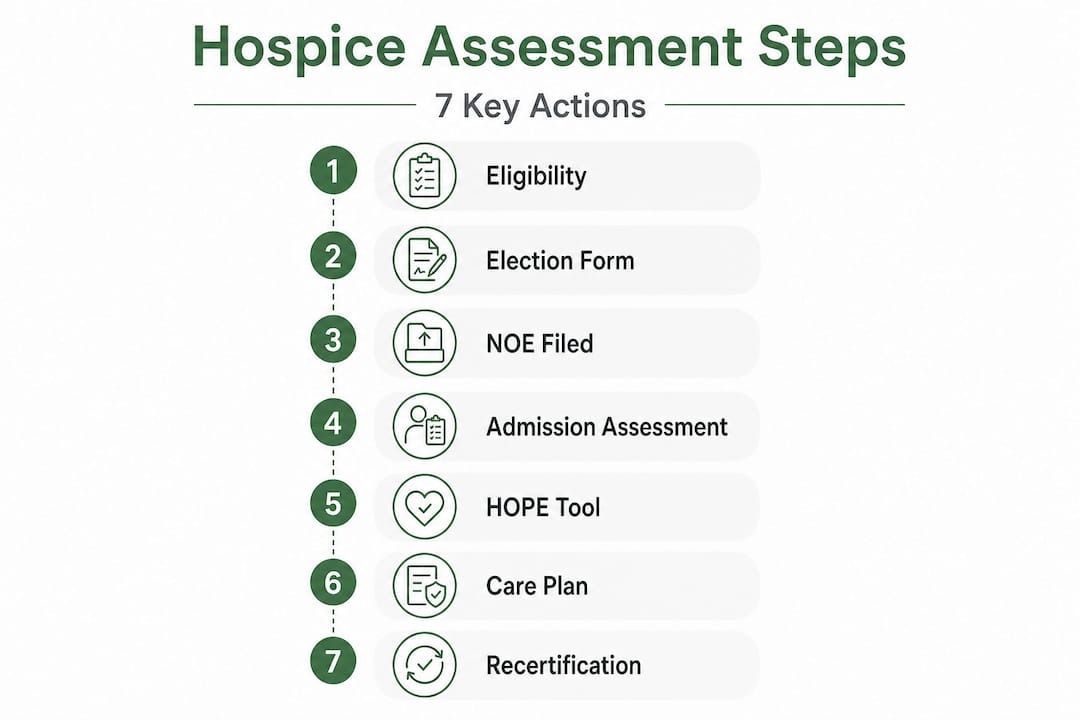
Step 2: Sign the hospice election statement. The patient or their legal representative signs a form electing hospice care under Medicare, acknowledging that curative treatment for the terminal diagnosis will be set aside in favor of comfort-focused care.
Step 3: File the Notice of Election (NOE). The hospice provider submits the NOE to Medicare within 5 calendar days of the admission date. This step protects Medicare coverage from the first day of care.
Step 4: Complete the comprehensive admission assessment. The IDG conducts a full evaluation within 5 calendar days of election. This includes physical symptom review, psychosocial screening, spiritual assessment, and the development of an initial care plan.
Step 5: Implement the HOPE tool assessment schedule. Under the new CMS HOPE tool effective October 1, 2025, assessments occur at multiple timepoints: HOPE Admission (within 5 days), HOPE Update Visits (HUV1 on days 6 through 15, HUV2 for longer stays), Symptom Follow-up Visits if needed, and Discharge. This structured schedule ensures ongoing monitoring rather than a single one-time evaluation.
Step 6: Review and update the care plan regularly. The IDG meets at least every 15 days during the first 90-day period and then regularly thereafter to review the care plan, adjust symptom management strategies, and address emerging needs.
Step 7: Prepare for recertification. At the end of each benefit period, the hospice physician or nurse practitioner recertifies continued eligibility. A face-to-face visit is required before the third and all subsequent benefit periods.
HOPE assessment timepoints overview:
| Timepoint | When it occurs | Primary focus |
|---|---|---|
| HOPE Admission | Within 5 calendar days | Initial full evaluation |
| HUV1 (Update Visit 1) | Days 6 through 15 | Symptom tracking and plan adjustments |
| HUV2 (Update Visit 2) | For stays beyond initial period | Ongoing needs review |
| Symptom Follow-up Visit | As clinically indicated | Targeted symptom management |
| HOPE Discharge | At end of care | Outcome documentation |
Families who understand the hospice care workflow are far better positioned to ask the right questions at each timepoint and to notice if something is being overlooked. Reviewing the full picture of compassionate at-home care also helps families set realistic expectations about day-to-day routines.
Addressing emotional, psychosocial, and spiritual needs
Beyond medical and logistical steps, thorough hospice assessments also address the deeper needs of your loved one. This is often the dimension families underestimate, and it is among the most important.

The comprehensive assessment requirement specifically calls for the IDG to evaluate not just physical symptoms, but also psychosocial, emotional, and spiritual needs. This means the assessment goes well beyond vital signs and medication lists.
Holistic assessment areas covered include:
- Emotional wellbeing: Current mental health status, history of anxiety or depression, and coping strategies
- Social support: Family structure, caregiver availability, financial stressors, and housing stability
- Spiritual needs: Religious affiliations, personal beliefs, rituals that bring comfort, and fear of death or the unknown
- Cultural considerations: Language preferences, cultural practices around death and dying, and family decision-making dynamics
- Grief and anticipatory loss: The patient’s own awareness of prognosis and the family’s emotional readiness
“Hospice care is not just about managing physical symptoms. It is about honoring the whole person, including their story, their relationships, and what brings them peace in life’s final chapter.”
The role of spiritual care in hospice is often misunderstood. It does not require any particular religious belief. The chaplain on your care team is trained to meet patients and families wherever they are spiritually, offering presence, listening, and meaningful support without judgment. Similarly, psychosocial support in hospice addresses things like family conflict, caregiver burnout, and the practical anxieties that come with this season. For families looking for additional comfort resources, reviewing holistic comfort tips can help supplement the care being provided.
Pro Tip: Before the social worker or chaplain visits, take a few minutes to write down what matters most to your loved one. This might include favorite music, meaningful rituals, people they want nearby, or things left unsaid. Sharing this information with the care team helps them personalize the experience in ways that can be profoundly comforting.
Hospice recertification and follow-up steps
After the initial phases, keeping care ongoing requires regular follow-up and recertification steps. This is where many families feel less certain, but the process is straightforward once you know what to expect.
Medicare hospice benefits are structured around benefit periods. The first two periods are each 90 days long. After that, benefit periods shift to 60-day increments. At the close of each period, the patient must be recertified as still meeting the eligibility criteria for hospice care. Families often worry that recertification means their loved one “doesn’t qualify anymore,” but in practice, most patients are recertified without difficulty if their condition remains consistent with a terminal prognosis.
Key follow-up and recertification steps include:
- Face-to-face encounter with the hospice physician or nurse practitioner before the third benefit period and all subsequent ones
- Written recertification statement from the certifying physician
- Updated care plan reflecting any changes in condition, goals, or family circumstances
- IDG review and documentation of continued appropriateness of hospice care
- Communication with the family about what the next benefit period will involve
The recertification structure is clear: two initial 90-day periods, then 60-day periods going forward, with a mandatory face-to-face encounter before the third and all subsequent periods. Missing this encounter can result in a coverage gap, so families should confirm that the visit is scheduled well in advance of the benefit period end date.
Staying informed about quality hospice care standards in California helps you hold your provider accountable and ask the right questions at each recertification point.
Our hard-won lessons: What actually matters in hospice assessments
Having covered the process and requirements, here is what our experience has shown truly matters for caregivers.
Documentation is essential, but it is not enough on its own. We have seen families assume that because the paperwork was filed and the boxes were checked, everything was handled. The reality is that assessments are only as meaningful as the conversations that surround them. If the nurse completes the symptom checklist but the family never mentions that Mom is waking up at 3 a.m. in distress, that information does not make it into the care plan.
The most effective caregivers we have worked with treat every assessment visit as an opportunity to speak up. They come with notes. They ask, “Is there anything we haven’t covered?” They request follow-up if something feels unresolved. This kind of advocacy is not confrontational. It is collaborative. And it consistently leads to better outcomes.
One of the areas families most often overlook is the emotional and spiritual dimension. It is easy to focus on medication schedules and symptom management and to let the chaplain’s visit feel like a lower priority. But our team has seen countless times how a single meaningful conversation with a spiritual care provider can ease weeks of anxiety for both the patient and the family. Do not treat it as optional.
Using a structured essential care checklist alongside your hospice team’s guidance gives you a practical framework to ensure nothing falls through the cracks. The checklist is a tool, but your voice is the real safeguard.
Connect with compassionate hospice assessment support
Navigating hospice assessments is something no family should have to do alone. At Graceland Hospice Care, we bring together experienced interdisciplinary teams who are deeply committed to honoring each patient’s dignity and each family’s needs. Whether you are just beginning to explore hospice options or you are already in the process and feeling uncertain about next steps, we are here to help. Explore our full range of hospice services to understand how we support families throughout Southern California with personalized, compassionate care. Contact us today for a free consultation and let us walk alongside you through every step of this journey.
Frequently asked questions
How quickly must the Notice of Election be submitted after hospice admission?
The NOE must be filed within 5 calendar days of hospice admission to ensure Medicare coverage begins promptly and without interruption.
What specialists are involved in the hospice assessment?
The interdisciplinary team includes a physician, nurse, social worker, chaplain, and others as needed, with each member evaluating a distinct dimension of the patient’s needs as required by CMS guidelines.
What is the HOPE tool and why is it important?
The HOPE tool is a new CMS assessment framework that establishes structured evaluation timepoints, effective October 1, 2025, ensuring patients receive consistent and thorough assessments throughout their hospice stay.
How often does hospice recertification occur?
Hospice recertification follows a structured schedule: two initial 90-day periods followed by 60-day periods, with a required face-to-face encounter before the third and all subsequent benefit periods.
Recommended
- Home Hospice Care Workflow: A Step-by-Step Guide for Families | Graceland Hospice Care Blog
- End of Life Care Steps for Home Hospice Success | Graceland Hospice Care Blog
- End of Life Care Guide for Compassionate At-Home Support | Graceland Hospice Care Blog
- Hospice Visit Workflow for Comfort Care at Home | Graceland Hospice Care Blog