How to choose hospice care: a guide for California families

How to choose hospice care: a guide for California families
TL;DR:
- Choosing hospice involves assessing eligibility, certifications, and provider credentials carefully.
- Use rating tools and reviews to compare quality and ensure providers meet legal standards.
- Prioritize compassionate communication, cultural sensitivity, and family support in your final choice.
Choosing hospice care for someone you love is one of the most profound decisions a family can make. The weight of that moment, the mix of grief, urgency, and uncertainty, can make even the most organized person feel lost. California families face a particularly layered process, with state-specific eligibility rules, licensing requirements, and a wide range of provider options to sort through. This guide walks you through each step with clarity and compassion, so you can feel confident that your loved one will receive the dignity and comfort they deserve during life’s final chapter.
Table of Contents
- Understanding hospice care and eligibility in California
- Researching and comparing local hospice providers
- Evaluating certification, licensing, and accreditation
- Balancing care needs and making your final decision
- A more compassionate approach: what most guides miss
- Connecting with trusted hospice care in California
- Frequently asked questions
Key Takeaways
| Point | Details |
|---|---|
| Confirm eligibility requirements | A physician must certify that your loved one has six months or less to live for hospice care coverage in California. |
| Compare provider ratings | Use Medicare Hospice Compare to review star ratings and family survey results for local hospice agencies. |
| Verify certification and licensing | Check that providers have Medicare/Medi-Cal certification, state licensing, and national accreditation. |
| Include emotional support | Choose agencies with strong family support and counseling, not just medical credentials. |
| Ask key questions | Prepare and ask clear questions about provider services, accreditations, and survey results before deciding. |
Understanding hospice care and eligibility in California
Hospice care is not about giving up. It is about shifting the goal from curing an illness to providing comfort, peace, and quality time. When a terminal diagnosis has been confirmed and curative treatment is no longer the focus, hospice steps in to manage pain, offer emotional support, and care for both the patient and the family.
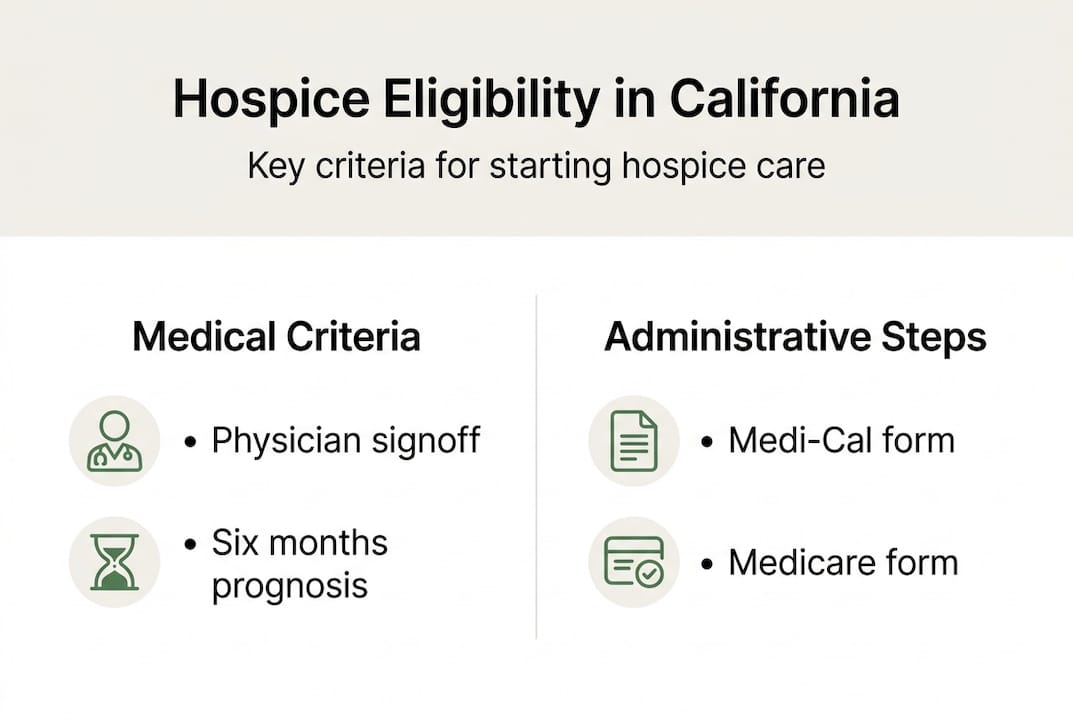
For understanding hospice care in California, eligibility is defined by specific medical and administrative criteria. California Medi-Cal eligibility requires a physician prognosis of six months or less and attestation form submission. This means two physicians must certify the prognosis, and the family must complete the enrollment process promptly.
Benefit periods under Medicare and Medi-Cal follow a structured timeline:
| Benefit period | Duration |
|---|---|
| First period | 90 days |
| Second period | 90 days |
| Subsequent periods | 60 days each, unlimited |
These periods can be renewed as long as the patient continues to meet eligibility criteria. If a patient’s condition improves, they can leave hospice and return later if needed.
When evaluating providers, look for these key credentials:
- Medicare certification: Required for federal reimbursement and baseline quality standards
- Medi-Cal certification: Required for California state coverage
- Joint Commission accreditation: A nationally recognized quality benchmark
- ACHC (Accreditation Commission for Health Care): Signals clinical excellence
- CHAPCA membership: California Hospice and Palliative Care Association, a state-level quality indicator
Pro Tip: Ask any provider upfront whether they hold both Medicare and Medi-Cal certification. A provider with only one may limit your coverage options significantly.
Understanding these requirements before you begin your search saves time and prevents the heartbreak of choosing a provider that does not meet your loved one’s coverage needs.
Researching and comparing local hospice providers
Once you understand eligibility, the next step is finding the right provider. California has hundreds of licensed hospice agencies, and the quality gap between them can be significant. Fortunately, there are reliable tools to help you compare.

Medicare Hospice Compare offers 1 to 5 star ratings on overall quality, patient care, and CAHPS family surveys. California’s average family rating is 3.1 out of 5, which falls below the national average of 3.6 out of 5. That gap matters. It means families in California need to be more selective, not less.
Here is a simplified comparison of what to look for when reviewing providers:
| Rating category | What it measures | Why it matters |
|---|---|---|
| Overall star rating | General quality score | Quick snapshot of performance |
| Patient care rating | Clinical care quality | Reflects medical team competence |
| CAHPS family survey | Real family experiences | Most human measure of quality |
CAHPS stands for Consumer Assessment of Healthcare Providers and Systems. These surveys collect feedback directly from families who have used the service, making them one of the most honest indicators of what daily care actually looks like.
Key things to look for when reviewing local providers:
- Home hospice availability: Can they provide full services in your loved one’s home?
- After-hours support: Is a nurse or counselor available at 2 a.m. if needed?
- Bereavement services: Do they support the family after the patient passes?
- Cultural and language support: Especially important in California’s diverse communities
Pro Tip: Search Medicare Hospice Compare by zip code to narrow results to agencies near you. Read the CAHPS comments carefully. Families often describe specific moments that reveal the true character of a provider.
Reviewing hospice care standards and learning how to evaluate them puts you in a much stronger position. You can also explore starting hospice care at home to understand what the transition looks like in practice.
Evaluating certification, licensing, and accreditation
Researching ratings is a strong start, but verifying credentials is where families often miss a critical step. A provider may present well in conversation while lacking the formal certifications that protect your loved one.
California requires that hospice providers submit the Hospice Program Attestation form within five days of election and hold appropriate certifications. This is not optional. It is a legal requirement, and any provider that cannot confirm compliance should raise a red flag.
Here is a step-by-step approach to verifying credentials:
- Request the Medicare provider number. You can use this to confirm certification status directly on the Medicare website.
- Ask for the Medi-Cal provider ID. This confirms state coverage eligibility.
- Request copies of accreditation certificates. Joint Commission, ACHC, or CHAPCA documentation should be available on request.
- Check the California DHCS provider directory. This confirms state licensing is current.
- Ask when the last survey or inspection occurred. Providers in good standing will answer this confidently.
“A provider’s willingness to share credentials openly is itself a sign of trustworthiness. Hesitation or vague answers are worth noting.”
The role of hospice aides in daily care is significant, and their qualifications are tied directly to the agency’s certification status. Similarly, understanding the role of caregivers in hospice helps families know what to expect from the team entering their home.
For California licensing details, the state’s Department of Health Care Services maintains up-to-date records. Cross-checking what a provider tells you against official state records takes less than ten minutes and can prevent serious problems down the line.
Balancing care needs and making your final decision
Credentials confirm that a provider meets legal standards. But the final decision involves something harder to quantify: whether this team feels right for your family.
Compassionate care requires both certified expertise and clear communication with the family. That means the best provider is not always the one with the most awards. It is the one whose team listens, responds, and genuinely connects with your loved one’s needs.
Here is a practical checklist to guide your final evaluation:
- Match clinical services to your loved one’s diagnosis. Not all hospices specialize in the same conditions.
- Ask about after-hours support. Emergencies do not follow business hours.
- Discuss family counseling options. Grief support for the whole family is part of quality hospice care.
- Review the CAHPS survey results one more time. Look specifically for comments about communication and responsiveness.
- Include your loved one in the conversation. Their comfort with the team matters deeply.
Pro Tip: Prepare a written list of questions before your first provider meeting. Families who arrive with questions get better answers and feel more in control of the process.
Avoid these common mistakes:
- Choosing based on proximity alone without checking ratings or credentials
- Overlooking CAHPS survey results because they seem complicated
- Assuming all hospice providers offer the same level of home-based support
Understanding the difference between hospice vs home health is also important at this stage. They are not the same service, and knowing the distinction helps you ask better questions. The at-home care guide offers additional detail on what families can expect when care is delivered in the home.
Revisit your decision as your loved one’s needs change. Hospice is not a one-time choice set in stone.
A more compassionate approach: what most guides miss
Most checklists stop at certifications and star ratings. Those things matter, but they do not capture the full picture of what a family actually needs during this time.
California’s population is among the most culturally diverse in the country. A provider that scores well on paper may still fall short if they cannot communicate in your family’s language or understand your cultural values around death and caregiving. That gap is real, and it is rarely discussed in standard guides.
We have seen families feel satisfied with a provider’s credentials only to feel unsupported weeks later because no one checked in between scheduled visits. True quality means proactive communication, not just reactive care.
Our honest advice: do not wait until something feels wrong to reassess. Ask every provider how often they initiate contact with the family, not just the patient. Ask what happens when the care plan needs to change. The family guide to hospice care can help you frame those conversations.
Emotional support is not a bonus feature. It is the core of what good hospice care looks like.
Connecting with trusted hospice care in California
At Graceland Hospice Care, we understand that no checklist fully captures what your family is going through. Our team is California-licensed and accredited, and we bring both clinical expertise and genuine compassion to every home we serve. We work closely with families to build care plans that honor your loved one’s wishes, support your family’s emotional needs, and meet every regulatory requirement California sets.
Explore our hospice care services to learn how we can support your family through this season. We offer a free consultation so you can ask questions, share your concerns, and decide together whether we are the right fit. You do not have to navigate this alone.
Frequently asked questions
How do I know if my loved one is eligible for hospice care in California?
Eligibility requires a physician certification of six months or less to live, plus submission of a Hospice Program Attestation form within five days of election. Both conditions must be met to begin receiving benefits.
What are the most important certifications and licenses for hospice providers in California?
Medicare and Medi-Cal certification, current state licensing, and third-party accreditation from organizations like Joint Commission, ACHC, or CHAPCA are the key credentials to verify before choosing a provider.
How can I compare the quality of local hospice providers for home care?
Use Medicare Hospice Compare to review star ratings, patient care measures, and CAHPS family surveys for providers in your zip code, giving you a side-by-side view of real performance.
What questions should I ask a hospice provider before choosing?
Ask about certification and accreditation, after-hours care availability, family counseling services, and their most recent CAHPS family survey results to get a complete picture of what daily care looks like.