Hospice social workers: essential support for CA families
Hospice social workers: essential support for CA families
TL;DR:
- Hospice social workers provide emotional, cultural, and logistical support beyond medical care.
- They are integral to the interdisciplinary team, guiding families through complex end-of-life issues.
- Early engagement with social workers improves family communication, grief processing, and care outcomes.
When a loved one enters hospice care, most families picture nurses managing medications and doctors adjusting treatment plans. What many miss is the quiet, steady presence of the hospice social worker, a professional whose support can shape the entire experience for both the patient and the people who love them. Hospice social workers play a vital yet often underappreciated role in end-of-life care, extending well beyond medical support to address emotional, cultural, and logistical needs. This article explains what hospice social workers actually do, how they serve California families specifically, and why engaging with them early can make a meaningful difference during life’s final chapter.
Table of Contents
- What does a hospice social worker do?
- How hospice social workers support families in California
- Specialized expertise and standards for hospice social workers
- Navigating complex family and care challenges with social worker support
- The hospice social worker’s place in the care team
- Why families should make the most of hospice social worker support
- Get trusted hospice support in California
- Frequently asked questions
Key Takeaways
| Point | Details |
|---|---|
| Comprehensive family support | Hospice social workers help families navigate emotional, practical, and cultural challenges, not just medical. |
| Rigorous training and certification | California requires advanced education and licensing for hospice social workers to ensure high-quality care. |
| Long-term, tailored assistance | Support from hospice social workers continues before, during, and over a year after a loved one passes. |
| Collaboration for better outcomes | Social workers work with healthcare teams to provide coordinated, holistic care for families and patients. |
| Advocacy for access | Social workers play a vital role in bridging care gaps for rural, non-cancer, and underserved populations. |
What does a hospice social worker do?
Hospice social workers wear many hats, and that versatility is exactly what makes them so valuable. Their work is not limited to paperwork or referrals. They sit with families in moments of fear, help patients articulate their wishes, and connect caregivers to resources they did not know existed.
Their core responsibilities include:
- Psychosocial assessments: Evaluating the emotional, social, and spiritual needs of both the patient and family members.
- Counseling: Providing individual and family counseling to address grief, fear, and relationship strain.
- Resource connection: Linking families to financial assistance, community programs, and practical support services.
- Advance care planning: Helping patients and families document wishes through advance directives and related legal documents.
- Communication bridging: Translating complex medical information into language families can understand and act on.
- Anticipatory grief counseling: Preparing families emotionally for the loss ahead, so they are not blindsided when it comes.
One of the most important tools social workers use is the biopsychosocial-spiritual assessment, which looks at a person’s biological condition, psychological state, social environment, and spiritual beliefs together. This whole-person view ensures that care plans reflect what actually matters to each individual and family, not just clinical data.
Social workers are also core members of the Interdisciplinary Group (IDG), working alongside physicians, nurses, and chaplains. You can learn more about how spiritual care in hospice fits into this team approach.
| Social worker intervention | When it is typically used |
|---|---|
| Initial psychosocial assessment | At admission to hospice |
| Family counseling sessions | Ongoing throughout care |
| Advance directive assistance | Early in the hospice process |
| Crisis intervention | During acute emotional distress |
| Bereavement follow-up | After the patient passes |
| Resource and financial referrals | As practical needs arise |
The ethical standards for social workers in palliative settings require that these professionals maintain confidentiality, respect cultural differences, and advocate for patient dignity at every step.
Pro Tip: You do not need to wait for a crisis to reach out to your social worker. Ask them early about emotional support, financial resources, and family communication strategies. They are there for all of it, not just the hard moments.
How hospice social workers support families in California
After understanding the day-to-day work of social workers, families often ask how this support plays out personally. The answer is: in more ways than most people expect.
California hospice social workers provide a wide range of hands-on support, including:
- Crisis intervention when a family member is overwhelmed or a conflict arises suddenly.
- Grief and bereavement counseling before and after the patient’s passing.
- Family mediation to help relatives navigate disagreements about care decisions.
- Cultural and religious support to ensure care aligns with the family’s values and traditions.
- Practical coordination such as arranging transportation, home safety evaluations, or connecting families to financial aid programs.
One of the most distinctive features of California hospice care is the length of bereavement support available. Social workers provide bereavement for up to 13 months after a patient’s death in Medicare-certified hospices. This ongoing relationship gives families a safe space to process grief long after the immediate loss, which research consistently links to healthier long-term outcomes. You can explore more about bereavement support after loss and what to expect during that period.
| Care element | Without social worker | With social worker |
|---|---|---|
| Family communication | Often fragmented | Structured and supported |
| Grief processing | Unguided | Counseled and ongoing |
| Resource access | Limited awareness | Proactively connected |
| Cultural sensitivity | May be overlooked | Actively integrated |
| Bereavement follow-up | Minimal or none | Up to 13 months of support |
“Families who receive consistent social work support during hospice report lower levels of stress, better communication, and a stronger sense that their loved one’s wishes were honored.”
Understanding what hospice care includes helps families set realistic expectations and make full use of every service available to them. The value of hospice in Medicare is well-documented, and social work is a central reason why families consistently report high satisfaction with hospice experiences.
Specialized expertise and standards for hospice social workers
Families may wonder how social workers are qualified for such emotionally complex settings. The answer is: through rigorous training, supervised experience, and ongoing education.
Becoming a licensed hospice social worker in California involves several structured steps:
- Earn a Master of Social Work (MSW) from an accredited program with coursework in clinical practice and human behavior.
- Register as an Associate Social Worker (ASW) with the California Board of Behavioral Sciences immediately after graduation.
- Complete 3,000 supervised clinical hours, which must include work with diverse populations and complex emotional situations.
- Pass the LCSW licensing exam and fulfill state-specific requirements including courses on suicide risk assessment and elder abuse reporting.
- Pursue optional advanced certification, such as the Certified Hospice and Palliative Social Worker (CHP-SW) credential, which signals specialized expertise in end-of-life care.
This is not a quick path. It reflects the seriousness of the work and the trust families place in these professionals. The national social work standards reinforce these requirements and set the ethical framework for practice.
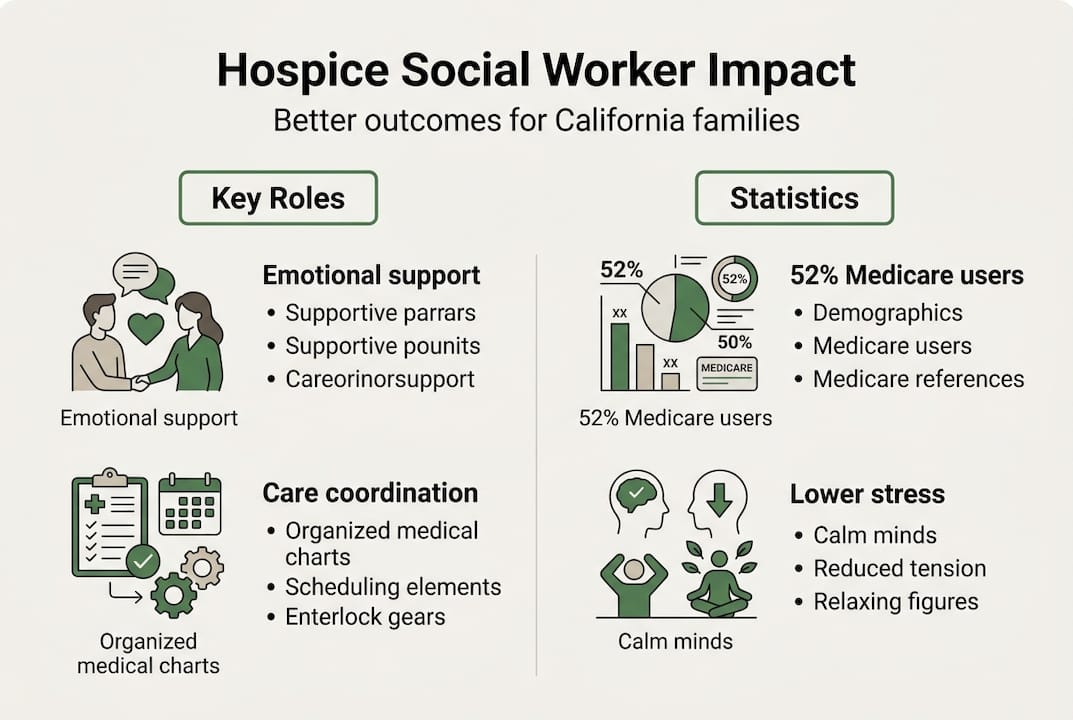
Statistic to know: Over 52% of Medicare decedents in 2024 used hospice care, and studies consistently link social worker involvement to lower depression and caregiver stress in those families.
Families should also know that hospice care standards in California set clear expectations for how social workers must practice. And the qualities of hospice staff that families value most, such as empathy, clear communication, and cultural awareness, are exactly what advanced training is designed to build.
Pro Tip: When meeting your hospice social worker for the first time, ask whether they hold a CHP-SW certification. This credential means they have gone beyond the baseline and have specialized training in the unique challenges of end-of-life care.
Navigating complex family and care challenges with social worker support
Beyond the routine, some hospice experiences require special creativity and skill. Life is rarely simple, and neither are the situations hospice social workers navigate every day.
Some of the most common complex challenges include:
- Caregiver burnout: A family member who has been providing care for months may be emotionally and physically exhausted. Social workers identify burnout early and connect caregivers to respite care and community support.
- Family conflicts: Disagreements about treatment decisions, visitation, or end-of-life wishes can fracture families at the worst possible time. Social workers facilitate conversations and help families find common ground.
- Cultural and religious considerations: Care that does not align with a family’s values can feel disrespectful. Social workers ensure that cultural practices and religious beliefs are woven into the care plan.
- Non-cancer diagnoses: Patients with heart failure, dementia, or other conditions may have different trajectories and needs. Social workers adapt their approach accordingly.
- Rural access disparities: Families in less populated parts of California may have fewer local resources. Social workers actively advocate and problem-solve to bridge these gaps.
The CHP-SW certification specifically prepares social workers for these advanced and complex cases. It is a meaningful distinction that families in difficult situations should look for.
“In the most challenging cases, a skilled hospice social worker does not just solve problems. They help families feel seen, heard, and supported in ways that no other team member can replicate.”
If you are a caregiver feeling stretched thin, know that caregiver support in hospice is a real and available resource. Understanding the role of caregivers in hospice can also help you set boundaries and protect your own wellbeing while caring for someone you love. Research on bridging care disparities shows that advocacy from social workers meaningfully improves outcomes for underserved patients.
The hospice social worker’s place in the care team
Finally, how does the social worker fit with the broader hospice team? The answer is that they are not a supporting character. They are central to how the whole team functions.
Social workers are an integral part of the Interdisciplinary Group (IDG), collaborating closely with every other professional on the team. Here is how that collaboration typically unfolds:
- Initial team meeting: The social worker shares findings from the psychosocial assessment, giving the physician and nurse a fuller picture of the patient’s home environment and family dynamics.
- Ongoing IDG meetings: The team reviews each patient’s care plan regularly. The social worker flags emotional or logistical concerns that may affect medical decisions.
- Communication coordination: When a family has questions or concerns, the social worker often serves as the first point of contact, then relays information to the appropriate team member.
- Chaplain collaboration: Social workers and chaplains work closely together, especially when spiritual distress is intertwined with emotional suffering. Each brings a distinct perspective that strengthens the overall response.
- Discharge or transition planning: If a patient’s condition changes, the social worker helps coordinate transitions smoothly, ensuring families are never left without a clear next step.
This structure means that no concern falls through the cracks. Families can learn more about the hospice team workflow and what to expect from each visit. The hospice care team at a quality provider is designed so that every professional reinforces the others, creating a safety net of support around the patient and family.
Why families should make the most of hospice social worker support
Here is something we have seen time and again: families who treat the social worker as an optional extra miss out on one of the most powerful forms of support available to them. This is not a minor oversight. It can mean the difference between a family that feels guided and held through an impossible time, and one that feels alone.
Social worker support is proven to reduce family stress and improve outcomes for both patients and caregivers. The families who benefit most are those who engage early, ask questions freely, and bring their real concerns to the table, whether those concerns are emotional, cultural, financial, or relational.
Do not wait until there is a crisis. Bring up the tension between siblings now. Mention that your cultural traditions matter. Ask about financial assistance before you are overwhelmed. Your social worker is not there to judge. They are there to help. An end-of-life care guide can also help you understand what questions to ask and when.
Get trusted hospice support in California
If you are seeking expert hospice guidance for your loved one in California, here is where to begin. At Graceland Hospice Care, our team includes skilled, certified social workers who are fully committed to supporting your family through every stage of this journey. We believe that compassionate care means addressing the whole person, not just the medical condition. Our social workers work alongside nurses, physicians, and chaplains to ensure nothing is missed and no family feels alone. Browse our resources for hospice families or contact us today for a free consultation. We are here to help you find the right path forward with dignity and care.
Frequently asked questions
Do hospice social workers help with legal paperwork or advance directives?
Yes, hospice social workers assist families with advance directives, power of attorney documents, and ensuring that the patient’s wishes are clearly documented and honored by the care team.
How long do hospice social workers provide support after a loved one passes?
In California, bereavement support continues for up to 13 months after the patient’s death through Medicare-certified hospices, giving families time and space to grieve with professional guidance.
Do rural families in California get the same access to hospice social worker services?
Rural families may face access barriers, but social workers actively work to bridge these disparities through advocacy, telehealth options, and connecting families to local community resources.
What qualifications must a California hospice social worker have?
They must hold a Master of Social Work degree, complete 3,000 supervised clinical hours, register as an ASW, and obtain full LCSW licensure with state-required coursework in areas like elder abuse and suicide risk.
Is a hospice social worker necessary if there is already a nurse or chaplain involved?
Absolutely. Social workers complement the IDG by addressing emotional, family, and logistical needs that fall outside the scope of medical or spiritual care, making the entire team more effective.