How to discuss hospice with your family: a guide

How to discuss hospice with your family: a guide
TL;DR:
- Talking openly about hospice care with a seriously ill loved one can bring relief, closeness, and shared purpose to families. Early and honest conversations prevent crises, clarify misconceptions, and help align care with patient values, ultimately providing comfort and dignity at the end of life. Proper preparation, compassionate communication, and ongoing support are essential for navigating this difficult yet vital dialogue.
Talking about hospice care with a seriously ill loved one ranks among the most emotionally difficult conversations a family can face. Many people delay the discussion out of fear — fear of causing pain, of seeming to give up, or simply not knowing what to say. Yet the families who find the courage to speak openly about end-of-life options often describe a sense of relief, closeness, and shared purpose they didn’t expect. This guide walks you through every stage of that conversation, from recognizing when the time is right, to preparing what to say, to following up with clarity and compassion.
Table of Contents
- When and why to bring up hospice care
- Key steps for preparing the hospice conversation
- How to have the hospice talk: step-by-step guidance
- What to do after the conversation: follow-up and ongoing support
- What most families get wrong about the hospice conversation
- How Graceland Hospice Care can support your family
- Frequently asked questions
Key Takeaways
| Point | Details |
|---|---|
| Start early | Discuss hospice options before a crisis to reduce stress and regret. |
| Focus on patient values | Keep conversations centered on the wishes and needs of your loved one. |
| Use clear language | Distinguish hospice from palliative care to avoid confusion. |
| Seek support | Involve professionals like social workers to guide family discussions. |
| Follow up | Clarify next steps and stay connected with resources after the conversation. |
When and why to bring up hospice care
To understand how to begin, we must first clarify when and why the hospice conversation should happen.
One of the most persistent challenges families face is confusion about what hospice actually is. Many people believe it means giving up, when in fact it means shifting the goal of care from curing an illness to managing comfort, dignity, and quality of life. Understanding hospice care helps families see it as an affirmative choice, not a last resort.
It’s also important to distinguish hospice from palliative care, since people often use the two terms interchangeably. As noted by end-of-life care experts, using the correct terminology matters because the two services differ in eligibility, timing, and the model of support provided. Palliative care can begin at any stage of a serious illness and can run alongside curative treatments. Hospice care, by contrast, is typically available when a physician estimates that a patient has six months or less to live if the illness follows its expected course, and the patient has chosen to stop pursuing curative treatment.
Signs that the time may be right
Recognizing when to start the conversation is not always obvious. Here are common situations that signal the dialogue should begin:
- A physician has recommended hospice or indicated that curative treatment is no longer working
- The patient is experiencing frequent hospitalizations with little improvement
- Daily functioning is declining significantly, such as difficulty eating, walking, or communicating
- The patient has expressed a desire to stop aggressive treatment
- The family is struggling to manage care at home without professional support
- Watching for signs it might be time for a higher level of care can also prompt the conversation
| Situation | Hospice relevance |
|---|---|
| Terminal diagnosis with 6-month prognosis | Primary eligibility window |
| Repeated hospital stays with little improvement | Strong indicator to begin discussion |
| Patient expresses desire for comfort-focused care | Immediate conversation needed |
| Family caregiver burnout or overwhelm | Time to explore professional support options |
| Pain no longer controlled by current treatment | Hospice symptom management may help |
“The conversations that happen early — before a crisis — are the ones that bring the most peace. Families who talk openly about care goals report less regret and greater satisfaction with the final months of their loved one’s life.”
Waiting for a medical crisis to force the conversation is one of the most common and painful mistakes families make. Early, honest dialogue gives everyone time to process their feelings and make thoughtful decisions together.
Key steps for preparing the hospice conversation
Once you recognize the need to discuss hospice, prepare the foundation for a supportive and productive conversation.

Preparation is what separates a chaotic, emotionally charged argument from a meaningful family discussion. Before anyone sits down together, there are several important steps to take.
How to prepare effectively
- Gather medical information first. Speak with the patient’s physician to understand the diagnosis, prognosis, and what hospice eligibility looks like. Bring a list of questions so nothing important is missed.
- Consult with the care team. Nurses, social workers, and case managers are invaluable resources. They have often had these conversations before and can guide you on language and timing.
- Decide who should be in the room. Not every family member needs to attend every meeting. Prioritize those who are most involved in daily care and decision-making. Think about who the patient trusts most.
- Consider a neutral facilitator. A social worker or hospital chaplain can help keep the conversation focused and prevent it from being derailed by strong emotions or competing opinions. As guidance for families on difficult conversations advises, structured family meetings with a neutral facilitator are far more productive than informal, unplanned discussions.
- Set ground rules before the meeting. Agree that the conversation will focus on what the patient values, not what each family member prefers. Remind everyone that the goal is to support their loved one, not to win an argument.
- Think about location and timing. Choose a quiet, private setting with enough time that no one feels rushed. Avoid scheduling the meeting just before or after a medical procedure.
Understanding how to improve family dynamics during caregiving transitions can also provide helpful context as you prepare to bring family members together.
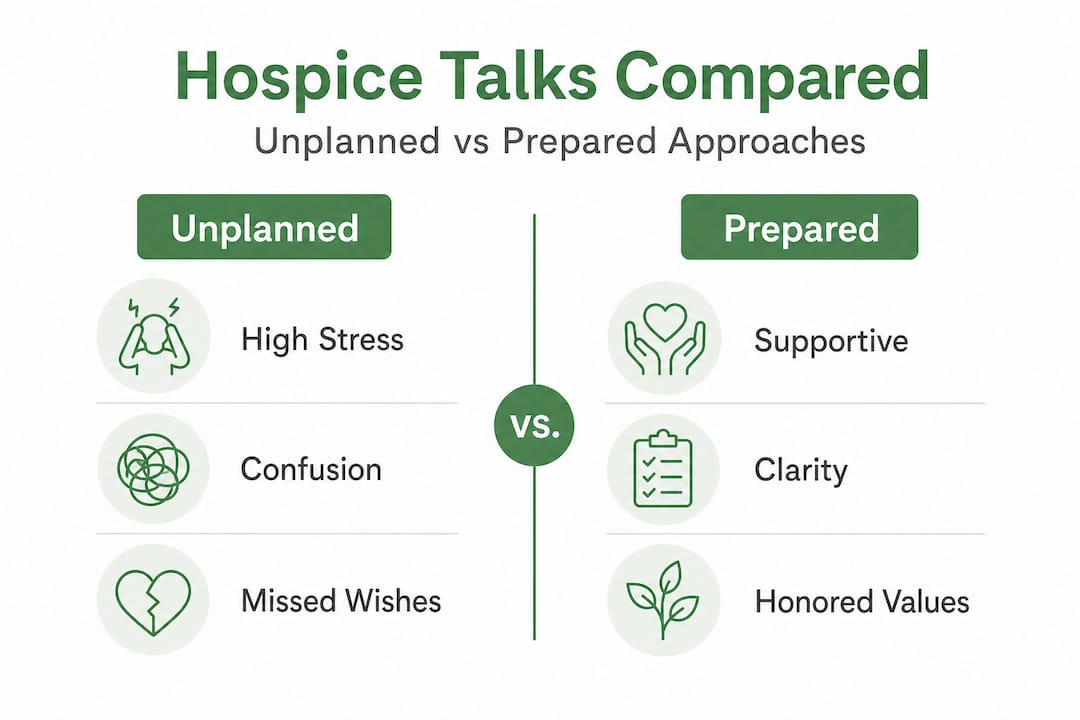
Comparing unplanned vs. prepared conversations
| Factor | Unplanned conversation | Prepared conversation |
|---|---|---|
| Emotional atmosphere | Reactive, high stress | Calmer, more focused |
| Outcome quality | Often unresolved | Clearer decisions |
| Patient’s wishes honored | May be overlooked | Central to the discussion |
| Family conflict risk | Higher | Significantly reduced |
| Follow-up clarity | Unclear | Well defined |
Pro Tip: Write down three things the patient has said about their values, wishes, or fears. Bring these notes to the family meeting and reference them directly. It keeps the conversation grounded in what matters most.
How to have the hospice talk: step-by-step guidance
Solid preparation leads to a smoother conversation. Here’s how to conduct the hospice discussion itself.
Even the most prepared family can feel uncertain once the conversation begins. The following steps can help you navigate it with compassion and clarity.
- Check in with the patient first. Before gathering the family, ask your loved one how they are feeling about their care and what they want from their final chapter. Their words should guide the entire meeting.
- Open with empathy, not information. Start by acknowledging how hard the situation is for everyone. Something as simple as “We love you and we want to make sure you’re comfortable and cared for” sets a tone of support rather than urgency.
- Introduce hospice clearly and accurately. Use plain language. Explain that hospice is a specialized team, including doctors, nurses, social workers, and chaplains, who focus entirely on comfort. Clarify that choosing hospice does not mean “giving up.” As end-of-life care resources emphasize, using accurate language prevents misunderstandings about eligibility and what the transition actually involves.
- Ask open questions and listen. Encourage the patient and family members to share their concerns. “What worries you most about this?” or “What does a good day look like for you right now?” opens dialogue rather than closing it.
- Address objections with facts and empathy. Common fears include concerns that hospice hastens death (research shows it does not), that the patient will be alone (hospice teams provide around-the-clock support), or that it’s permanent (patients can leave hospice if they choose curative treatment again).
- Keep returning to patient values. When emotions run high, bring the focus back to what the patient has said they want. Strong hospice communication strategies consistently emphasize this approach to prevent derailment.
- End with clear next steps. Before the meeting closes, summarize what was decided, what questions remain, and who will follow up on specific tasks.
Common objections and compassionate responses:
- “This feels like giving up.” Hospice chooses comfort and dignity over procedures that no longer help. It’s a different kind of fighting.
- “What if they get better?” Hospice is not permanent. Patients can return to curative treatment if their condition improves.
- “I’m not ready.” Your feelings are valid. Hospice can be discussed now and decided later. Having the information is not the same as making a final decision.
- “What about [family member] who disagrees?” Choosing care with confidence means staying anchored to what the patient wants, with professional help if needed.
“The most important voice in this conversation is the patient’s. Everything else — family history, personal fears, differing opinions — should come second to what your loved one is telling you they need.”
Pro Tip: If the conversation becomes heated, it’s okay to pause. Say, “Let’s take a short break and come back to this in a few minutes.” Stepping away briefly is far better than saying something that creates lasting hurt.
What to do after the conversation: follow-up and ongoing support
A good follow-up plan ensures clarity, unity, and needed support after the key conversation.
The initial hospice discussion is rarely the last one. Families often need time to absorb what was said, ask new questions, and adjust emotionally. A thoughtful follow-up plan makes all the difference.
Steps for effective follow-up
- Recap decisions in writing. Within 24 hours, send a brief summary of what was agreed upon to all participants. This reduces misunderstandings and gives everyone a shared reference point.
- Identify unresolved questions. Make a list of anything that wasn’t fully addressed and assign someone to follow up with the care team. No question is too small.
- Connect with a hospice provider. If hospice care is being seriously considered, schedule a consultation. Providers will explain exactly what services are available and what the enrollment process involves.
- Use caregiver support resources actively. Caregivers often neglect their own emotional needs during this period. Support groups, counselors, and online communities can offer significant relief.
- Plan follow-up conversations. One meeting is rarely enough. Check in with the patient and each other regularly. Feelings and circumstances change.
- Explore hospice at home options. Many families are surprised to learn that hospice can be provided wherever the patient calls home, including private residences, nursing facilities, and assisted living communities.
- Lean on bereavement and emotional support services. Grief doesn’t start at death. Many hospice programs offer counseling support for families throughout the care journey and beyond.
As senior placement guidance for families illustrates, navigating care transitions is a process that benefits from professional guidance at every step.
| Support resource | What it offers |
|---|---|
| Hospice social worker | Practical planning, emotional support, family mediation |
| Chaplain or spiritual counselor | Spiritual comfort, meaning-making support |
| Bereavement counselor | Grief support during and after the care journey |
| Caregiver support group | Shared experience, practical tips from peers |
| Hospice care information | Educational resources for patients and families |
Pro Tip: Keep a small notebook or digital note specifically for hospice-related questions as they come up between family conversations. Bringing these to your next meeting with the care team ensures nothing is forgotten.
What most families get wrong about the hospice conversation
One thing we have observed again and again is that families approach the hospice conversation as a single, definitive event — something that needs to be resolved in one sitting. That framing puts enormous pressure on everyone involved and often leads to avoidance.
The truth is that this is a series of conversations, not one. The first talk might simply be about values and fears. The second might address specific care options. A third might involve the formal steps of enrolling in hospice services. When families give themselves permission to take it in stages, the emotional load becomes far more manageable.
Another common mistake is allowing the loudest voice in the room to speak for the patient. Family members carry their own grief, their own histories, and their own beliefs about death and dying. Those feelings are real and deserve acknowledgment. But they cannot override what why hospice matters to the person who is actually living through this illness.
We have seen families wait so long to have this conversation that it never happens at all — the patient is unable to speak for themselves by the time hospice is considered, and the family is left making decisions in a crisis without any sense of what their loved one truly wanted. That outcome creates lasting regret. The families who avoid that outcome are not braver than others. They simply start talking sooner, with whatever imperfect words they have.
How Graceland Hospice Care can support your family
If you’re ready to take the next steps or want more personalized guidance, Graceland can help.
At Graceland Hospice Care, we understand that knowing what to say is only part of the challenge. Many families also need a compassionate partner who can walk alongside them through this process. Our care teams, which include experienced nurses, social workers, physicians, chaplains, and counselors, are specifically trained to support families at every stage of the hospice journey, including the initial conversation.
We provide family education meetings, one-on-one consultations, and a full range of hospice care services designed to ensure that every eligible patient receives the comfort and dignity they deserve. You can also hear directly from those we’ve served through family experiences shared on our website. You are not alone in this, and you don’t have to figure it out without support. Please contact us today for a free consultation.
Frequently asked questions
What’s the difference between hospice care and palliative care?
Hospice care is for those nearing the end of life who are no longer seeking curative treatments, while palliative care can be offered alongside curative treatments at any illness stage. As end-of-life care guidance notes, using the correct term helps families understand eligibility and what type of support they will receive.
How do I know when it’s time to talk about hospice?
Consider starting the conversation when the patient’s condition is declining, curative treatments are no longer effective, or a physician has raised the possibility. Referring to end-of-life care information can help families understand eligibility criteria more clearly.
What if family members disagree about hospice care?
Use a structured family meeting, keep the focus on the patient’s stated values and wishes, and consider involving a neutral facilitator such as a social worker to help guide the discussion toward consensus.
Should children or teens be included in the hospice conversation?
It depends on their maturity and the nature of their relationship with the patient, but honest, age-appropriate dialogue generally helps children process grief more effectively and feel respected and included.
What support resources are available for families after choosing hospice?
Hospice teams, social workers, chaplains, bereavement counselors, and caregiver support groups all offer meaningful emotional and practical support throughout the care journey and beyond.
Recommended
- Understanding Hospice Care: A Guide for Families | Graceland Hospice Care Blog
- How hospice honors wishes in California: A complete guide | Graceland Hospice Care Blog
- Understanding Hospice Care Levels: A Guide for California Families | Graceland Hospice Care Blog
- Hospice communication strategies for California caregivers