Hospice Coverage in California: What Families Need to Know

Hospice Coverage in California: What Families Need to Know
TL;DR:
- California’s hospice landscape in 2026 has seen significant upheaval due to widespread license revocations and investigations, affecting access and coverage. Families must understand eligibility, documentation, and recent regulatory changes to ensure proper care and avoid unexpected costs. Choosing a compliant, transparent provider is crucial for receiving quality end-of-life support amid evolving oversight and billing requirements.
California’s hospice landscape shifted dramatically in 2026, and families navigating end-of-life care decisions need to understand exactly what that means for coverage and access. Since Governor Newsom’s hospice moratorium, over 280 hospice licenses have been revoked in California, with hundreds more providers under active investigation. In this environment, misunderstanding even one coverage detail can mean denied services, unexpected bills, or real distress for your family during an already difficult time. This guide walks you through everything you need to know about California hospice coverage in 2026, from eligibility basics to the newest regulatory changes.
Table of Contents
- How hospice coverage works in California in 2026
- The coverage journey: Election, benefit periods, and documentation
- What’s covered—and what’s not—in California hospice care
- Recent updates: Oversight, provider requirements, and payment changes for 2026
- What most families miss when navigating hospice coverage
- Next steps: Find trustworthy hospice support for your family
- Frequently asked questions
Key Takeaways
| Point | Details |
|---|---|
| Eligibility hinges on certification | Both Medicare and Medi-Cal require terminal illness certification and election for hospice care in California. |
| Documentation timing matters | Families should confirm their provider’s timely online documentation to avoid reimbursement or coverage issues. |
| Transparency is improving | CMS and California now require clearer documentation and oversight, but provider choices require diligence in 2026. |
| Know what’s covered | Clear distinctions between covered and non-covered services help prevent billing surprises and denials. |
| Ongoing updates impact care | Payment rates, oversight, and provider requirements in 2026 mean families benefit by staying current and informed. |
How hospice coverage works in California in 2026
With the urgent need for clarity in California’s oversight landscape, let’s break down exactly how hospice coverage works and who qualifies in 2026.
Hospice care in California is primarily funded through two programs: Medicare and Medi-Cal. Understanding which applies to your loved one is the first step, because the eligibility requirements and coverage details are not identical.
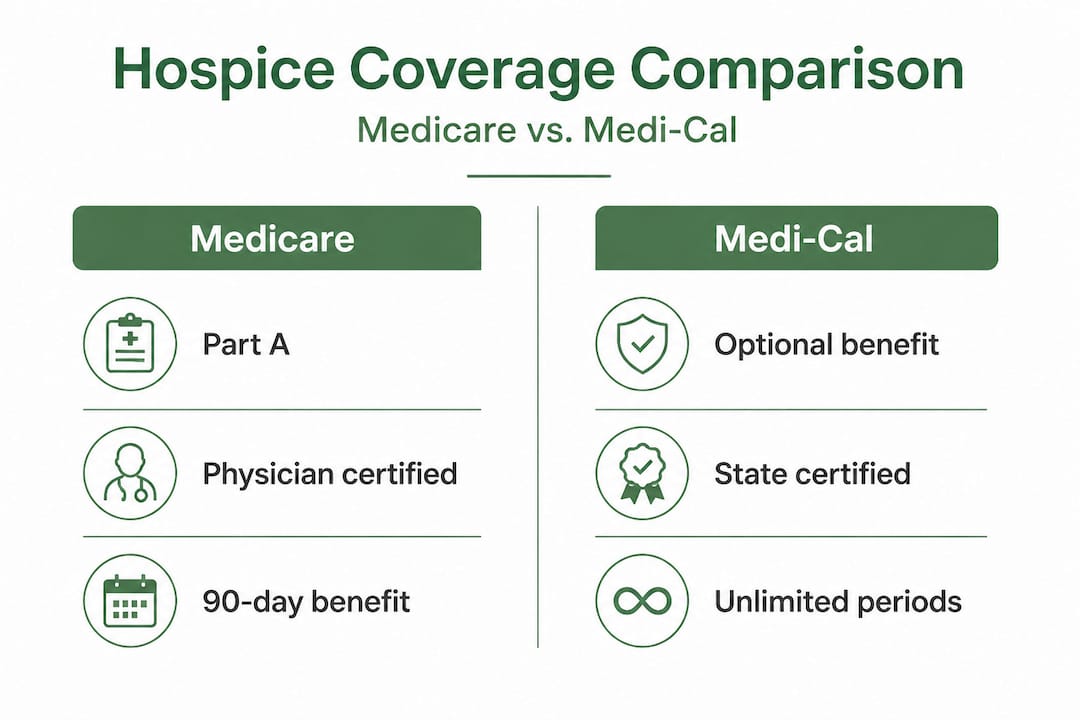
Medicare hospice coverage is available to anyone enrolled in Medicare Part A who has received a certification of terminal illness from a physician. The treating doctor and the hospice medical director must both certify that, if the illness follows its normal course, the patient has six months or less to live. Once that certification is in place, the patient must formally elect the hospice benefit, which means agreeing to receive comfort-focused care rather than curative treatment for the terminal condition.
Medi-Cal hospice coverage functions similarly. Medi-Cal covers hospice as an optional benefit for eligible recipients who elect hospice and are certified as having a life expectancy of six months or less. The practical difference is that Medi-Cal serves lower-income Californians who may not be enrolled in Medicare, though many patients qualify for both programs simultaneously. Understanding hospice costs in California under each program can help families plan without financial surprises.
Who qualifies and where care is provided
Both programs cover hospice care in a range of settings. Your loved one does not need to be in a hospital or nursing facility to receive benefits. Covered care settings typically include:
- Private home or family residence, which is the most common setting
- Assisted living facilities or residential care homes
- Skilled nursing facilities, when the patient resides there
- Inpatient hospice facilities, for short-term symptom management or respite care
- Hospitals, in situations requiring acute symptom control
The care setting matters to families because it directly shapes the daily experience of their loved one. Choosing the right setting is part of thoughtful end-of-life planning, and hospice providers should be able to guide you through the options.

| Feature | Medicare hospice | Medi-Cal hospice |
|---|---|---|
| Primary eligibility | Medicare Part A enrollment | Medi-Cal eligibility |
| Prognosis requirement | Six months or less | Six months or less |
| Election required | Yes | Yes |
| Dual enrollment possible | Yes (with Medi-Cal) | Yes (with Medicare) |
| Care settings covered | Home, inpatient, SNF, ALF | Home, inpatient, SNF, ALF |
Pro Tip: Start the enrollment process as early as possible. Physicians and hospice teams often have documentation backlogs, and delays in certification can push back the start of covered services by days or even weeks.
The coverage journey: Election, benefit periods, and documentation
Understanding eligibility sets the foundation, but how does the benefit actually unfold once you choose hospice? Let’s outline each step and what families should expect.
Choosing hospice is not a single phone call. It involves a defined series of steps, each with paperwork and timelines that families should track carefully. Missing or delayed documentation is one of the most common reasons that reimbursement issues arise, and those issues can eventually trickle down to the family in the form of unexpected charges.
Here is the sequence of events after a loved one decides to elect hospice:
- Physician certification: The attending physician and the hospice medical director certify terminal illness with a life expectancy of six months or less.
- Hospice election statement: The patient or legal representative signs a formal statement choosing to receive hospice care and waiving the right to curative treatment for the terminal condition.
- Provider enrollment verification: Confirm that your chosen hospice is enrolled as a Medi-Cal and/or Medicare-certified provider. Providers must be enrolled as Medi-Cal hospice providers and submit claims using the UB-04 form.
- Interdisciplinary care plan: The hospice team develops a personalized plan of care within 48 hours of admission.
- Ongoing documentation: The hospice provider submits ongoing clinical notes, recertification documents, and billing records on schedule.
Benefit period structure
One thing families are often surprised to learn is that hospice coverage does not expire after 90 days. Medi-Cal hospice coverage follows a structure of two initial 90-day periods followed by unlimited 60-day periods. Medicare follows the same general framework. At the start of each period, a physician must recertify that the patient still meets the terminal illness criteria.
| Benefit period | Duration | Recertification required |
|---|---|---|
| First period | 90 days | At start |
| Second period | 90 days | Yes |
| Subsequent periods | 60 days each | Yes, each period |
| Total duration | Unlimited | Yes, each renewal |
CMS has also moved to strengthen transparency in how patients understand what hospice does and does not cover. As the agency has noted:
“CMS proposes new transparency measures to strengthen oversight of hospice providers, including a hospice election statement addendum requirement to clarify covered and non-covered services.”
This addendum requirement means that, going forward, patients and families will receive a written summary of what their specific plan covers at the time of election. This is a significant patient protection. You can review common hospice questions for California families to prepare for those early conversations.
Pro Tip: Ask your hospice provider when they plan to submit recertification documents before each benefit period ends. A delay on their end does not pause your care, but it can create administrative complications that are stressful to untangle later.
What’s covered—and what’s not—in California hospice care
Now that you know the sequence of coverage, remember that not all care is included. Here is what you must clarify to prevent unexpected costs or treatment denials.
Hospice coverage is intentionally broad when it comes to comfort-focused services. The goal is to manage pain, maintain dignity, and support the whole family throughout the process. Under both Medicare and Medi-Cal, core covered services typically include:
- Nursing visits, including 24/7 on-call access for urgent needs
- Physician services related to the terminal condition
- Medications for pain relief and symptom management tied to the terminal illness
- Medical equipment and supplies, such as hospital beds, wheelchairs, and oxygen
- Home health aide and personal care services
- Social work services for counseling and practical family support
- Spiritual care and chaplain services
- Grief counseling and bereavement support for family members, even after the patient’s passing
- Short-term inpatient care for acute symptom episodes
- Respite care for family caregivers, typically up to five consecutive days
Where families sometimes run into difficulty is the boundary between what is covered under hospice and what remains available through standard Medicare or Medi-Cal. Hospice is intended for comfort and palliation, not curative treatment for the terminal condition. However, Medicare-covered services that are unrelated to the terminal illness may still be available outside of hospice.
This distinction matters enormously in practice. For example, if your loved one is in hospice for advanced heart failure but breaks a bone in an unrelated accident, treatment for that fracture may still be covered under regular Medicare. The challenge is that families rarely know to ask this question upfront.
“CMS is working to require hospice election statement addenda to improve clarity about which services are covered within hospice and which remain available outside of it.”
Families dealing with specific diagnoses should review what care looks like in practice. For instance, hospice care for cancer often involves nuanced decisions about which treatments shift from curative to comfort-focused. Exploring hospice provider options with an experienced team can help you match the right level of support to your loved one’s specific needs.
Pro Tip: Before your loved one’s first day in hospice, ask the provider to give you a written summary of covered versus excluded services. Most families assume coverage is straightforward and only discover the gaps when a bill arrives.
Recent updates: Oversight, provider requirements, and payment changes for 2026
Hospice coverage is not static. Important recent changes may directly impact your care decisions in 2026, and families need to be informed before they choose a provider.
California’s provider oversight crisis
The scale of provider problems in California’s hospice industry is extraordinary. The California Department of Public Health has revoked the licenses of more than 280 hospice providers in the past two years, with approximately 300 additional hospices currently being evaluated for revocation. Many of these cases involve billing fraud, failure to provide required services, or inadequate staffing.
For families, this creates a real and immediate risk. Choosing a provider that is under investigation or loses its license mid-enrollment can disrupt care and complicate coverage reimbursement. Here is how to verify a provider before you commit:
- Check the California Department of Public Health’s hospice care standards and licensure database
- Ask the provider directly whether they have received any CDPH notices or sanctions in the past 24 months
- Confirm that the provider is enrolled and in good standing with both Medicare and Medi-Cal
- Request documentation of the provider’s current online attestation compliance status
New online attestation requirement effective March 2026
Starting March 2, 2026, DHCS implemented a mandatory online attestation workflow for Medi-Cal hospice providers. This means every licensed Medi-Cal hospice must now complete a digital attestation process to remain eligible to bill for services. Providers who have not completed this process cannot submit compliant claims, which could interrupt payment and, indirectly, service availability.
Medicare payment rate changes for 2026
| Payment element | 2026 value |
|---|---|
| Hospice payment rate update | 2.6% increase |
| FY 2026 aggregate cap per provider | $35,361.44 |
The 2.6% rate increase helps providers cover rising staffing and supply costs. The aggregate payment cap of $35,361.44 per beneficiary per provider is the ceiling on what a single hospice can be reimbursed for any one patient in a benefit year. Providers who approach or exceed this cap may face incentives to manage care differently, which is important context for families choosing a provider with a full patient census.
What most families miss when navigating hospice coverage
Behind the new rules and provider lists, what actually trips up most California families? Here is the perspective you will not find in the official handbooks.
From our experience at Graceland Hospice, the single most common source of family stress is not the diagnosis or even the emotional weight of the journey. It is confusion about where covered hospice care ends and where standard medical care begins. Families often believe hospice coverage is a complete safety net, covering everything their loved one might need. In reality, coverage is defined by the terminal condition and related symptoms, and that boundary requires active clarification.
The Medi-Cal documentation requirements around certification and benefit periods are not bureaucratic red tape. They are the administrative backbone that determines whether a family faces out-of-pocket liability. When a provider misses a recertification deadline or submits a claim using incorrect procedure codes, the family may receive a bill that should have been covered. Most families do not know to ask whether their provider has a dedicated billing compliance team.
We also see families wait too long to ask the hard questions. The time to understand what is and is not covered is before care begins, not after a difficult conversation about a service the family assumed was included. Ask your potential provider about their documentation processes, their recertification scheduling practices, and their track record with CDPH compliance. These questions feel uncomfortable, but they protect your loved one.
Reviewing FAQs about hospice coverage before your first meeting with a provider gives you the vocabulary and confidence to ask those questions without feeling overwhelmed. Families who arrive informed get better, clearer answers.
The most meaningful thing we have learned is this: informed families are empowered families. The hospice benefit exists to provide comfort, dignity, and real relief during life’s final chapter. Understanding it fully is how you make sure your loved one actually receives all of it.
Next steps: Find trustworthy hospice support for your family
Armed with a clear understanding of coverage, benefit periods, and 2026 updates, the most important next step is choosing a provider you can trust completely.
At Graceland Hospice, we are committed to full compliance with California’s 2026 requirements, including the new Medi-Cal attestation workflow and CMS transparency measures. We believe every family deserves a provider who can explain coverage clearly, complete documentation on time, and deliver compassionate, consistent care. Our team is here to walk with you through every step, from your first eligibility question to ongoing support for your family. Visit our Graceland Hospice Care services page to learn about our approach, or explore our blog resources for deeper guidance. Contact us today for a free consultation and let us help your loved one receive the care they deserve.
Frequently asked questions
Who qualifies for hospice coverage under Medi-Cal or Medicare in California?
Eligibility generally requires a physician’s certification that the patient has six months or less to live and the patient’s formal election of hospice care, with Medi-Cal and Medicare each having their own enrollment requirements. Patients who qualify for both programs may receive coordinated coverage from both simultaneously.
What hospice services are considered ‘covered’ versus extra or out-of-pocket?
Covered services include pain management, nursing, medications related to the terminal illness, medical equipment, and bereavement support, but treatments unrelated to the terminal condition may fall outside the hospice benefit and require separate coverage. Always request a written breakdown of covered versus excluded services before enrollment begins.
How can I check if a California hospice provider is licensed and compliant in 2026?
Families should verify licensure through the California Department of Public Health and ask providers directly about their compliance status, given that over 280 licenses have already been revoked and hundreds more hospices are under active review. Confirming the provider’s Medi-Cal attestation status as of March 2026 is an important additional step.
Have there been payment rate changes or caps for hospice in 2026?
Yes, the Medicare hospice payment rate increased by 2.6% for fiscal year 2026, and the annual aggregate cap per provider is set at $35,361.44 per beneficiary. These figures help families understand the financial environment in which their chosen provider operates.
Recommended
- Are hospice costs covered? A California family’s guide | Graceland Hospice Care Blog
- Understanding Hospice Care Levels: A Guide for California Families | Graceland Hospice Care Blog
- Answers to common hospice questions: a California family guide | Graceland Hospice Care Blog
- End-of-Life Planning Guide: Hospice & Comfort Care at Home | Graceland Hospice Care Blog