Hospice care eligibility in California: A step-by-step guide

Hospice care eligibility in California: A step-by-step guide
TL;DR:
- California hospice eligibility requires a six-month terminal prognosis certified by two physicians.
- Families can revoke or re-elect hospice anytime, with no mandatory DNR order.
- Medi-Cal hospice in California offers no out-of-pocket costs and allows concurrent curative care for minors.
Many families in California assume their loved one must be days from passing to qualify for hospice care. That assumption causes real harm, because it leads to late referrals and missed weeks of comfort, support, and dignity. The truth is that hospice eligibility follows a clear, structured set of criteria that is both more precise and more accessible than most people realize. Whether your family member is covered by Medicare or Medi-Cal, understanding the real rules can help you act sooner and with greater confidence. This guide walks you through every step, from basic requirements to California-specific rules, so you can make informed decisions during one of life’s most tender chapters.
Table of Contents
- Understanding hospice care eligibility basics
- The step-by-step process: certifying a loved one for hospice
- Special eligibility scenarios and common conditions
- California-specific rules and what sets state eligibility apart
- Common challenges, revocation, and real-life exceptions
- Our perspective: The real impact of understanding hospice eligibility
- Find the right hospice care for your family in California
- Frequently asked questions
Key Takeaways
| Point | Details |
|---|---|
| Dual certification needed | Two physicians must confirm a terminal diagnosis with a life expectancy of six months or less for hospice eligibility. |
| Election of comfort care | Choosing hospice involves signing a statement for comfort-focused care, waiving curative treatment for the terminal illness. |
| Special state rules | California Medi-Cal follows federal rules but adds provider attestation and allows unique benefits for minors. |
| Options for revocation | Patients may revoke hospice, seek curative care, or change providers if circumstances or preferences shift. |
| Earlier is better | Timely eligibility and enrollment in hospice enhances quality of life for patients and families. |
Understanding hospice care eligibility basics
To provide the right foundation, let’s start with the basic rules that govern hospice eligibility.
Hospice care is a specialized form of medical support focused on comfort rather than cure. To qualify, a patient must meet several core requirements that apply across the country, including here in California. According to the Medicare Advocacy Quick Guide, hospice eligibility requires Medicare Part A entitlement and physician certification of a terminal illness with a life expectancy of six months or less if the disease runs its normal course.
Here are the foundational eligibility requirements at a glance:
- Medicare Part A enrollment: The patient must be enrolled in Medicare Part A, which covers inpatient hospital and skilled nursing care.
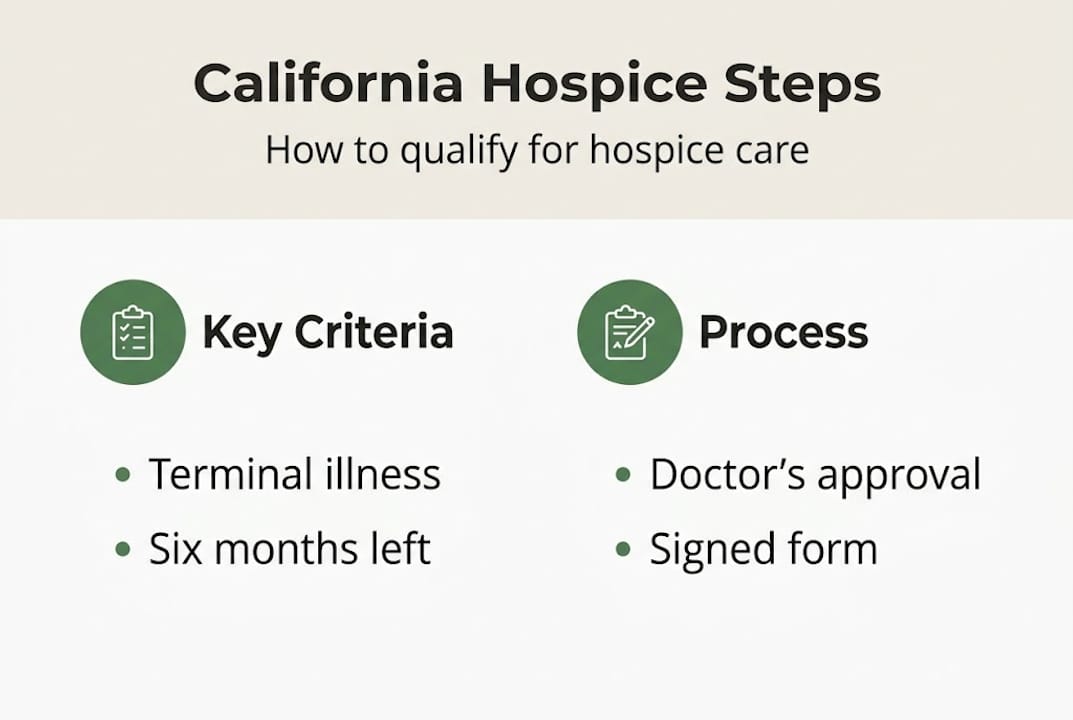
- Terminal diagnosis: A physician must certify that the patient has a life-limiting illness with a prognosis of six months or less.
- Two-physician certification: Both the patient’s attending physician and the hospice medical director must certify the terminal condition.
- Election of hospice benefit: The patient or their representative must formally choose hospice care, agreeing to focus on comfort rather than curative treatment.
For California families, Medi-Cal follows the same framework. The California DHCS confirms that any Medi-Cal recipient with a six-month prognosis may elect hospice, and the state aligns its rules closely with Medicare’s standards.
| Eligibility factor | Medicare requirement | Medi-Cal requirement |
|---|---|---|
| Insurance type | Medicare Part A | Medi-Cal enrollment |
| Prognosis | 6 months or less | 6 months or less |
| Physician certification | Two physicians required | Two physicians required |
| Care focus | Comfort over cure | Comfort over cure |
| Provider certification | Medicare-certified | State-certified and enrolled |
A meaningful statistic puts this into perspective: in 2024, 1.9 million Medicare beneficiaries used hospice care. That number reflects growing awareness, but also signals how many families are navigating this process every year. Understanding the caregiver roles in hospice can also help families prepare for what comes next once eligibility is confirmed.
The step-by-step process: certifying a loved one for hospice
With the criteria clarified, here’s exactly how the eligibility and certification process unfolds in real life.
The certification process may feel daunting at first, but it follows a logical sequence. Knowing each step helps families move forward with clarity instead of anxiety.
- Attending physician assessment: Your loved one’s primary doctor evaluates their current condition and determines whether a terminal prognosis of six months or less is appropriate.
- Hospice medical director review: A physician affiliated with the hospice provider independently reviews the case and co-certifies the terminal diagnosis.
- Election statement signed: The patient or their legal representative signs an election statement, formally choosing the hospice benefit and agreeing to prioritize comfort-focused care.
- Benefit period begins: The first benefit period lasts 90 days, followed by a second 90-day period. After that, care continues in 60-day periods as long as eligibility is maintained.
- Recertification and face-to-face visit: After 180 days of hospice care, a hospice physician or nurse practitioner must conduct an in-person visit with the patient. This face-to-face encounter is required before recertification can occur.
The Quick Guide to Hospice Coverage 2025 confirms that dual physician certification and a signed election statement are required, along with recertification and a face-to-face encounter after 180 days.
“Choosing hospice is not giving up. It is choosing a different kind of care, one that honors the whole person and supports the entire family.”
Pro Tip: Keep organized copies of all certification paperwork, election statements, and physician notes. When recertification time arrives, having this documentation ready makes the renewal process much smoother and reduces stress for everyone involved.
Special eligibility scenarios and common conditions
While the criteria are consistent, applying them to certain conditions can be complex.

Not every illness follows a predictable path, and some diagnoses require more nuanced documentation to establish hospice eligibility. Two of the most common and most misunderstood are dementia and heart failure.
For dementia, eligibility typically requires reaching stage 7 or higher on the Functional Assessment Staging Tool (FAST scale). At this stage, the patient is unable to walk independently, cannot speak more than six intelligible words per day, and shows signs of significant physical decline. For heart failure, the standard generally includes New York Heart Association (NYHA) Class IV status, an ejection fraction below 20 percent (meaning the heart pumps very little blood effectively), and the presence of multiple other health conditions. The eligibility benchmarks for dementia and heart failure confirm these specific clinical markers as key qualifying criteria.
| Diagnosis | Key eligibility markers |
|---|---|
| Dementia | FAST stage 7+, unable to ambulate, fewer than 6 spoken words per day |
| Heart failure | NYHA Class IV, ejection fraction under 20%, multiple comorbidities |
| Cancer | Metastatic or advanced stage, declining functional status |
| COPD | Severe airflow limitation, oxygen dependence, frequent hospitalizations |
| Stroke | Severe neurological deficits, inability to swallow, recurrent infections |
Understanding whether hospice is the right fit versus other options like hospice vs home health or palliative vs hospice care is an important distinction many families miss. For those facing a cancer diagnosis specifically, a dedicated cancer hospice guide can offer more tailored guidance.
Pro Tip: For non-cancer illnesses like dementia or heart failure, documented evidence of decline over time is critical. Keep a log of changes in function, weight, and symptoms. This record strengthens the case for eligibility and supports ongoing recertification.
California-specific rules and what sets state eligibility apart
Eligibility can also hinge on local requirements, which are particularly important for California families.
California’s Medi-Cal program mirrors Medicare hospice rules in most ways, but there are several state-specific features that families should know about.
- Provider attestation: Hospice providers in California must submit an online Hospice Program Attestation through the state system. This attestation must be completed within five days of the patient’s election date.
- No out-of-pocket costs: Unlike some other states, California’s Medi-Cal hospice benefit carries no copays for covered services. Families do not pay out of pocket for hospice care under Medi-Cal.
- Provider enrollment requirements: Hospice agencies must be both Medicare-certified and enrolled in Medi-Cal to serve patients under the state program.
- Concurrent care for minors: This is one of California’s most important distinctions. Children and young adults under age 21 who are enrolled in Medi-Cal can receive hospice and curative care simultaneously. They do not have to choose one or the other, which is a significant departure from adult hospice rules.
- Attestation timeline: The five-day attestation window is firm. Missing it can delay or disrupt coverage, so families should confirm their provider is completing this step promptly.
Families navigating Medi-Cal hospice in California benefit greatly from working with providers who understand both the state and federal layers of the process. Learning more about caregiver support in California can also help families prepare for the practical day-to-day realities of hospice at home.
Common challenges, revocation, and real-life exceptions
Even with a clear process, real life brings situations that don’t fit the standard mold.
One of the most common concerns families raise is this: what happens if a loved one changes their mind, or if their condition improves? The answer is more flexible than most people expect.
- Revocation is always an option: A patient can revoke the hospice benefit at any time and return to standard curative treatment. There is no penalty for doing so.
- Re-election is allowed: After revoking hospice, a patient can re-elect the benefit later if their condition warrants it. The process simply restarts.
- Changing providers: Patients can switch to a different hospice provider once per benefit period. This is important to know if a family feels the current provider is not meeting their needs.
- Living beyond six months: If a patient lives longer than expected, hospice care continues as long as the physician recertifies that the terminal prognosis still applies. Longevity alone does not disqualify someone.
- No DNR required: A common misconception is that choosing hospice means signing a Do Not Resuscitate order. That is not true. The California Medi-Cal manual confirms that patients can revoke and return to hospice and that a DNR is not a requirement for enrollment.
Families also sometimes face late referrals, which can limit the time available to benefit from hospice services. Understanding at-home hospice options early in the process, as well as knowing about emergency care and hospice, can help families avoid being caught off guard. Resources on end-of-life care choices and starting hospice care at home are valuable starting points.
Pro Tip: If you are unsure whether your loved one qualifies, ask the hospice provider to conduct a free eligibility assessment. Most reputable providers, including those certified in California, will do this at no cost.
Our perspective: The real impact of understanding hospice eligibility
It’s important to step back and see why all these details matter beyond the paperwork.
At Graceland Hospice, we have seen firsthand what happens when families receive clear information early versus when they receive it too late. The difference is not just logistical. It is deeply human. Families who understand hospice eligibility sooner are able to shift from crisis mode to intentional care. They spend less time managing paperwork and more time being present.
The CMS Hospice Monitoring Report 2025 notes that while utilization is high, late referrals remain common, and earlier hospice enrollment consistently improves quality of life. Cultural and systemic barriers also continue to affect uptake in many California communities, meaning some families never access the care their loved ones deserve.
We believe that eligibility confusion is one of the most preventable barriers to timely hospice care. When families know the real criteria, they advocate more effectively. They ask better questions. They act sooner. Reviewing hospice care standards in California is one way to build that foundation of knowledge before a crisis forces the decision.
Find the right hospice care for your family in California
When you’re ready to take the next step, support and expertise are available right here.
Navigating hospice eligibility is a process no family should face alone. At Graceland Hospice, we walk alongside California families every step of the way, from the first eligibility question to ongoing care and support. Our team is experienced in both Medicare and Medi-Cal hospice requirements, and we are committed to making sure every eligible patient receives the care and dignity they deserve. Explore our California hospice care services or browse our full list of services to learn more. Visit Graceland Hospice today and contact us for a free consultation.
Frequently asked questions
Who determines if someone is eligible for hospice care in California?
Two physicians must certify terminal illness and a life expectancy of six months or less for both Medicare and Medi-Cal hospice eligibility in California. The certifying physicians are the patient’s attending doctor and the hospice medical director.
Can you leave hospice care and return later?
Yes, patients can revoke hospice at any time and re-elect it later if their condition warrants it. They may also change hospice providers once per benefit period.
Does a hospice patient need a Do Not Resuscitate (DNR) order in California?
No, a DNR order is not required to enroll in hospice care in California. Patients may choose to complete a DNR, but it is entirely optional and not a condition of eligibility.
What if a patient lives longer than six months on hospice?
Hospice care can continue beyond six months with physician recertification every 60 days if the patient still meets terminal criteria. Living longer than expected does not end eligibility on its own.
Are there out-of-pocket costs for Medi-Cal hospice in California?
No, hospice under Medi-Cal in California does not require copays or out-of-pocket payments for covered services. This makes hospice accessible to families regardless of financial situation.
Recommended
- How to Start Hospice Care for Loved Ones at Home | Graceland Hospice Care Blog
- Emergency care in hospice: a guide for California families | Graceland Hospice Care Blog
- Understanding Hospice Care: A Guide for Families | Graceland Hospice Care Blog
- Role of Caregivers in Hospice – Making End-of-Life More Compassionate | Graceland Hospice Care Blog
- Why updating life insurance matters for California families - Jenkins Insurance Agency Inc.