A Compassionate Guide to Children and Hospice Care

A Compassionate Guide to Children and Hospice Care
TL;DR:
- Pediatric hospice offers personalized care that supports children alongside ongoing treatments.
- Families can access concurrent care, allowing medical treatment and hospice services simultaneously.
- Emotional, spiritual, and legacy-making support are integral to the holistic hospice approach.
Choosing hospice care for your child is one of the most emotionally complex decisions a parent can face. Many families hesitate because they believe hospice means abandoning hope or stopping the fight. That misconception keeps some children from receiving the comfort, dignity, and specialized support they deserve. The truth is that pediatric hospice is a deeply personalized, family-centered approach that can exist alongside treatment and provides far more than medical care. This guide walks you through what makes it unique, how to access it, and what holistic and ethical support looks like in practice.
Table of Contents
- What makes pediatric hospice care unique?
- Accessing hospice: Choosing timing, eligibility, and concurrent care
- Holistic approaches: Legacy-making, psychosocial, and spiritual support
- Navigating ethical dilemmas and family roles
- A personal perspective: What truly matters in pediatric hospice care
- Where to find compassionate pediatric hospice care
- Frequently asked questions
Key Takeaways
| Point | Details |
|---|---|
| Pediatric hospice is unique | Children’s hospice care adapts to developmental and emotional needs, not just medical symptoms. |
| Concurrent care is possible | Kids on Medicaid/CHIP can get both hospice and ongoing treatments at the same time. |
| Legacy and support matter | Emotional, spiritual, and legacy-making interventions are key parts of children’s hospice. |
| Ethics and culture influence care | Decisions about end-of-life reflect ethical, family, and cultural perspectives. |
| Help is available | Compassionate hospice providers guide families at every step of the journey. |
What makes pediatric hospice care unique?
Pediatric hospice is not simply adult hospice scaled down. The physical, emotional, and developmental realities of childhood create an entirely different caregiving landscape. As ethical complexities in pediatric hospice confirm, children are not merely small adults; developmental stages affect care needs and planning in ways that require specialized clinical and emotional expertise.
A child’s understanding of illness and death changes dramatically from toddlerhood through adolescence. A five-year-old may not grasp permanence the way a teenager does, and care plans must reflect that. Symptom management, communication strategies, and even medication dosing differ significantly across age groups.
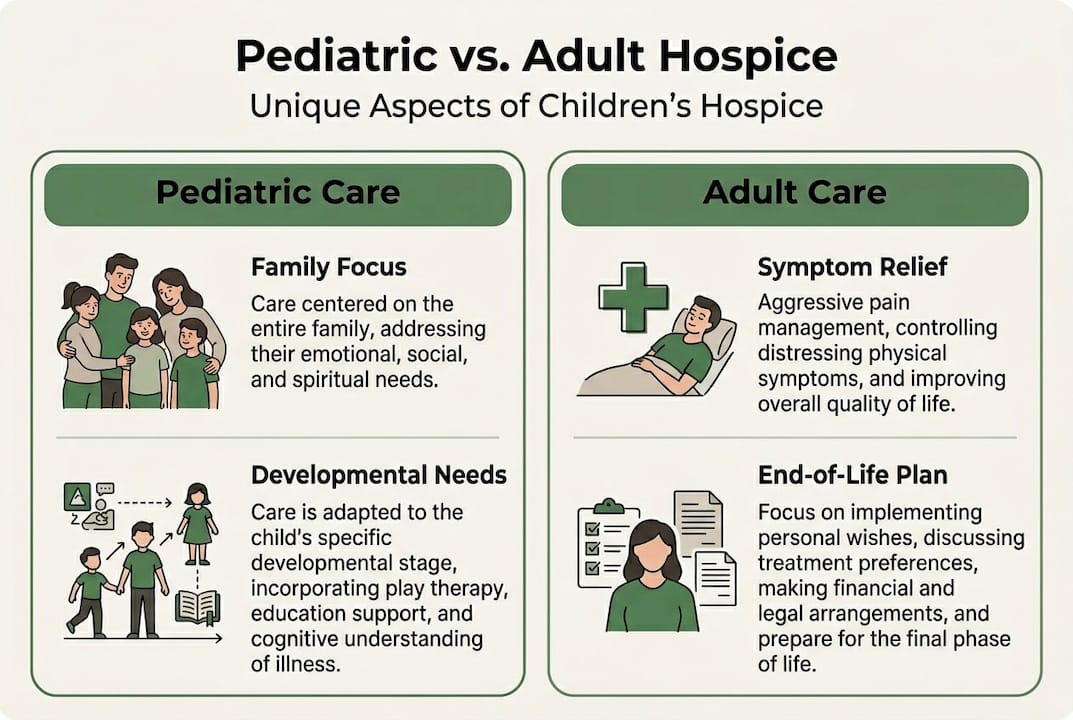
Families are not bystanders in pediatric hospice. They are active partners. The care relationship forms a triad: the physician, the child, and the parents or guardians. Each voice carries weight, and good teams work to honor all three while keeping the child’s comfort at the center.
Some common misconceptions worth addressing:
- Hospice means giving up on your child
- Hospice is only for the final days of life
- Children cannot participate in their own care decisions
- Hospice and curative treatment cannot coexist
None of these are true. Understanding the difference between hospice vs palliative care is a helpful starting point for families sorting through these questions.
Cultural and ethical values also shape how families engage with hospice. Some cultures prioritize collective family decision-making over individual patient autonomy. Others have specific beliefs about disclosing a terminal diagnosis to a child. Skilled pediatric hospice teams are trained to navigate these differences with sensitivity and without judgment.
“Children are not merely small adults; developmental stages affect care needs and planning.” This truth sits at the heart of every good pediatric hospice program.
| Feature | Adult hospice | Pediatric hospice |
|---|---|---|
| Eligibility age | Typically 18+ | Birth through young adulthood |
| Decision-making | Patient-centered | Triad: child, parent, physician |
| Developmental considerations | Minimal | Central to all care planning |
| Concurrent care option | Limited | Available under Medicaid/CHIP |
| Emotional support scope | Patient and family | Child, siblings, and extended family |
Accessing hospice: Choosing timing, eligibility, and concurrent care
One of the most practical questions families ask is: when is the right time? Clinicians often use what is called the “surprise question”: would you be surprised if this child did not survive the next six to twelve months? If the honest answer is no, it may be time to explore hospice.
Other signs that hospice conversations are appropriate include frequent hospitalizations, declining response to treatment, increasing pain or discomfort, and a shift in family goals toward quality of life over curative outcomes.
Eligibility basics:
To qualify for hospice, a child generally needs a physician-certified life-limiting diagnosis with a prognosis that aligns with hospice criteria. However, eligibility is evaluated individually, and families should not assume their child does or does not qualify without a proper assessment.
One of the most important developments in pediatric hospice is concurrent care, which allows hospice services alongside curative treatments for children under 21 on Medicaid or CHIP. This reduces unnecessary live discharges and means families do not have to choose between comfort and hope.
Pro Tip: Ask your child’s care team specifically about concurrent care eligibility. Many families are unaware this option exists, and it can significantly reduce the emotional burden of feeling forced to choose one path.
Here is a simplified look at typical cost considerations by age group:
| Age group | Primary coverage | Concurrent care available | Key cost notes |
|---|---|---|---|
| Under 21 (Medicaid/CHIP) | Medicaid or CHIP | Yes | Most services covered |
| Under 21 (private insurance) | Private plan | Varies by plan | Check plan specifics |
| Young adult (21+) | Medicare or private | Limited | Standard adult hospice rules apply |
To begin the process, follow these steps:
- Speak with your child’s primary physician or specialist about hospice eligibility
- Request a referral to a pediatric hospice program
- Schedule an intake assessment with the hospice team
- Review the care plan together, including concurrent care options
- Connect with caregiver support resources early, not just when you feel overwhelmed
Starting early gives your family more time to build relationships with the care team and make thoughtful decisions without crisis-driven pressure.
Holistic approaches: Legacy-making, psychosocial, and spiritual support
Medical care is only one part of what pediatric hospice offers. The emotional, psychological, and spiritual dimensions of this journey matter just as much, and often leave the most lasting impact on families.

Legacy-making is one of the most meaningful tools in pediatric hospice. These are intentional activities designed to capture a child’s presence, personality, and love in tangible ways. Legacy-making interventions such as hand and foot molds and photo projects improve quality of life, dignity, and coping for both children and their families.
Examples of legacy-making activities include:
- Hand and foot molds or casts
- Memory boxes filled with meaningful objects
- Recorded voice messages or video letters
- Art projects and painted canvases
- Celebration of life events while the child is still present
- Written or illustrated life story books
These are not just keepsakes. They are tools for healing, for siblings, for grandparents, and for the child themselves who often finds deep meaning in leaving something behind. Exploring legacy-making in hospice early gives families more options and less pressure.
Psychosocial support is equally essential. Psychosocial interventions and preloss care are emphasized in leading care guidelines, along with advance care planning that helps families articulate their wishes before a crisis forces the conversation. Families can also find additional tools through psychosocial oncology resources that support emotional well-being throughout the journey.
Pro Tip: Do not wait until grief arrives to seek bereavement support. Preloss counseling, which begins while your child is still alive, helps families process anticipatory grief and build resilience before the hardest moments.
Spiritual care is another pillar. Whether your family holds religious beliefs, spiritual practices, or neither, hospice chaplains and spiritual counselors are trained to meet you exactly where you are. Understanding the role of spiritual care in hospice can help families feel less alone in the questions that have no easy answers.
Navigating ethical dilemmas and family roles
Pediatric hospice often places families in situations that feel impossible. There is no rulebook for deciding when to shift from curative hope to comfort-focused care, and the emotional weight of that decision can feel crushing.
Ethical challenges arise frequently and take many forms:
- Disagreement between parents about the right course of action
- A child old enough to express preferences that differ from parental wishes
- Cultural beliefs that conflict with medical recommendations
- Questions about how much information to share with the child
- Disputes about resource allocation or access to experimental treatments
Cultural differences, parental latitude, and resource debates influence choices in pediatric hospice, and in rare cases the harm principle may be used for state intervention when a child’s wellbeing is at serious risk.
This is not a judgment on any family. It reflects how genuinely difficult these situations are, and why specialized pediatric hospice teams include ethicists, social workers, and counselors alongside medical staff.
“The goal is never to override a family’s love. It is to make sure that love is expressed in a way that protects the child’s dignity and comfort.”
Proactive communication is the best tool families have. Ask your care team to walk you through possible scenarios before they happen. Understand what decisions may arise and what your options are. This kind of preparation does not mean you are giving up. It means you are advocating.
Knowing what hospice services for families include and what palliative support at home looks like in practice can help you ask better questions and feel more in control during moments that feel anything but.
If you ever feel uncertain or unheard, it is completely appropriate to request a family meeting, ask for a second opinion, or seek guidance from a patient advocate.
A personal perspective: What truly matters in pediatric hospice care
After supporting many families through this journey, we have noticed something that guides and frameworks rarely capture: the most healing moments are almost never the clinical ones. They are the quiet ones. A parent reading a favorite book aloud. A sibling drawing a picture for the hospital wall. A child laughing at a silly movie surrounded by people who love them.
Conventional thinking tends to focus on decisions and timelines. But families often tell us that what they remember most is whether they felt seen and whether their child felt safe. Those two things matter more than any protocol.
We also believe that advocating for your family’s values is not selfish. It is the most important thing you can do. Every family is different. Every child is different. A care plan that honors who your child actually is, their personality, their fears, their joys, will always serve them better than a generic approach.
If you are feeling lost, know that asking for compassionate support at home is a sign of strength, not surrender.
Where to find compassionate pediatric hospice care
You do not have to navigate this alone. At Graceland Hospice, we specialize in providing compassionate, family-centered care that honors your child’s individuality and your family’s values. Our team is trained to support the full range of needs, medical, emotional, spiritual, and practical, so you can focus on being present.
We invite you to explore our Graceland Hospice Care services and review our complete care services to understand how we can support your family. Whether you have questions, need guidance, or are ready to begin, please contact us for a free consultation. You deserve answers, and your child deserves comfort.
Frequently asked questions
Can my child receive hospice and continue treatments?
Yes, concurrent care allows children under 21 on Medicaid or CHIP to receive both hospice services and ongoing curative treatments at the same time.
What kinds of legacy-making or emotional support are offered?
Legacy-making interventions like hand molds and photo projects, along with emotional and spiritual counseling, help children and families find meaning, comfort, and connection throughout the hospice journey.
How do I start the hospice process for my child?
Begin by speaking with your child’s physician; a hospice referral can be initiated when a life-limiting diagnosis makes comfort and quality of life the primary goal.
What ethical issues might arise in pediatric hospice care?
Ethical complexities can include balancing curative hope with comfort, navigating cultural differences in disclosure and decision-making, and understanding the boundaries of parental authority in care choices.
Recommended
- End of Life Care Guide for Compassionate At-Home Support | Graceland Hospice Care Blog
- Understanding Hospice Care: A Guide for Families | Graceland Hospice Care Blog
- Role of Caregivers in Hospice – Making End-of-Life More Compassionate | Graceland Hospice Care Blog
- Hospice vs Home Health – Choosing Compassionate Care | Graceland Hospice Care Blog
- Helping Elderly Parents Downsize | A New Englander’s Guide to Compassionate Moves