Why choose hospice care at home? Benefits & support

Why choose hospice care at home? Benefits & support
TL;DR:
- Hospice focuses on comfort and dignity, not giving up on loved ones’ hope.
- Qualified patients receive personalized, team-based care at home, supported by coverage options like Medi-Cal.
- Families benefit from emotional support, symptom management, and the flexibility to revoke or extend care.
Many families believe that choosing hospice means giving up on their loved one. That belief is one of the most painful and persistent misconceptions in end-of-life care, and it keeps families from accessing support they truly need. Hospice is not about abandoning hope. It is about redirecting care toward comfort, dignity, and meaningful time together. Whether your loved one has a serious illness or a life-limiting condition, understanding what hospice at home really offers can change everything. This article walks you through the facts, the benefits, the costs, and the common fears, so you can make a confident, loving decision.
Table of Contents
- What is hospice care and who qualifies?
- How hospice at home supports families and loved ones
- What hospice care covers and how costs work in California
- Hospice myths vs. realities: What families need to know
- A fresh perspective: Why choosing hospice is an act of strength
- Ready to talk? Hospice support is available
- Frequently asked questions
Key Takeaways
| Point | Details |
|---|---|
| Hospice is quality-focused | Choosing hospice supports comfort and dignity, not just end-of-life care. |
| Home hospice empowers families | At-home hospice brings support, guidance, and relief to both patients and loved ones. |
| Costs are largely covered | Medicare and Medi-Cal cover most expenses for qualified patients in California. |
| Misconceptions can delay help | Understanding hospice reality leads to better decisions and timely support. |
What is hospice care and who qualifies?
Hospice care is a specialized form of support designed for people with a serious illness and a life expectancy of six months or less, as certified by a physician. But here is what many families do not realize: the definition of hospice care is far broader than most people assume. It is not a single moment or a final-days service. It is an ongoing philosophy of care that prioritizes quality of life over aggressive treatment.
In California, qualifying for hospice involves a physician’s prognosis confirming that the illness is terminal if it follows its natural course. Once enrolled, patients receive regular care and can be recertified to continue receiving services if their condition persists. This means hospice is not a one-time decision with no exit. Families have flexibility.
Here are some key eligibility facts that may surprise you:
- Patients can revoke hospice at any time and return to standard medical treatment if their condition improves or they change their mind.
- Recertification is available after the initial benefit periods, allowing continued care beyond six months when the prognosis still applies.
- Children under 21 in California can receive both curative and hospice care at the same time, a critical distinction from adult hospice rules.
- Medi-Cal covers hospice coinsurance, meaning most California families with Medi-Cal pay little to nothing out of pocket for home hospice services.
- Patients who improve enough to no longer meet the criteria can graduate from hospice and return if needed later.
Pro Tip: After the initial 90-day benefit periods, a face-to-face encounter with a hospice physician or nurse practitioner is required before recertification. Schedule this proactively so care is never interrupted.
“Choosing hospice is not the end of the road. For many families, it is the beginning of a more peaceful, supported journey through life’s final chapter.”
For a deeper look at the process, understanding hospice care can help you and your family feel more prepared before speaking with a physician. You can also review California Medi-Cal hospice coverage directly to understand your financial options.
How hospice at home supports families and loved ones
With a clear understanding of who qualifies for hospice, let’s look at how hospice at home transforms care for everyone involved. One of the most powerful aspects of home hospice is that it brings a full care team directly to your loved one, in the place where they feel safest and most comfortable.
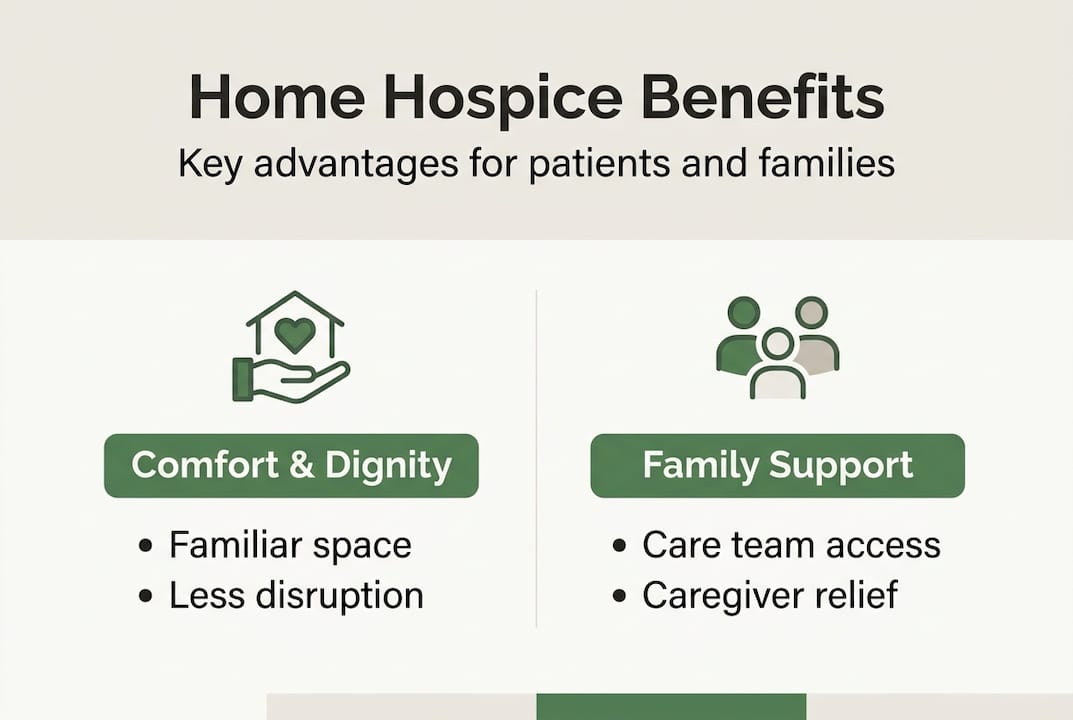
The hospice team is not just one nurse. It is a coordinated group of professionals who work together to address every dimension of your loved one’s needs. As hospice teams provide medical, emotional, and spiritual support, they coordinate services across disciplines so nothing falls through the cracks.
Here is what that team typically includes:
- Registered nurses who visit regularly to monitor symptoms, manage pain, and adjust care plans
- Social workers who help families navigate paperwork, benefits, and emotional challenges
- Chaplains or spiritual counselors who offer comfort aligned with the patient’s beliefs
- Home health aides who assist with bathing, grooming, and daily personal care
- Trained volunteers who provide companionship and give family caregivers a much-needed break
- Bereavement counselors who support the family before and after loss
One of the greatest gifts of home hospice is the reduction in unnecessary hospital visits. When pain and symptoms are managed proactively at home, your loved one stays comfortable and surrounded by family rather than in a clinical setting. That matters deeply, both emotionally and physically.
“Families who choose home hospice consistently report feeling less overwhelmed and more present with their loved one during this time.”
Pro Tip: Ask your hospice provider about 24/7 on-call nurse access. Knowing someone is available at 2 a.m. when symptoms spike can bring enormous peace of mind to family caregivers.
To understand why hospice at home matters for the whole family, and to explore caregiver support in hospice, you will find that the support extends well beyond the patient. Families also benefit from compassionate end-of-life support that helps them process grief while their loved one is still present.
What hospice care covers and how costs work in California
Having seen how hospice at home uplifts families, you may wonder, “What will it actually cover, and what will this cost?” The answer, for most California families, is reassuring.
Hospice at home typically covers a wide range of services under Medicare and Medi-Cal. Here is a comparison of what each payer covers:
| Service | Medicare | Medi-Cal | Private insurance |
|---|---|---|---|
| Skilled nursing visits | Yes | Yes | Varies |
| Medications for comfort | Yes | Yes | Varies |
| Medical equipment (hospital bed, wheelchair) | Yes | Yes | Varies |
| Social work and counseling | Yes | Yes | Varies |
| Spiritual care | Yes | Yes | Rarely |
| Bereavement support | Yes | Yes | Rarely |
| Respite care (short-term inpatient relief) | Yes | Yes | Varies |
For most families, Medi-Cal covers hospice coinsurance and the majority of associated costs, including revocation and recertification scenarios. This means that if your loved one’s condition improves and they graduate from hospice, the transition back to standard care is supported without a financial penalty.
Here are additional services included at no extra cost under most hospice benefits:
- Bereavement counseling for up to 13 months after the patient’s passing
- Spiritual care tailored to the patient’s personal beliefs
- Volunteer support for companionship and caregiver relief
- Medications directly related to the terminal diagnosis
For children under 21 in California, the rules are especially supportive. Curative treatment can continue alongside hospice services, meaning families do not have to choose one or the other. You can explore hospice service examples to see exactly what a care plan might look like in practice. For a full breakdown of benefits, visit Medi-Cal hospice benefits directly.
Hospice myths vs. realities: What families need to know
Even with facts in hand, misconceptions about hospice can hold families back. Let’s tackle these head-on.
| Myth | Reality |
|---|---|
| Hospice means giving up | Hospice prioritizes quality of life and dignity, not defeat |
| It’s only for the last few days | Patients can enroll for six months or longer with recertification |
| We lose control of decisions | Families remain central to all care decisions throughout |
| It’s too expensive | Medi-Cal and Medicare cover most or all costs for eligible patients |
| You can’t change your mind | Hospice can be revoked at any time without penalty |
Understanding the difference between hospice vs palliative care also helps families make informed decisions without confusion. Many families discover that common hospice myths have been the only thing standing between them and meaningful support.
Here are practical steps to start the conversation with your family and care team:
- Talk openly with your loved one about their wishes for comfort and quality of life.
- Speak with the primary physician and ask directly whether hospice eligibility applies.
- Request a hospice consultation from a licensed provider, which is typically free and carries no obligation.
- Review the financial coverage through Medi-Cal or Medicare before making any decisions.
- Involve the whole family so everyone understands what hospice does and does not mean.
The reality is that hospice can begin earlier than most families realize. Continued eligibility depends on the patient’s evolving condition, not a fixed deadline. And if health improves, returning to standard care is always an option. Choosing hospice does not close any doors. It opens new ones, toward comfort, presence, and peace. You can also find more information about eligibility and coverage at Medi-Cal hospice facts.
A fresh perspective: Why choosing hospice is an act of strength
Here is something that families rarely hear: most families who choose hospice say they wish they had started sooner. Not because care was lacking before, but because the support, the relief, and the quality of time together were so much greater once hospice began.
There is a quiet courage in choosing comfort over intervention. It takes strength to say, “I want my loved one to feel safe, loved, and free from pain.” That is not giving up. That is one of the most loving decisions a family can make.
The advantages for caregivers are also significant and often underestimated. Caregivers who have hospice support report less burnout, less isolation, and more meaningful moments with their loved one. That is not a small thing.

Pro Tip: The sooner supportive care begins, the more time your family has to simply be present, rather than managing logistics alone.
More California families are choosing home hospice earlier because they understand that hospice aligns care with family goals, not just clinical measurements. When care reflects what your loved one truly values, the experience of this time changes completely.
Ready to talk? Hospice support is available
If this article has helped you see hospice in a new light, you are not alone. Many families come to us with questions, fears, and a deep love for someone they want to protect. At Graceland Hospice Care, we are here to walk alongside you, not to rush any decision, but to make sure you have the information and support you deserve.
Explore our hospice services in California to understand what a personalized care plan looks like, or reach out to our team for a free consultation. Families across Orange County and throughout California trust us to bring compassionate, expert care directly to their home. Let us help you take the next step with confidence and peace of mind.
Frequently asked questions
Can my loved one stop hospice if they change their mind?
Yes, hospice can be revoked at any time, and patients can return to standard treatments or curative care if their condition improves or their preferences change.
Are hospice costs covered by Medi-Cal or Medicare in California?
Medi-Cal covers hospice coinsurance and most costs, including medical equipment, medications, and support services, meaning most eligible families pay little to nothing out of pocket.
How long can someone receive hospice care?
Hospice is not limited to six months. With physician recertification, care can continue beyond six months as long as the patient continues to meet eligibility criteria.
Does choosing hospice mean we have to give up other treatments?
For patients under 21, curative and hospice care can be received at the same time in California. Adult patients focus on comfort care, but they retain the right to revoke hospice and resume other treatments at any point.
What if there is an emergency during hospice at home?
Hospice providers offer 24/7 on-call nursing support, and care plans include emergency protocols so families always have someone to call when urgent needs arise at home.
Recommended
- Why Hospice at Home Matters for Families | Graceland Hospice Care Blog
- Blog & Resources | Graceland Hospice Care
- Why Choose At-Home Hospice for Orange County Families | Graceland Hospice Care Blog
- Hospice vs Home Health – Choosing Compassionate Care | Graceland Hospice Care Blog
- Understanding Palliative Care: A Holistic Approach to Serious Illness with Dr. John Horton