How to communicate with your hospice team: caregiver guide
How to communicate with your hospice team: caregiver guide
Caring for a loved one in hospice can feel overwhelming, especially when you are unsure how to speak up, ask the right questions, or make sure your family’s needs are truly heard. That uncertainty is completely normal, and you are not alone in feeling it. The good news is that clear, intentional communication with your hospice team can reduce your stress, improve your loved one’s comfort, and give your family a stronger sense of peace. This guide offers practical tools, step-by-step strategies, and expert-backed frameworks so you can feel confident and supported through every stage of care.
Table of Contents
- Understanding the importance of communication with hospice teams
- Preparation: Setting your communication preferences and expectations
- Step-by-step guide: Communicating through every phase of care
- Key questions to ask your hospice team
- Troubleshooting and navigating communication challenges
- Find support and trusted guidance for every step
- Frequently asked questions
Key Takeaways
| Point | Details |
|---|---|
| Set communication preferences | State your needs and cultural preferences with the hospice team from the start. |
| Ask direct questions | Specific questions about care and decision-making clarify expectations for everyone. |
| Use proven frameworks | Teach-back and family meetings help all sides truly understand each other. |
| Address challenges early | Plan for language, tech, or emotional barriers to maintain smooth communication. |
| Partner with professionals | Hospice teams are trained to support you and can mediate when families have concerns. |
Understanding the importance of communication with hospice teams
When a loved one enters hospice, families often feel caught between grief and the pressure to make important decisions quickly. Clear communication with the hospice team is not just helpful, it is essential. It shapes the quality of care your loved one receives and directly affects how supported you feel as a caregiver.
Research confirms this. Shared decision-making is something 61% of caregivers actively want, and effective communication has been shown to reduce caregiver distress significantly. When families feel heard, they are better equipped to make informed choices that reflect their loved one’s values and wishes.
Families who engage openly with hospice teams report feeling more in control during an otherwise uncertain time. Reading a hospice care guide can help you understand what to expect before those first conversations even begin.
Here is what proactive communication can do for your family:
- Reduce confusion about medications, schedules, and care responsibilities
- Help the team understand your loved one’s cultural, spiritual, and personal values
- Create a shared plan that everyone, including distant relatives, can follow
- Build trust between your family and the care team over time
“I just wanted someone to explain what was happening and ask me what we needed. Once they did, everything felt more manageable.” — Family caregiver
Families who understand hospice quality standards are also better positioned to advocate for their loved ones when something does not feel right.
With the reasons for intentional communication clear, the next step is to prepare for a productive relationship with the hospice team.
Preparation: Setting your communication preferences and expectations
Before care begins, take time to think about how your family communicates best. Every family is different, and a good hospice team will adapt to your needs, but only if you tell them what those needs are.
Stating your preferences upfront is one of the most effective things you can do. This includes language needs, preferred update methods, cultural or religious considerations, and even your internet reliability if video calls are involved.

Pro Tip: Write down your communication preferences before your first meeting with the hospice team. Bring a printed copy so nothing gets forgotten in the emotion of the moment.
Here is a checklist of preferences to discuss early:
- Preferred language and whether an interpreter is needed
- Update frequency: daily, every few days, or only when something changes
- Contact method: phone calls, text messages, a patient portal, or written summaries
- Who receives updates: primary caregiver, multiple family members, or a designated point of contact
- Cultural or religious values that should guide care decisions
- Time zone differences if family members are in different locations
For families with long-distance relatives, video calls and shared digital notes can keep everyone aligned. Understanding the qualities of hospice staff helps you know who to contact for which concerns.
| Communication method | Best for | Limitation |
|---|---|---|
| Phone calls | Urgent updates, emotional conversations | Not always documented |
| Text messages | Quick check-ins, reminders | May miss nuance |
| Patient portal | Ongoing records, multiple family members | Requires internet access |
| Written summaries | Non-English speakers, complex information | Takes more time to prepare |
| Video calls | Long-distance family, visual check-ins | Technology barriers possible |
Knowing how the visit workflow at home operates will also help you plan when and how to connect with the team.
Once preferences are established, it is time to engage the hospice team step by step.
Step-by-step guide: Communicating through every phase of care
Good communication is not a one-time event. It is an ongoing process that evolves as your loved one’s needs change. Here is a practical sequence to follow:
- Introduce your family and needs at the first meeting. Share who the primary caregiver is, who else is involved, and what your loved one values most.
- Ask direct, specific questions during mid-care check-ins. Vague questions get vague answers. “How is she doing?” is less useful than “Has her pain level changed this week?”
- Schedule family meetings when major decisions arise or when multiple family members need to align. Ask the hospice team to facilitate.
- Use the teach-back method to confirm your understanding. After receiving information, summarize what you heard and ask the team to correct anything you missed.
- Speak up if you feel dismissed. You have every right to ask for clarification, request a second opinion, or ask to speak with a supervisor.
Pro Tip: After every significant conversation with the hospice team, send a brief follow-up message summarizing what was discussed. This creates a record and confirms shared understanding.
Nursing teams often use structured communication frameworks like the COMFORT model, which stands for Connect, Options, Mindful presence, Family, Openings, Relating, and Team. Understanding that your care team uses these frameworks can help you feel more confident that conversations are intentional and compassionate, not improvised.
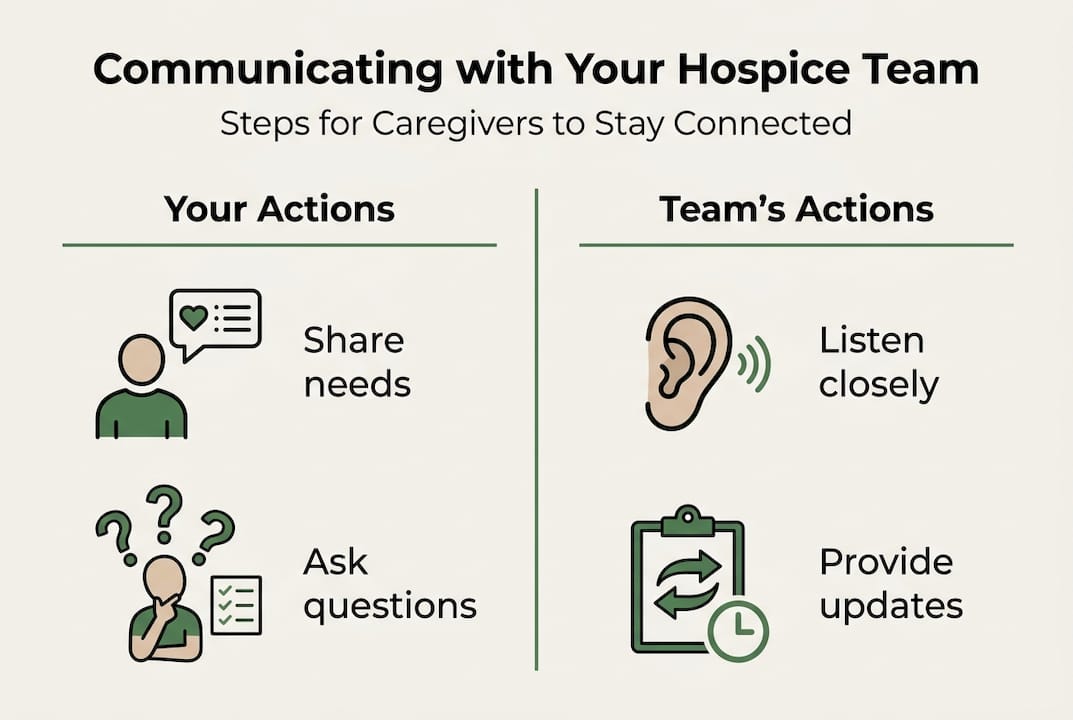
| Communication phase | Your role | Team’s role |
|---|---|---|
| Initial contact | Share family needs and values | Listen, document, adapt |
| Mid-care coordination | Ask specific questions | Provide clear, honest updates |
| Family meetings | Align on decisions | Facilitate and guide |
| End-of-life transitions | Express wishes clearly | Confirm and honor those wishes |
Reviewing a home hospice workflow guide can help you understand what happens between visits so you know when to reach out. You can also explore steps for hospice success to see the bigger picture of how care unfolds.
Proper process helps, but knowing what questions to ask brings real clarity and advocacy power.
Key questions to ask your hospice team
Having a ready list of questions removes the pressure of thinking on your feet during emotional moments. These questions are grounded in what families most commonly need to know.
Asking direct, specific questions about care involvement, cultural respect, response times, Medicare coverage, and home care availability gives you the information you need to advocate effectively.
Here are essential questions to keep on hand:
- How will I be involved in care decisions, and how much input do I have?
- What is the best way to reach someone on the team after hours or in an emergency?
- How are medications managed, and what should I watch for at home?
- What does Medicare or our insurance cover, and are there any out-of-pocket costs?
- How will the team respect our cultural or religious practices?
- What signs should prompt me to call the team right away?
- How often will the care plan be reviewed and updated?
“The questions you ask today shape the care your loved one receives tomorrow. No question is too small or too personal.”
Families who understand standards for home hospice are better prepared to evaluate whether their loved one is receiving appropriate care. If symptoms become a concern, knowing about managing hospice symptoms helps you ask more targeted questions.
While questions help guide care, families may encounter challenges. Here is how to navigate them.
Troubleshooting and navigating communication challenges
Even with the best intentions, communication can break down. Language barriers, family disagreements, and emotional overwhelm are all common. Knowing how to handle them in advance makes a real difference.
Language and cultural barriers require interpreter services, and you have the right to request one. Younger caregivers may prefer text-based updates, while older family members might want phone calls. Distance caregivers can stay connected through video calls and shared apps.
Here are practical solutions for common challenges:
- Language barriers: Request a professional interpreter, not just a bilingual family member, to ensure accuracy in medical conversations
- Technology gaps: Ask for printed summaries if video calls or portals are not accessible
- Geographic distance: Set up a group messaging thread or shared document so all family members receive the same updates
- Family disagreements: Bring in a hospice social worker to help mediate and refocus the conversation on the patient’s wishes
- Emotional overwhelm: Let the team know when you need a pause. Good hospice staff will follow your lead
Pro Tip: If family members are processing grief at different speeds, ask the hospice social worker to hold separate conversations with each person. This respects individual coping styles without creating conflict.
Expert research on palliative communication shows that open information sharing can sometimes increase anxiety if it is not paced to match a family’s emotional readiness. Skilled hospice teams use empathy and intentional pauses to make difficult conversations feel safer.
“It is not just about what is said, but when and how it is said. Timing and tone matter as much as the words themselves.”
If you are still exploring what type of care is right for your loved one, understanding the differences between hospice and palliative care can help clarify your options.
Mastering these skills prepares you for meaningful, productive collaboration with your hospice team.
Find support and trusted guidance for every step
At Graceland Hospice Care, we believe that every family deserves a care team that listens as carefully as it acts. The strategies in this guide are most powerful when paired with a hospice provider who genuinely prioritizes your voice. Our team is trained to meet families where they are, whether that means adjusting communication styles, facilitating family meetings, or simply being present during the hardest moments. Explore our hospice services to learn how we support both the medical and emotional needs of caregivers and patients. Contact us today for a free consultation and let us help you build a communication plan that works for your family.
Frequently asked questions
What if I’m not comfortable asking questions during hospice meetings?
Designate a trusted family member or close friend to speak on your behalf, or ask the hospice team to provide written updates after each meeting so you can review information at your own pace.
How often should I expect updates from the hospice team?
You can set your preferred update frequency, whether daily, weekly, or as needed, by discussing this upfront with the team before care begins.
What should I do if there is a language barrier?
Request professional interpreter services or ask for written materials in your preferred language to ensure nothing important is lost in translation.
Are there structured ways to make sure my concerns are heard?
Yes. Use the teach-back method after conversations to confirm understanding, or request a formal family meeting where all concerns can be addressed together.
What if my family disagrees with each other or the hospice staff?
Ask a neutral hospice social worker to facilitate the conversation, keeping the focus on the patient’s documented wishes and comfort rather than individual preferences.
Recommended
- Hospice Visit Workflow for Comfort Care at Home | Graceland Hospice Care Blog
- Understanding Hospice Care: A Guide for Families | Graceland Hospice Care Blog
- Home Hospice Care Workflow: A Step-by-Step Guide for Families | Graceland Hospice Care Blog
- End of Life Care Guide for Compassionate At-Home Support | Graceland Hospice Care Blog