Hospice vs Home Health – Choosing Compassionate Care

Hospice vs Home Health – Choosing Compassionate Care
Choosing how to support a dying parent at home can feel incredibly stressful, especially for caregivers in Orange County facing unfamiliar decisions about hospice and home health care. The terms may sound alike, but hospice and home health care provide truly different kinds of support that impact daily life, medical routines, and your parent’s comfort during their final months. Understanding the real differences empowers you to make thoughtful choices that respect your parent’s wishes while ensuring the best possible care at home.
Table of Contents
- Hospice And Home Health Defined Clearly
- Key Differences: Goals And Services Compared
- Who Qualifies For Each Type Of Care?
- Costs, Insurance, And Financial Factors
- Transitioning From Home Health To Hospice Care
- Making The Right Choice For Your Family
Key Takeaways
| Point | Details |
|---|---|
| Understanding Care Options | Hospice and home health care serve different purposes; home health focuses on recovery, while hospice emphasizes comfort and quality of life for those with terminal conditions. |
| Eligibility Requirements | Home health care is broadly accessible for ongoing medical needs, while hospice care requires a terminal diagnosis with a prognosis of six months or less. |
| Insurance Coverage | Medicare typically covers both home health and hospice services with minimal out-of-pocket costs, but exclusions exist, especially for custodial care. |
| Transitioning Between Services | It’s important to communicate with your parent’s doctor about when to transition from home health to hospice care based on the realistic prognosis and your parent’s needs. |
Hospice and Home Health Defined Clearly
When you’re standing at the crossroads of deciding what’s best for your parent’s final chapter, the terminology alone can feel overwhelming. Hospice and home health care sound similar, but they operate on fundamentally different principles. Understanding this distinction isn’t just academic—it directly impacts the kind of support your parent receives, where they spend their time, and how their final weeks or months unfold. Let’s break down what each one actually means so you can make informed decisions with confidence.
What Home Health Care Really Is
Home health care is medical and personal support designed to help people with acute or chronic illnesses recover, manage ongoing conditions, or improve their quality of life. Think of it as bringing skilled nursing, physical therapy, occupational therapy, and other medical services directly to your parent’s bedroom in Orange County. The primary goal is functional improvement or stabilization—getting your parent stronger, more independent, or better able to manage their condition.
Home health services typically include:
- Skilled nursing visits for wound care, medication management, or monitoring vital signs
- Physical and occupational therapy to rebuild strength or improve mobility
- Home health aide services for bathing, dressing, and personal care
- Speech therapy or other specialized treatments
- Ongoing assessment and management of existing health conditions
The care team visits on a schedule (perhaps twice weekly or more), performs specific interventions, and documents progress toward measurable goals. Your parent remains the active participant in their own recovery. Doctors still focus on curative or restorative treatment—whether that’s managing diabetes, recovering from surgery, or stabilizing heart disease.
Home health care works well when your parent has potential for improvement or when managing a chronic condition at home is safer and more comfortable than in a facility. Perhaps your mom is recovering from a fall, or your dad needs wound care after hospitalization. Home health bridges that gap between hospital discharge and returning to independent living.
What Hospice Care Actually Means
Hospice care represents a fundamental shift in medical philosophy. Rather than focusing on cure or recovery, hospice addresses comfort and quality of life for people in their final six months of life. It’s not about fighting the disease anymore—it’s about honoring the person while managing pain, nausea, anxiety, and other distressing symptoms.
When your parent enters hospice, the team includes:
- Physicians who specialize in comfort care
- Registered nurses trained in end-of-life symptom management
- Hospice aides for personal care and companionship
- Social workers and counselors supporting emotional and spiritual needs
- Chaplains or spiritual care advisors (regardless of faith background)
- Volunteers who provide practical help and presence
- Bereavement support for your family, often extending a year after your parent’s death
Hospice operates on a different timeline. Instead of scheduling specific appointments, hospice providers are available 24/7. Your parent’s nurse might visit multiple times weekly or stay longer during difficult periods. The focus shifts from “How do we extend life?” to “How do we honor this life as it naturally concludes?”
Hospice is about presence, not procedures. It’s ensuring your parent remains comfortable, connected to family, and treated with dignity during their final chapter.
The Practical Differences That Matter to You
These definitions matter less than how they actually function in your daily life. Here’s what changes:
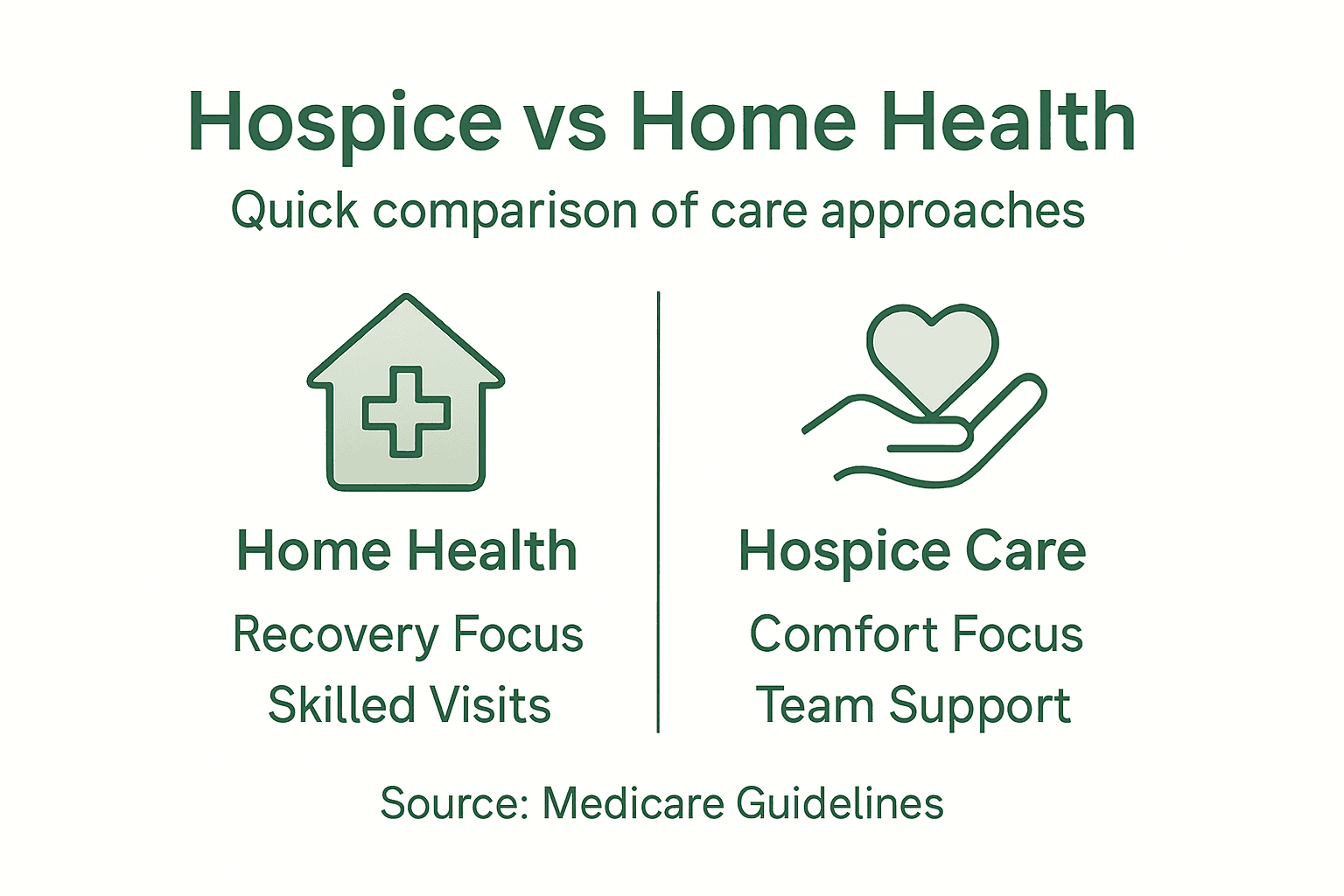
| Aspect | Home Health Care | Hospice Care |
|---|---|---|
| Primary Goal | Recovery or condition management | Comfort and quality of life |
| Timeline | Variable, often weeks to months | Typically final 6 months of life |
| Focus | Curative or restorative treatment | Symptom management and support |
| Availability | Scheduled visits | 24/7 on-call support |
| Location | Usually at home; may transition elsewhere | Primarily at home (or facility if preferred) |
| Medication Approach | Manages disease-specific medications | Focuses on comfort medications |
| When Appropriate | After hospitalization, managing chronic illness | When cure is no longer possible |
In Orange County, where many adult children are caring for aging parents at home, these distinctions shape everything from how often staff visit to which medications are prioritized. Your parent might start with home health after hospitalization, then transition to hospice when the medical reality becomes clear.
To help clarify which service best suits your parent’s situation, here are typical scenarios for choosing home health or hospice:
| Scenario | Home Health Care | Hospice Care |
|---|---|---|
| Post-surgery rehabilitation | Clearly indicated | Rarely appropriate |
| Advanced terminal illness | Rarely beneficial | Strongly recommended |
| Managing chronic conditions at home | Useful for improvement | Best when comfort is priority |
| Frequent hospitalizations, declining health | May help temporarily | Typically needed long-term |
| Family prefers active treatment | Supported | Not aligned with hospice focus |
| Patient requests minimal interventions | Some services available | Focused on comfort and dignity |
This helps you align care with your parent’s medical and personal needs.
One More Critical Distinction
Home health care assumes your parent will improve or stabilize. The care plan has specific endpoints—your parent will walk better, manage their insulin independently, or return to a baseline. Hospice assumes a different trajectory. The team acknowledges that your parent’s condition will gradually decline, and the goal becomes ensuring peace, dignity, and connection during that time.
Neither is better or worse. Each serves a specific purpose for people at different stages of life and illness. But choosing the wrong one means your parent receives care misaligned with their actual situation. A parent in decline might languish with home health providers still pushing for physical therapy progress. A parent with reversible illness might suffer unnecessarily in hospice without access to treatments that could genuinely help.
Pro tip: Ask your parent’s doctor directly: “Is my parent in a stage where recovery is realistic, or are we now focused on comfort?” This single question will clarify whether home health or hospice better serves your family’s needs right now.
Key Differences: Goals and Services Compared
Now that you understand the basic definitions, let’s dig deeper into what actually happens when hospice or home health walks through your parent’s door. The goals driving each service shape everything—from which medications the nurse brings to how the care team measures success. For caregivers in Orange County managing a parent’s final chapter, these differences determine whether your parent receives exactly what they need or something that misses the mark entirely.
Understanding the Core Goals
The fundamental difference comes down to this: home health care asks “How do we improve or maintain function?” while hospice asks “How do we ensure comfort and dignity as life naturally concludes?”
Home health care operates with improvement or stabilization as its north star. Your parent’s doctor develops a specific care plan with measurable goals. These might include increasing walking distance after a fall, managing blood sugar levels independently, or regaining strength after hospitalization. Every visit is designed to move toward those endpoints. The team tracks progress, adjusts treatments based on results, and celebrates milestones. Your parent might graduate from home health when they’ve recovered enough to manage on their own or with minimal support.
Hospice care embraces a different reality entirely. Rather than working toward recovery, hospice balances comfort with quality of life when a parent has six months or less to live. The focus shifts from “Will this help my parent get better?” to “Will this reduce suffering and preserve what matters most?” That might mean choosing pain relief over alertness, or prioritizing time with family over medical interventions. Goals become deeply personal—maybe your parent wants to attend their grandchild’s graduation, or simply to have pain-free days with loved ones nearby.
The measure of success in hospice isn’t recovery—it’s whether your parent experiences peace, maintains dignity, and feels their life and relationships honored.
Services: What Actually Shows Up at Your Door
These different goals translate into completely different service packages.
Home Health Care Services:
- Skilled nursing for wound care, catheter management, medication administration, and health monitoring
- Physical therapy to rebuild strength, improve balance, and prevent falls
- Occupational therapy to help your parent relearn daily tasks like dressing, cooking, or managing finances
- Speech therapy for swallowing difficulties or communication challenges
- Medical equipment such as walkers, grab bars, or oxygen systems
- Home health aides for bathing, grooming, meal prep, and light housekeeping
- Disease-specific management focused on conditions like diabetes, heart disease, or respiratory issues
These visits happen on a schedule—perhaps twice weekly or more often depending on your parent’s needs. The nurse arrives, assesses progress toward specific goals, performs interventions, and documents everything. Your parent is expected to participate actively in their own recovery.
Hospice Care Services:
- Pain and symptom management addressing pain, nausea, shortness of breath, anxiety, and other distressing symptoms
- Nursing care available 24/7, with visits tailored to your parent’s needs rather than a fixed schedule
- Hospice aides for personal care and comfort, often providing presence as much as assistance
- Social work and counseling helping your family navigate this transition and process emotions
- Spiritual care through chaplains or advisors supporting your parent’s faith or values, regardless of religious background
- Medication management focused on comfort rather than disease management
- Volunteer services providing companionship, running errands, or simply sitting with your parent
- Bereavement support for your family extending months or even a year after your parent’s death
- Family conferences where the team helps your family understand what to expect and make decisions aligned with your parent’s wishes
How the Teams Work Differently
Even when both services visit your Orange County home, they operate with different rhythms and priorities.
Home health nurses focus on specific clinical tasks. They might spend 45 minutes teaching your parent to use an inhaler correctly, adjusting insulin dosages, or changing wound dressings. Progress gets measured—fewer falls, better blood sugar control, improved mobility. Your parent’s recovery timeline shapes everything. If progress stalls, the doctor might intensify interventions or refer to additional specialists.
Hospice nurses work from a different playbook. They might spend an hour simply ensuring your parent is comfortable, listening to concerns, and supporting your family emotionally. Rather than problem-solving toward recovery, they’re managing what’s happening naturally. If pain emerges, they adjust comfort medications. If your parent becomes restless, they explore whether anxiety, spiritual concerns, or physical discomfort is driving it. The team prioritizes what matters most to your parent right now—not what medical protocols typically dictate.

Hospice care provides comprehensive support that extends beyond medical needs. Your parent’s social worker might help your family have difficult conversations. A volunteer might sit with your dad so you can shower. A chaplain might explore your mom’s spiritual concerns about dying. This isn’t ancillary to hospice—it’s central to the mission.
Medication Philosophies: A Telling Difference
Notice how each service approaches medications:
-
Home health prioritizes disease management. Your parent takes blood pressure medication, cholesterol drugs, diabetes medications, and other treatments aimed at controlling or slowing conditions.
-
Hospice prioritizes comfort. While your parent might continue some medications for symptom relief, aggressive disease management typically stops. Your parent won’t start new blood pressure medications or continue insulin if it requires painful finger sticks and doesn’t serve comfort.
This shift can feel jarring. Your parent might need to discontinue medications they’ve taken for years. But this reflects the honest reality: when someone is dying, managing blood pressure with medications becomes less meaningful than ensuring they’re comfortable and pain-free.
The Practical Timeline Implication
Home health is temporary. You’ll see the same nurse 2-3 times weekly for a defined period—perhaps 6-8 weeks after hospitalization, or longer if managing a chronic condition. The goal is discharge back to independent or minimal-support living.
Hospice might last weeks or months, depending on your parent’s trajectory. But it’s indefinite by nature. The team stays involved until your parent passes away, then continues supporting your family through grief.
Pro tip: Before committing to either service, ask your parent’s doctor specifically: “Based on my parent’s current condition and prognosis, which service aligns better with what we’re realistically trying to achieve?” Your doctor’s answer—recovery/improvement versus comfort/quality of life—clarifies which service is truly appropriate right now.
Who Qualifies for Each Type of Care?
Understanding eligibility isn’t just bureaucratic—it’s the gateway to accessing the right support at the right time. Your parent might desperately need hospice care, but if nobody explains the qualification criteria, your family could miss the window to access it. Conversely, pushing your parent into hospice before they’re ready denies them services that could genuinely help them recover or maintain independence. Let’s clarify exactly who qualifies for each.
Home Health Care Eligibility: Broader Than You Might Think
Home health care has remarkably broad eligibility criteria. If your parent has a medical need that can be safely managed at home, they likely qualify. This includes:
- Recent hospitalization or surgery requiring wound care, physical therapy, or nursing follow-up
- Chronic conditions like diabetes, heart disease, COPD, or arthritis needing ongoing management
- Post-stroke or post-accident rehabilitation
- Medication management and monitoring for multiple conditions
- Mobility limitations or fall risk requiring physical or occupational therapy
- Infusion therapy, catheter care, or other skilled nursing interventions
- Recovery from acute illness like pneumonia or urinary tract infections
- Functional decline in activities of daily living—bathing, dressing, meal preparation
Essentially, if your parent has a doctor’s order for home health services and has skilled nursing or therapy needs, they likely qualify. Insurance typically covers home health when it’s medically necessary and ordered by a physician.
Your parent’s condition and prognosis don’t eliminate eligibility for home health. Someone with terminal cancer who still has potential for improved mobility or pain control through physical therapy qualifies. Someone with advanced dementia who needs wound care or medication management qualifies. The service exists to help people at nearly any stage—it’s the presence of a skilled medical need that matters, not the underlying diagnosis.
Hospice Care Eligibility: More Specific, But Still Accessible
Hospice eligibility is more narrowly defined, but not as restrictive as many families believe. Hospice care is available for seriously ill patients when a cure is no longer possible, with a prognosis of six months or less and a focus on comfort rather than curative treatment.
To qualify for hospice, your parent typically needs:
- A terminal diagnosis with a realistic prognosis of six months or less if the disease follows its natural course
- Physician certification that curative treatment is no longer appropriate or desired
- Agreement from your parent (or healthcare proxy) that comfort care aligns with their goals
- Eligibility through insurance—Medicare, Medicaid, or private insurance must cover hospice services
Common diagnoses leading to hospice include advanced cancer, heart disease with significant decline, advanced dementia, COPD, liver disease, kidney failure, and neurological conditions like ALS. But eligibility isn’t limited to these. Any terminal condition with a realistic six-month prognosis qualifies.
The six-month prognosis isn’t a guarantee—some patients live longer, others shorter. It’s an honest medical estimate of trajectory.
The Crucial Gray Zone: When Your Parent Needs Both Services
Here’s where eligibility gets complicated in real life. Your parent might benefit from home health’s physical therapy while simultaneously needing hospice’s 24/7 support and bereavement services. Some Orange County patients transition from home health to hospice. Others receive concurrent services briefly while determining the best path forward.
Many patients receive home health and palliative care simultaneously. Palliative care (different from hospice) can coexist with curative or restorative treatment, managing symptoms while your parent pursues home health rehabilitation. This might happen during recovery from surgery when your parent is also dealing with cancer pain, or when managing multiple serious conditions.
The transition from home health to hospice typically happens when:
- Your parent’s condition declines despite home health interventions
- Recovery goals become unrealistic
- Your parent or doctor decides comfort care matters more than continued therapy
- Your parent’s condition qualifies medically—a six-month-or-less prognosis becomes clear
- Your parent expresses that they no longer want aggressive treatment
Specific Orange County Eligibility Considerations
In Orange County, most major insurers cover both home health and hospice. Medicare beneficiaries typically have strong coverage for both services. Medicaid coverage varies by your parent’s specific plan. Private insurance often covers hospice but may have restrictions on home health duration or types of therapy covered.
Your parent’s living situation also matters. Home health works anywhere—your parent’s home, an apartment, an assisted living facility, or a family member’s house. Hospice can be provided at home, in a nursing facility, in a hospital, or in a specialized hospice center, though most Orange County families choose home-based hospice for comfort and privacy.
The Practical Reality of Qualification
Don’t assume your parent doesn’t qualify. Many families wait too long to explore hospice because they underestimate eligibility. If your parent has a serious illness and their condition is worsening, ask your doctor directly: “Based on my parent’s current trajectory, would they qualify for hospice services?” Your doctor can assess whether the six-month prognosis applies.
Similarly, don’t assume your parent automatically needs hospice just because they have a serious diagnosis. Home health might be exactly right if functional improvement is realistic or if managing an ongoing condition at home prevents institutional care.
The best approach: have your parent’s doctor assess eligibility for both services. Understanding your options doesn’t commit you to anything—it simply ensures you know what’s available when you need it.
Pro tip: Request a consult call with both a home health agency and a hospice provider before your parent’s crisis point arrives; they’ll answer eligibility questions and clarify what each service actually provides in your specific situation, eliminating guesswork when time matters.
Costs, Insurance, and Financial Factors
Money matters. Let’s be direct about it. When you’re deciding between hospice and home health for your parent in Orange County, cost and insurance coverage shouldn’t be obstacles to choosing the right care. Yet for many families, financial uncertainty clouds decision-making exactly when clarity matters most. Understanding what insurance actually covers—and what it doesn’t—removes one major source of stress.
Home Health Care Costs and Coverage
Medicare coverage for home health is remarkably comprehensive if your parent qualifies. Medicare covers certain home health services when your parent is under a doctor’s care, homebound, and needs intermittent skilled nursing or therapy. Here’s what Medicare pays for:
- Skilled nursing visits for wound care, catheter management, or health monitoring
- Physical therapy, occupational therapy, and speech therapy
- Home health aide services for personal care
- Medical social services and counseling
- Medical equipment like hospital beds, walkers, or oxygen systems
- Medications and supplies used during skilled nursing visits
If your parent qualifies, you typically pay nothing out of pocket for covered services. No copayments, no deductibles, no surprise bills. Medicare simply covers it. That’s the good news.
The catch? Medicare doesn’t cover everything. Services explicitly excluded include 24-hour care, meal delivery, custodial care (help with bathing or dressing when skilled nursing isn’t needed), and homemaking services. Also, eligibility gets reassessed regularly—if your parent’s condition stabilizes or improves, Medicare might determine home health is no longer medically necessary and stop coverage.
For those with private insurance, coverage varies significantly by plan. Some plans cover home health generously; others impose visit limits or require high copayments. Medicaid coverage depends on your parent’s specific state plan. If your parent isn’t Medicare-eligible, call their insurance carrier directly and ask: “What home health services does this plan cover, and what are the patient’s costs?”
Hospice Care Costs and Coverage
Here’s where hospice offers genuine financial relief for many families. Medicare and most insurance plans cover hospice care costs if your parent meets eligibility criteria. Medicare-covered hospice services include:
- Physician services and nursing care
- Medications related to the terminal condition
- Medical equipment and supplies
- Counseling and social work services
- Spiritual care and chaplain services
- Volunteer services
- Bereavement support for your family
- Respite care (short-term facility care to give family caregivers a break)
Like home health, eligible Medicare patients typically pay nothing for covered hospice services. Your parent might have a small copayment for medications (usually $5 per prescription), but that’s often it. No bills for nursing visits, no charges for bereavement counseling, no fees for chaplain services. Hospice organizations absorb these costs when Medicare covers eligibility.
What hospice doesn’t cover varies by situation. Room and board fees in facilities are typically not included if your parent is in a nursing home or assisted living facility. Extended stays requiring 24/7 nursing care in a facility may involve additional costs. Some specialized services might not be covered. But for home-based hospice in Orange County, costs are generally minimal for Medicare beneficiaries.
Here’s a consolidated summary of insurance coverage factors for each type of care:
| Factor | Home Health Care | Hospice Care |
|---|---|---|
| Medicare coverage | Comprehensive, some limits | Broad, most services covered |
| Typical out-of-pocket cost | Usually $0 for eligible patients | Usually $0; small fees for meds |
| Private insurance | May limit visits or therapy | Often covers if prognosis fits |
| Common exclusions | Custodial care, meal prep | Room/board in facilities |
Understanding these can reduce financial stress when choosing care.
The Financial Reality of Uncovered Costs
Here’s what actually happens when insurance reaches its limits. Your parent receives home health for eight weeks post-hospitalization. Medicare coverage ends because they’ve stabilized. Your parent still needs assistance with bathing and medication management, but now that’s categorized as “custodial care”—insurance doesn’t cover it.
You have options:
- Pay privately for continued home health aide services (typically $25-$35 per hour in Orange County)
- Transition to hospice if your parent’s condition qualifies medically
- Arrange family care, where adult children or relatives provide assistance
- Explore Medicaid if your parent’s assets and income qualify (this requires discussion with a financial advisor or elder law attorney)
- Access community resources like senior centers offering meal programs or transportation
When insurance coverage ends, hospice becomes the most financially accessible option if your parent’s medical condition qualifies. It’s designed to provide comprehensive, affordable care when curative treatment is no longer the goal.
Private Pay and Out-of-Pocket Scenarios
Not every Orange County family has Medicare. Some parents have limited insurance or none at all. In these situations:
Home health costs typically range from $50-$150+ per visit, depending on the service and agency. A twice-weekly nursing visit regimen could cost $400-$600 monthly out of pocket. Physical therapy visits might run $75-$150 each. These expenses add up quickly, especially for long-term chronic condition management.
Hospice costs for uninsured or underinsured patients vary. Some hospice organizations are non-profit and provide services regardless of ability to pay. Others accept private payment but might offer sliding scale fees. Many have financial assistance programs or community grants supporting care for those without insurance.
If your parent lacks coverage, ask hospice providers directly about financial assistance. Many Orange County hospice organizations (including Graceland Hospice) offer free consultations where they’ll discuss options and help navigate costs transparently.
Insurance Changes and Transitions
One practical reality: insurance coverage can shift during transitions. Your parent might have home health covered through Medicare, then transition to hospice when appropriate. Both services understand insurance complexity. Good providers will explain coverage changes and help you understand what shifts financially as your parent’s care evolves.
Don’t let uncertainty paralyze decision-making. If home health seems right but you’re unsure about costs, call the agency and ask. If hospice might be appropriate, contact a provider for a free consultation. Most will clarify coverage without any commitment required.
Pro tip: Before your parent’s medical situation becomes urgent, request benefit statements from their insurance showing what home health and hospice services are covered; having this information documented prevents surprises and clarifies your financial options when time-sensitive decisions are needed.
Transitioning From Home Health to Hospice Care
The transition from home health to hospice rarely happens in a single moment. More often, it unfolds gradually as your parent’s condition changes, medical realities become clearer, and conversations shift from recovery to comfort. For Orange County caregivers, this transition can feel emotionally overwhelming—like you’re giving up hope. You’re not. You’re pivoting toward what your parent actually needs right now. Understanding how this transition works removes fear from the process and helps your family move forward with clarity.
Recognizing When the Transition Makes Sense
Home health works beautifully when recovery or functional improvement is realistic. But at some point, that trajectory changes. Your parent’s condition declines despite interventions. Physical therapy stops producing gains. Your parent expresses fatigue with aggressive treatment. Your doctor mentions prognosis or discusses what to expect as the condition progresses.
These are signs the transition might be approaching:
- Your parent’s condition worsens despite home health interventions
- Recovery goals become unrealistic or your parent no longer wants them
- Your parent expresses more interest in comfort than in continuing therapy
- Hospitalizations become more frequent or recovery takes longer
- Your parent mentions fear, pain, or concerns about dying
- Your doctor uses language like “we should discuss comfort care” or “talk about what matters most”
- Your parent stops participating in therapy or resists interventions
- Appetite declines, energy fades, or functional abilities shrink noticeably
Notice these aren’t dramatic medical crises. They’re subtle shifts in trajectory and priorities. This is precisely when the conversation about hospice becomes relevant.
The transition isn’t failure—it’s honoring your parent’s changing reality and ensuring care aligns with what’s actually achievable and what your parent truly values.
How the Transition Conversation Typically Starts
Often, the transition conversation begins with your parent’s physician. They’ve watched the home health progress notes, reviewed test results, and seen the pattern. A good doctor says something like: “Your mother’s heart function has declined significantly. I don’t think we’re going to see the improvement we hoped for. Let’s talk about shifting our focus to comfort and quality of life.”
That conversation can feel jarring. But it’s actually a gift—your doctor is being honest about what’s realistic and offering a path forward aligned with your parent’s actual situation.
If your doctor doesn’t initiate this conversation but you sense your parent is declining, ask directly. Say: “Based on my parent’s current trajectory, would hospice be appropriate to discuss?” Your doctor might say yes, or might say your parent still has recovery potential. Either way, you’ll have clarity.
Transitioning to hospice typically occurs when a patient has a life-limiting illness with a prognosis of six months or less, and the focus shifts from curative treatment to comfort care. This medical transition reflects your parent’s actual situation, not a loss of hope.
The Practical Steps of Transition
Once you and your parent’s doctor agree hospice is appropriate, the process moves fairly quickly. Here’s what typically happens:
1. Physician referral and certification Your doctor completes hospice certification paperwork indicating your parent’s terminal diagnosis and prognosis. This is straightforward—it’s simply documenting what the doctor already believes about your parent’s condition.
2. Hospice intake and assessment A hospice nurse contacts your family and schedules an initial visit. They’ll assess your parent’s condition, symptoms, medications, and goals. They’ll explain services and answer questions. This is your chance to discuss what matters most to your parent.
3. Discontinuing curative treatments Here’s where the shift becomes tangible. Your parent stops chemotherapy, stops aggressive physical therapy, stops medications aimed at disease management. This doesn’t mean stopping all medications—comfort medications continue. It means stopping treatments aimed at fighting the illness when comfort is now the priority.
4. Transitioning from home health to hospice Home health services typically end when hospice begins. Your parent’s home health nurse makes a final visit. Hospice services start. The rhythm changes—instead of scheduled twice-weekly visits, hospice is on-call 24/7 based on your parent’s needs.
5. Introducing the hospice team Your parent meets the hospice nurse, aide, social worker, and chaplain. These become the consistent faces supporting your family. They’ll develop a care plan addressing your parent’s specific symptoms, concerns, and goals.
Addressing Emotional Resistance
Your parent might resist the transition. They might feel like hospice means “giving up.” They might fear abandonment or worry about pain. These feelings are valid and common. Here’s what helps:
- Reframe the conversation. “Hospice isn’t about giving up—it’s about focusing on what matters most to you right now.”
- Emphasize continued care. “You’ll still have a nurse, still have support. We’re just changing the focus.”
- Address fears directly. “If you’re worried about pain, hospice specializes in keeping you comfortable. That’s their whole focus.”
- Involve your parent in decision-making. Let them choose when the transition happens (if medically appropriate). Autonomy reduces resistance.
- Give time for questions. Hospice providers are skilled at addressing fears and explaining how comfort care actually works.
Some parents move to hospice willingly, even with relief. Others need time and reassurance. Both responses are normal.
Managing Family Emotions During Transition
You might struggle with the transition too. You might feel like you’re abandoning recovery efforts, or that you should push for “one more treatment.” You might grieve the loss of your parent getting better. These feelings are profound and legitimate.
Remember: transitioning to hospice doesn’t mean your parent dies tomorrow. Some hospice patients live weeks, others live months. It means you stop treating the disease and start focusing on your parent’s comfort, dignity, and the time you have together. For many families, this shift reduces suffering significantly and allows meaningful time together.
Overlapping Services During Transition
Sometimes your parent might briefly receive both home health and palliative care, or home health might extend slightly while hospice discussions happen. This overlap is fine—it allows your parent and family time to adjust while ensuring continuous care. Don’t worry about awkward transitions. Providers coordinate seamlessly.
This transition is one of the most significant decisions you’ll make for your parent. Trust that you’re moving toward what actually serves your parent now—not away from hope, but toward honest, compassionate care aligned with reality.
Pro tip: When your doctor first suggests hospice, don’t decide immediately; instead, ask for a meeting with the hospice team to discuss your parent’s specific situation, goals, and concerns before committing, which removes uncertainty and often clarifies that this is exactly the right choice.
Making the Right Choice for Your Family
You’re not just choosing between two types of care. You’re making a decision about how your parent spends their final weeks or months, what kind of support your family receives, and what values guide this deeply personal time. That weight sits heavy. But here’s what matters: there’s no universally “right” choice. There’s only the right choice for your parent’s actual situation, your family’s capacity, and what your parent genuinely wants. This section helps you think through that decision clearly.
Start With Your Parent’s Goals and Wishes
Everything starts here. Not with medical recommendations, not with what seems practical, not with what other families chose. What does your parent actually want?
Have this conversation while your parent can still communicate clearly. Ask directly:
- “What matters most to you right now?”
- “If you couldn’t get better, what would be important?”
- “Are you more focused on extending life, or on being comfortable?”
- “What would quality of life mean to you?”
- “Are there specific things you want to do or accomplish?”
- “What scares you most about what comes next?”
These conversations feel uncomfortable. They’re also invaluable. Your parent’s answers should drive the decision. If your parent wants to pursue recovery aggressively, home health makes sense. If your parent expresses fear about pain, or wants time with family without medical interventions, hospice might align better.
Some parents can’t or won’t have these conversations. That’s real life. In that case, make decisions based on what you know about your parent’s values. What would they choose if they could?
Making the right choice involves understanding patient wishes and goals at the end of life. Your parent’s voice should be the loudest in this decision.
Assess Your Parent’s Actual Medical Trajectory
Next, get clarity on what’s medically realistic. Ask your parent’s doctor these specific questions:
- “Based on my parent’s current condition, what is the realistic prognosis?”
- “Is recovery or significant functional improvement likely?”
- “How would you estimate my parent’s remaining life expectancy?”
- “What does continued aggressive treatment actually offer at this point?”
- “What would comfort-focused care look like for my parent?”
- “When would you recommend we consider hospice?”
Your doctor’s honest assessment matters enormously. If your parent has early-stage disease with recovery potential, home health serves them well. If your parent has advanced disease with a realistic six-month-or-less prognosis, hospice honesty aligns with medical reality.
Don’t ask your doctor to predict exactly when your parent will die—nobody knows. But ask for direction on trajectory. Is this a recovery situation or a comfort situation? That clarity reshapes everything.
Consider Your Family’s Capacity
Home health requires your family to coordinate care, ensure your parent participates in therapy, manage medications, and arrange transportation to appointments. This works beautifully if you have bandwidth and support.
Hospice requires emotional presence—being with your parent as they decline, navigating conversations about death, supporting your parent’s spiritual or emotional needs. It’s less logistically demanding but emotionally intense.
Be honest about your family’s capacity:
- How much time can you realistically dedicate to caregiving?
- Do you have other family members to share responsibilities?
- What’s your family’s emotional resilience around end-of-life care?
- Are you struggling financially, and would lower-cost care help?
- Does your parent need complex medical management, or are they relatively stable?
Choosing the wrong service for your family’s capacity creates unnecessary suffering. If you’re already stretched thin, pushing toward intensive home health might break you. If your parent needs active rehabilitation and your family has capacity to support it, home health offers meaningful progress.
Evaluate the Practical Setting
Where is your parent living? That matters.
Your parent in their own home has flexibility with either service. Home health therapists visit; hospice is on-call. Both work.
Your parent in assisted living or a nursing facility has different considerations. Some facilities have relationships with specific home health agencies or hospice providers. Some manage coordination seamlessly; others create friction. Ask the facility what their experience is with each service.
Your parent hospitalized currently? Hospitals often have recommendations. Ask what transitions smoothly from their setting.
Listen to Your Intuition About Readiness
After gathering information, pause. Sit with the decision. Does one option feel right? Does the other feel like resistance or fighting reality?
Often, families know the answer before they consciously admit it. Your parent is declining despite interventions—you feel it. Your parent mentions being tired of treatment—you hear it. Your gut says “comfort care is what matters now”—trust that.
Similarly, if your gut says “my parent still has recovery potential,” that’s valid information. Maybe the medical trajectory isn’t as dire as it feels. Maybe one more round of physical therapy creates meaningful improvement. Trust that too.
Your intuition, combined with medical clarity and your parent’s wishes, points toward the right choice.
The Permission You Need
Here’s what families often need to hear: choosing hospice is not giving up. It’s giving your parent what they actually need. If comfort care is what’s realistic and what your parent wants, hospice honors that. If recovery is still possible and your parent wants to pursue it, home health honors that.
You don’t need permission from anyone to make the choice that serves your parent. But if you need it anyway: you have it. Choose what’s honest, what your parent wants, and what your family can actually sustain.
Moving Forward After the Decision
Once you decide, commit fully. Don’t second-guess constantly. If you chose home health, support the recovery process without dwelling on “what if hospice was better.” If you chose hospice, don’t torture yourself with “should we have tried more treatment.”
If circumstances change—your parent’s condition shifts, your assessment becomes outdated—reassess. You can transition between services. Decisions aren’t permanent. But while you’re in one path, walk it fully.
Pro tip: Schedule a family meeting with your parent (if able), key caregivers, and ideally your parent’s doctor to discuss this decision together; hearing everyone’s perspective and concerns surfaces hidden worries and often reveals clarity that individual conversations miss.
Finding the Right Care for Your Loved One in Their Final Chapter
Deciding between hospice and home health care can feel overwhelming when you want the very best for your parent during a deeply personal and challenging time. The key challenge is understanding whether comfort-focused hospice care or recovery-oriented home health care truly aligns with your parent’s current medical needs and wishes. You want to honor their dignity, provide compassionate support, and reduce suffering without uncertainty or delay.
At Graceland Hospice we recognize the emotional weight these decisions carry. Our team is dedicated to guiding families through this journey with clear explanations of hospice care and what it means to prioritize comfort and quality of life. If you are wondering when hospice might be appropriate or how to navigate the transition from home health to hospice look no further than our expert resources and compassionate staff. Explore our insights and learn how we bring compassion into every home by visiting Graceland Hospice Blog.
Don’t wait until a crisis arises to understand your options. Reach out for a free consultation today and let us support your family in making the most informed, heartfelt decision for your loved one. Connect now at Graceland Hospice and take the first step toward compassionate care that truly fits your family’s needs.
Frequently Asked Questions
What is the primary difference between hospice and home health care?
Hospice focuses on providing comfort and quality of life for individuals in their final six months, while home health care aims at recovery and condition management, offering medical support for acute or chronic illnesses.
When should my parent consider transitioning from home health care to hospice?
Transition to hospice should be considered when your parent’s condition significantly declines, recovery goals become unrealistic, or they express a desire for comfort-focused care instead of aggressive treatment.
What services are included in home health care?
Home health care services typically include skilled nursing visits, physical and occupational therapy, speech therapy, home health aide support, and ongoing assessment and management of health conditions.
How is eligibility determined for hospice care?
Eligibility for hospice care requires a terminal diagnosis with a prognosis of six months or less to live, a physician’s certification that curative treatment is no longer appropriate, and agreement from the patient or healthcare proxy that comfort care aligns with their goals.
Recommended
- Graceland Hospice Care | Compassionate End-of-Life Care
- Graceland Hospice Care | Compassionate End-of-Life Care
- Graceland Hospice Care | Compassionate End-of-Life Care
- Graceland Hospice Care | Compassionate End-of-Life Care
- CarehomesIT - Specialist IT Support for Care Homes
- Why Your Competitors Are Filling Beds Faster (And How to Catch Up) - Smart Admissions